'Human development, security in S Asia at risk due to corruption'
Staff Correspondent
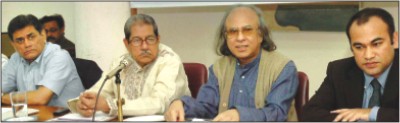
Human development and security in South Asia is facing serious risks due to corruption, non-transparency and lack of people's participation in governance, said the academics and development experts at a meeting yesterday.They said though economic growth in different counties of the region has taken a significant rise in recent years, one-third of its population around 50 crore are yet to be involved in economic, social and political process. The first meeting of the National Steering Committee (NSC) on 'Imaging A New South Asia (IANSA),' a regional civic campaign, was organised by Bangladesh Unnayan Parishad (BUP) and ActionAid Bangladesh (AAB) at the BUP auditorium in the city. The meeting was presided over by NSC Chair Prof Anisuzzaman. "We want to conduct policy research and campaign to create public opinions for making people-oriented policies and restructuring the institutions," said the NSC Co-chair Dr Qazi Kholiquzzaman Ahmed. He said each of the country individually and the South Asia as a whole need sustainable and equity-based development to overcome the existing scenario. There are huge prospects for regional and cooperative development in the region, but it has not been possible due to bureaucratic reasons, mistrust and lack of unity among people, said Dr Kholiquzzaman, also president of Bangladesh Economic Association (BEA). "We shall prioritise the opinions of those who remain excluded from the development process, and consider their aspirations to design our regional strategies against poverty and human insecurity," the economist said. ActionAid Bangladesh Country Director Shoaib Siddiqui said states are basically responsible for ensuring basic rights, but experience suggests that they always cannot play due role and are not accountable. "Peoples' participation therefore is very important," he said, adding that poverty in the region is somehow interconnected with each other, which is why poverty reduction is not possible if "we cannot strengthen the voice of the poor of this region." Though there is a regional state player, Saarc (South Asian Association for Regional Cooperation), but it cannot play its due role, which is why civil society groups of the region will work as pressure groups in this regard, he noted. Tawheed Reza Noor, IANSA Project Manager of ActionAid Asia, said though 60 years have passed after the colonial era of the sub-continent, the region still faces the risks of increasing inequality, social and political conflicts, increasing sense of fragmentation and mistrust. March towards establishing democracy in Nepal, claiming rights over natural resources like water of Narmada in India, and asserting share of farmers in public utilities like power at Kansat in Bangladesh are however some hopes for the deprived people, he said. Tawheed noted that IANSA, through campaigns, would prepare policy papers to handover to the Heads of the States of the region by August 15. The paper component for Bangladesh will be economic management, for India peace and justice, for Nepal human rights, democracy and governance and for Pakistan natural resources and sustainable environment. Former adviser to caretaker government CM Shafi Sami, Khushi Kabir of Nijera Kori, Editor of Sangbad Bazlur Rahman, Brig (Retd) Shahedul Anam of The Daily Star, novelist Selina Hossain, former chairman of Power Development Board Nuruddin M Kamal, Rokeya Kabir of Bangladesh Nari Progoti Sangha and Shirin Akhtar of Karmojibi Nari were present on the occasion.
|