Israel, US will shun Palestinian govt
Reuters, Ap, Jerusalem
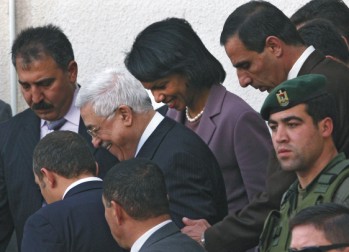
Israeli Prime Minister Ehud Olmert said yesterday he and President Bush agreed to shun a Palestinian unity government unless it accepted international demands on policy toward Israel. "A Palestinian government that does not accept the Quartet's conditions, cannot receive recognition and there will not be cooperation with it," Olmert said, referring to calls by international mediators for a unity government to recognise Israel, renounce violence and abide by existing interim peace accords. "I spoke about this on Friday with the President of the United States, and I can tell you the Israeli and US positions are completely identical," Olmert said in broadcast remarks before talks later in the day with visiting US Secretary of State Condoleezza Rice. Olmert said at the start of the weekly Cabinet meeting that he and President Bush had spoken by phone on Friday about a Palestinian power-sharing accord whose platform falls short of meeting those demands, posed by the so-called Quartet of Mideast negotiators the US, European Union, UN and Russia. "A Palestinian government that won't accept the Quartet conditions won't receive recognition and cooperation," Olmert said. "The American and Israeli positions are totally identical on this issue." The comments come ahead of a three-way meeting with the Palestinians on Monday. In a further indication of tensions before the meeting, Secretary of State Condoleezza Rice and Palestinian President Mahmoud Abbas canceled a press conference that had been scheduled to follow their one-on-one talks Sunday afternoon, Abbas' office said. Rice is to meet with Olmert later Sunday after her talks with Abbas, a moderate who favors peacemaking. All three are to get together Monday in what initially was to have been a summit designed to try to revive long-stalled peace talks. However, the summit has been overshadowed by Abbas' attempts to finalize a power-sharing agreement with the Islamic militant Hamas whose platform does not meet the international community's demands that the Palestinian government disarm, recognise Israel and accept existing accords. Israel and the US agree that their governments will not work with the emerging Palestinian coalition if it does not moderate it policies toward Israel. But neither Washington nor Israel have said, however, that they would boycott Abbas, who, as head of the Palestine Liberation Organisation, would head any peace talks. Negotiations broke down more than six years ago in an explosion of violence between the two sides. After meeting in Jerusalem on Saturday, Rice and Israeli Foreign Minister Tzipi Livni reiterated their demands that any Palestinian government toe the international line. Livni said the power-sharing agreement Abbas and Hamas reached earlier in the month in Saudi Arabia does "not meet the requirements" of the international community. Rice said the United States would not judge the new Palestinian government until it has been established, but acknowledged the coalition talks were overshadowing Monday's summit. Abbas aides have said they were warned by US officials that Washington would boycott a government with the platform agreed to in Saudi Arabia.
|