Bring corrupt people in energy sector to book
Bapa seminar urges govt
Staff Correspondent
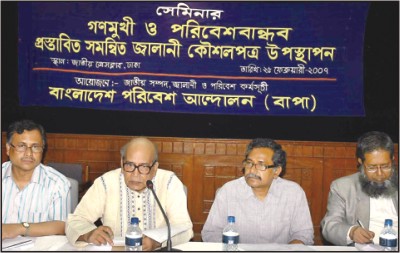
Economists and energy experts at a seminar yesterday called upon the government to establish people's ownership on the country's natural resources as these are facing aggression from foreign companies.They said the government should bring to book the politicians and bureaucrats who were involved in corruption in energy sector while signing Production Sharing Contracts (PSC) that went against national interest. The seminar on 'Energy strategy for Bangladesh: A brief survey with recommendation' was organised by Bangladesh Paribesh Andolon (Bapa) at the National Press Club in the city. The speakers recommended strengthening of national institutions with enough skilled manpower and formulation of an integrated national energy policy to ensure energy security and interest of the common people and environment instead of profits of foreign companies and their national collaborators. " Energy and water will be the centre of all future crises in the world and the developing countries with natural resources will be at great risk. Therefore, we must formulate an integrated energy policy considering the interest of the poor and environment," said Bapa President Prof Muzaffer Ahmad. It is high time for Bangladesh to seriously consider other options for energy, including hydro-electricity, biogas, wind-power, solar energy and even nuclear energy, he said, adding that the signing of energy-related contracts in the past were not transparent which was a hurdle for taking concrete decision in this respect. Bangladesh failed to develop expertise in energy sector, which is why it does not have strong negotiating capacity, said Prof Ahmad. "We should also consider the options for regional cooperation as well," he suggested. Prof Anu Muhammad of Jahangirnagar University said the foreign companies are increasingly taking the control of Bangladesh's natural resources due to successive government's apathy to develop efficiency in this sector. The governments did not formulate any policy at their own initiatives, rather they did it with the consultancies of financial organisations like World Bank and Asian Development Bank which are interested in the export of the resources, he noted. "As the resources are limited, we must plan for making its best use and establish 100 percent people's ownership on it," said Prof Anu Muhammad. "Bangladesh was supposed to have 70 percent of gas under the PSCs signed in the last two decades, but unfortunately the companies showed the production cost so high that its share was much less than that," he noted. The national institutions like Bapex (Bangladesh Petroleum Exploration and Production Company Ltd) and Petrobangla have also been made handicapped, while the foreign companies are taking away the national resources in the name of FDI (Foreign Direct Investment), he observed. White papers on all who were involved in corruptions in the energy sector should be published, the professor demanded. Petrobangla former chairman SKM Abdullah, who read out a paper prepared by Bangladesh Environmental Network (BEN), recommended establishing a national energy commission with technological experts, policy planners and decision makers to prepare a comprehensive energy strategy for the country. Prof Nurul Islam of Bangladesh University of Engineering and Technology said there are already two energy policies but none of them considered energy security. Dhaka University teachers Badrul Imam and Mohtasham, Bangladesh Water Partnership President Quamrul Islam Siddique and Saiful Haque of Workers' Party also spoke on this occasion.
|