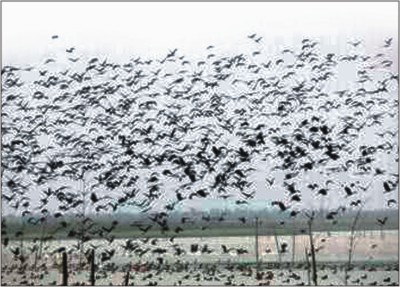
Noisy boats, poachers turn migratory birds away
Survey says 50pc birds did not visit Hakaluki Haor this year
Iqbal Siddiquee, Sylhet
The number of migratory birds in Hakaluki Haor fell by about 50 per cent this year compared to that of last year. However the total number of birds, mainly comprising local ones, went up. These were revealed in a survey organised by the Coastal and Wetland Bio-diversity Mana-gement Project (CWBMP) of the Department of Environment. Arrival of migratory birds decreased in last few years as many of their natural sanctuaries were disturbed due to 'noisy fishing' (by using mechanised boats) and hunting, the survey said. The survey was done by a team of wildlife experts including Dr. Inam Al Haque, Dr. SMA Rashid and Dr. MA Aziz. Some students from Jahangirnagar University, Chittagong University and Khulna University also took part in it. The survey was done on February 12 and 14. Last year's survey was also done during the same period. Zafar Siddique, Project Director of CWBMP, said a total of 51,521 birds of 42 species were sighted in the haor during this year's survey. The figure includes 18,555 migratory birds of 29 species and 32,966 of 13 local species. Four new species were found this year. These are Falcated Duck (locally called Fuluri Hansh), Gray Leg Goose (Metey Raj Hansh), Northern Lapwing (Utturey Titi) and Common Shell Duck (Pati Chokha-Chokhi). Around 37,520 migratory birds of 26 species and a total of 46,712 birds of 49 species were counted during last year's survey, he said. Three species - Spotbill Duck (Metey Hansh), Comb Duck (Nakta Hansh) and Grey Headed Lapwing (Metey Matha Titi)--found last year, were not sighted this year. Grey Headed Lapwing is a rare Siberian bird and the two others are local species. This year, the highest number of 30,262 birds of 10 species was spotted in Nagua-Loribai Beel where last year's figure was 27,486. Hakaluki Haor comprises over 18,000 hectares of water body spread over five upazilas in greater Sylhet. It was declared an Ecologically Critical Area (ECA) in 2000 to protect its bio-diversity.
|