Teaching fishermen to 'stitch in time' for better catches
Aminul Islam, Mymensingh
Indigenous fishes which were depleting fast are now increasing and fishermen around haors in greater Mymensingh are being benefited after introduction of Community Based Fisheries Management project. The project was launched by the Department of Fisheries (DoF) in September 2001. Over 400 fishermen families in Netrokona are involved in the project, which now ensures their livelihood along with maintaining the ecological balance. A team of newsmen visited water bodies under the project in Netrakona recently. Nine government water bodies have been included under the project. These are Boalia Doba and Kuma Beel, Rajdhala Beel, Pakla Beel, Atla Beel and Doba Beel in Purbadhala upazila;, Narsinghpur Nadi in Khaliajuri upazila, Ghoradubi Beel and Meda Beel in Kamlakanda upazila. The project also covers some water bodies in Mymensingh, Kishoreganj and Tangail districts. The project has created awareness among fishermen about preservation of different varieties of fishes and when to net what variety of fish, local fishermen and project officials said. To protect mother varieties of fishes in these water bodies and to increase production, 'fish sanctuaries' have been created at 'safe points' in the water bodies, where none is allowed to fish there, said Abul Hashem, Project Organizer in Purbadhala upazila in Netrokona. Earlier, mother fishes were rarely available in the water bodies. After implementation of the project, they are now take shelter in the 'safe points' when water recedes. With arrival of monsoon, the mother fishes spread out and release fries, said Nazmun Nahar Nur, Scientific Officer of the project. Indigenous varieties like Bhedari, Chital, Chapila, Khalisha, Taki, Ghora Macch, Baim, Ghania and Kali Boush are now found in these beels after creation of sanctuaries and awareness among fishermen, they said. All the water bodies taken under this project would be maintained by DoF till 2011 for improvement of life of people in haor areas, Mostafa Momin, another project official said. The Department for Interna-tional Development (DFID) is the donor agency for the project while World Fish Center, CARITAS, BRAC, FemCom Bangladesh, Bancha Shekha, Shishuk, Gharani, and Center for Natural Resources (CNRS) are partner NGOs working under it in low-lying areas of greater Mymensingh. For each water body, a committee named Beel Management Committee (BMC) has been formed with local fishermen. Abdur Sattar of Gujakhali Kanda village, who is president of Boalia Doba waterbody committee, told this correspondent that they became gainer financially from the project. "We learnt many things about condition of fish resources in the country", he said. Abdul Motaleb Titu and Akhtar Khatun, general secretary of the committee echoed in the same tone. The adding awareness programme has opened their eyes and they are now protecting fish resources for their benefit, he said. The project has also provided sanitation facilities for ultra-poor fishermen and established a community center at Gujakhali Kanda where villagers hold regular meetings. FemCom Bangladesh, a partner NGO, conducts awareness building activities among grassroots people. Puppet show and drama for school children and women, video shows, documentary films on fishery are part of awareness building activities, said Nargis Akhtar, Managing Director of FemCom Bangladesh. The awareness programmes have created a positive effect on the local people, she added. World Fish Center renders technical supports for the project. It includes research and monitoring of social and economic conditions of people in project areas, training, workshop, seminar, site visit and impact study, said Dr. Nurul Islam, Research Associate of World Fish Center.
|
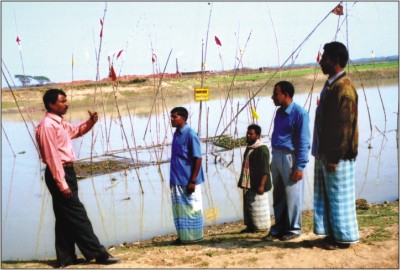
Project officials with local fishermen at a fish sanctuary at Boalia Beel in Netrakona. PHOTO: STAR |

