Books From The Ekushey Boi Mela
On Humayun Ahmed and Mohammed Zafar Iqbal
Azfar Aziz
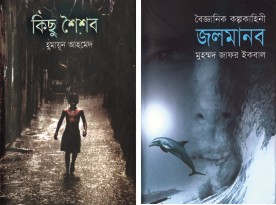
PrologueWhen my editor asked me to review two bestsellers, preferably novels, at this year's Ekushey Book Fair, I was at a loss, for I am by no means a devoted reader of contemporary Bangladeshi fiction. In fact, after Akhtaruzzaman Iliyas, I have read only a few novels of Bangladeshi writers published in the recent years and that, too, by chance or at some person's request. Anyway, a command is a command and I marched to the Boi Mela and asked around about the best-selling titles. The unanimous answer was that the books by Humayun Ahmed were at the very top, followed by those of his younger brother Mohammed Zafar Iqbal and next were those of Anisul Haque. So, I bought a copy of Humayun's Kichhu Shoishob and one of Zafar's, Jalmanob. Reading them was as entertaining as watching a well-made Hollywood film. Here, I also must add that while I found Humayun a fully commercial and professional producer of literary entertainment, Zafar appeared less so, as someone who strives to achieve some sort of aesthetic quality in his work. The rest of my impressions about the books are the following: I remember the time more than 30 years ago when after reading Humayun's Shangkhaneel Karagar and Nandito Narakey we thought they heralded a new genius in Bangla literature. But, over the years, that impression became more and more corroded by the acid of disillusionment and at one point we realised that the promising writer has turned into merely a technically accomplished and successful storyteller. At this year's book fair, he surfaced with 12 books, which is quite a feat for any novelist in the world. There is nothing wrong with writing a great many books only if the books are distinct in content and colour. I have sampled quite a few novels of Humayun, most of which seemed just variations of a single theme, not unlike a series of cartoon films or television sitcom where a fixed set of characters play out some new acts to make a new episode. It does not, of course, mean that he does not possess any skills or talents or merits. In fact, quite the opposite; otherwise he would not have become the most-read and one-of-a-kind of professional fiction writers of the country. His language is lucid and very readable. He never delves into any complex issue of any sort, which is ideal for the purpose of entertainment, although not for any involvement of the intellect. He is a grandmaster of the storytellers, who lets the tale run along the tracks for a while, and then makes a sudden twist in the narrative that thrills or charms or invokes some other emotion in the reader and thus retains his or her attention in the story. Humayun Ahmed never judges his characters but simply accepts everyone as he or she is -- another example of his excellent technique. For example, Kicchu Shoishob, in which he reminisces about his early childhood in Sylhet, can be compared with a photographic landscape, with some figures producing mirth, some sympathy, some nostalgia and so on, and that is all. It does not give rise to any question or goes deep into any event, psyche, trend, idea--nothing. Everything is superficial and there is nothing to bother or worry the reader about. It recounts events from a childhood, makes for pleasant reading, and after finishing it one can go to sleep with a satisfied yawn, like after having any other refreshing recreation. In a nutshell, this book, like most of his other works, provides excellent entertainment value for the average reader. And entertainment obviously is in great demand in our society, and also across the world, which is why Humayun Ahmed has been a best-selling writer for quite a long time now. He knows exactly what sort of stories the masses like to have served up to them. ******Jalmanob is a science fiction. There is no debate about the fact that Muhammed Zafar Iqbal is the author who contributed the most in carving out a prestigious niche for this genre of literature. With this one he has added yet another brick to the temple of Bangladeshi science fiction. Five books by Zafar have hit this year's February book fair. The number is less than half of what his brother has produced but Zafar's excellence lies not in quantity but the quality and the variety of his books, and in that his imagination and intellect are free of monotony and captivity of fixations, always treading on new ground in every new work. Jalmanob, or Water-Man, takes the reader to an imaginary future, where most of the land on Earth has become submerged in water as the sea level rose drastically due to severe greenhouse effects and other abuses of nature. The people who lived on higher grounds survived the calamity and the rest perished, with a few colonies managing to continue living on artificial islands or floats. The people living on land continue to progress in technology and have reached a stage where they no longer need to work; computers and robots do that for them. They need not think; a super computer does that for them. Their society in fact has come under the total control of that super computer. They do not know what to do with their time and so pass it in a trance produced by intoxicating substances, immersed in virtual reality, or hunting one or two water-men whom they have come to treat and hate as an alien species. And when they lose interest in everything, driven by black depression, they commit suicide, particularly the young people. The Jalmanobs, on the other hand, are technologically poorer but closer to nature, more alive. They have learned to communicate with dolphins, who have become their friends. The most important difference between the two branches of this post-deluge humanity is that the people living in water love one another and cherish all life forms while their counterparts on land are full of hatred, cynicism, lethargy, and lack of purpose. The book actually presents two hypothetical projected futures of humanity--one alienated from nature and dependent on machines and the other within the fold of nature and at peace with it. Of course, events happen in the book like in any other fiction, which ends in one of the policymakers on land realising their pitiful situation and trying to reverse the destructive trend; his daughter falls in love with a young water-man and finally deserts her people to go and live with her lover and his people, whom she has come to realise are far superior than her own ghostlike, perverted folks. Iqbal's language is smooth, free of cliché and jargon. The book is as much a science fiction as a depiction of what will happen if humanity continues to travel away from its earthly roots, becomes a slave of machines and systems of its own creation, and carries on the rat race for material gratification and seeking psychic high from drugs, delusions and fantasy. The catch line: Jalmanob is a science fiction and also a warning for those who will heed the message about the dangers inherent in destroying Nature. Azfar Aziz is a journalist/freelance contributor to The Daily Star literature page.
|
|

