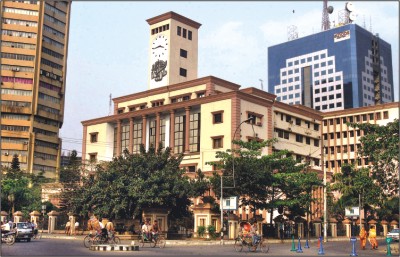
High time for Rajuk reform
Rajuk must change its role as a land developer and concentrate on proper planning of the city
Tawfique Ali
It is time the Rajdhani Unnayan Kartripakkha (Rajuk) ceased acting as a real estate developer and brought out all-out reforms to turn this organisation into a true autonomous regulatory body where participation of professionals and members of the civil society would be ensured, said urban experts.The reform at Rajuk is long overdue and the demand for change has gained momentum during the present interim government. According to urban experts, Rajuk should concentrate only on planning, monitoring and regulating housing, real estate and other development work in the capital. Rajuk may at best develop the basic infrastructure of the city, but it should be involved land development. Eminent environmentalist and trusty chairman of Transparency International Bangladesh (TIB) Prof Muzaffer Ahmad said Rajuk should to carry out only regulatory functions. Rajuk's predecessor, Dhaka Improvement Trust (DIT), used to be a regulatory body only and did very minimal development work. Prof Abdullah Abu Sayeed of Bishwa Sahitya Kendra, also vice-chairperson of Urban Development Committee, said Rajuk must dissociate itself from the role of a housing plot developer. "A trusty board with representation from the civil society should govern Rajuk's management," he advised. Rajuk must strictly play the role of a regulatory body now and not as a development agency at all, he said. If need be, the National Housing Authority could be turned into a corporation to take up comprehensive housing programmes to meeting the growing housing needs of the city inhabitants. Rajuk has to stop playing the role of a land developer simply because it has to effectively regulate developers to ensuring development of the city in a planned and fair manner, to protect the environment and interests of the city dwellers including the underprivileged, Prof Sayeed added. Prof Muzaffer Ahmad said at present, there is no participation of professionals in Rajuk's decision-making process. Pointing at corrupt practices at Rajuk, he further said any aspiring developer could get a construction plan approved by Rajuk through an underhand deal without taking beauty, safety of the neighbourhood and the environment into consideration. Private housing developers extract public money at their will and Rajuk must play a pro-people role to regulate and determine the prices of housing plots and apartments so that the general public is not exploited, Prof Muzaffer suggested. An ongoing TIB study on overall activities of Rajuk has been seriously hindered due to Rajuk's non-cooperation. Urban experts suggested that Rajuk charter has to have provisions for coordination with other utility service providing agencies. Planning section of Rajuk must be equipped with adequate number of competent planners. Management body has to be of representative nature. The Rajuk board has to be purged of its bureaucratic nature and must adopt a representative attitude. Rajuk chairman must be a secretary-level respected and competent senior person, who will enjoy full-scale autonomy. President of Institute of Architect Bangladesh (IAB) Mubasshar Hussain said Rajuk must immediately stop its real estate business for good. "The principal mandate of Rajuk is to control the city development, pass building designs and ensure proper implementation of the Dhaka Metropolitan Development Plan (DMDP) as per the Detailed Area Plan." Even though it is the custodian of DMDP, Rajuk is the agency that pioneered in destruction of wetlands and floodplains in and around the capital for developing housing plots, he said. During the process of reconstitution, all sorts of committees including building construction (BC) committee should be increased with an architect in each committee, Hussain said, Rajuk has to have adequate skilled professionals such as architects, planners and structural engineers. President of Real Estate and Housing Association of Bangladesh (Rehab) engineer M Abdul Awal said Rajuk must be a regulatory authority in the form of former DIT that will have public representation. Two of the crucial positions at Rajuk -- member planning and member development -- must be headed by a planner, an architect, or an engineer, he said. "Rajuk must cease to running plot business," said Awal, "In fact, there should be no land development business either in public or in private sector. There should be an end to land development business." Government should ensure adequate housing facilities together with private sector enterprises. Rajuk's capacity has to be increased in proportion with the increased population and expanded area of the capital city. On February 17, urban experts and environmentalists at a discussion on conservation of wetlands at the city's Brac Centre Inn demanded immediate reforms at Rajuk so it can stop illegal real estate companies from destroying the wetlands and floodplains that are clearly earmarked in the Dhaka Metropolitan Development Plan (DMDP). AMA Muhith, founding president of Bangladesh Poribesh Andolan (Bapa), said, "Now, we fervently appeal to the caretaker administration to separate Rajuk from its role as a real estate developer. Rajuk must play the role of a monitoring body, enforce the city planning and design policies." Filling up of wetlands and floodplains by real estate developers is not only ushering in an imminent environmental disaster, but also consistently choking the capital with perennial water logging and creating a mess in the sewer system, they said. Adviser to the housing and public works ministry barrister Mainul Hosein said on February 19 that the government has already discussed the issue of reforms at Rajuk. "We have thought of bringing a meaningful reform at the Rajuk's board level to make it participatory with people's representation in the form of the then Dhaka Improvement Trust (DIT)." "But I have not yet been able to raise it at the council of advisers because we are so preoccupied with other pressing demands," the adviser said. However, as part of a reform programme and to decentralise Rajuk activities, the government has divided it into four zones, he added.
|