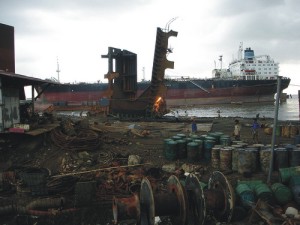
The tragedy of Chittagong port
Habibur Rahman
The recent attacks on the Nobel Laureate Dr. Muhammad Yunus on radio, television, and on other media for his suggestion to redevelop the Chittagong port has encouraged me to write about the port and its past and present economic as well as strategic values.If Egypt is the gift of the Nile, Chittagong in particular and Bangladesh in general, is the gift of the dancing Karnaphuli River, which itself originated from the Lusai hill. The port is just on the northwestern end of the Karnaphuli River joining the Bay of Bengal. Without going into a detailed history of the Chittagong port, it is sufficient to say that the British East India Company had first upgraded this historic port to serve their commercial interests following their occupation of Bengal. The spread of the Second World War in the Far East had enhanced the strategic and commercial importance of the port to British South East Asia and the Far Eastern war strategy. In 1943, the port became the vital link of communication with the Far East and a vital supply point for the British troops in the Burma front. The British left India in August 1947, without taking any parts of the port or its sovereignty, leaving behind a first class administration of the port under the Port Trust Authority of Chittagong. Ironically, less than sixty years following the departure of Imperial Britain from India, the then excellent Chittagong port became the victims of piracy and power politics. No sooner Dr. Yunus came forward with a visionary suggestion for turning the port into a first class regional or continental port for greater economic interest of Bangladesh, than the Nobel Laureate became the target of stinging criticism. Illogically, the antagonists of the port maintain that "protection and expansion of capitalism is the ultimate goal" of Dr. Yunus' campaign for the redevelopment of the port. One should remember that those days of the socialism had gone with the collapse of the Soviet Union in the early 1990s and the breaking up of the Berlin Wall. The authors of the socialism themselves embraced capitalism opening their doors for foreign entrepreneurship. Look to the economic boom in China, the mother of communism and Bangladesh's next-door neighbour India, which has already emerged as the third economic power in Asia because of its adoption of market economy and massive foreign investments. Bangladesh has already been in the global village with market economy well before India or China's entry to the global club. It is difficult to understand the assertion of the critics of Dr. Yunus that redevelopment of the port with foreign investment and technology would "endanger national security" of Bangladesh because of its location within the boundary of the naval zone. If so, Britain would not have upgraded the port or established the naval headquarters including an air port not very far from the port premises to defend India and fight against Japan during the Second World War. The location of the military installations or naval bases within the commercial complex has always been based on military consideration. So, the development or modernization of a port with foreign management and financial assistance does not endanger the sovereignty of a nation. There are evidences of operation of commercial ports in some countries by the foreign entrepreneurs without jeopardizing national security. Last year, Dubai, a member of the United Arab Emirates wanted to buy leasehold for a port in the United States of America. It is important to note in this context that in 1995 British Thames Water, the counterpart of the Bangladeshi WASA, got water management contracts in Thailand, China and Australia. In 1996, it won the contract to manage the water supply infrastructure in Turkey and in Indonesia in 1997. In December 2006, some countries including the State of Qatar tried to buy the Thames Water and Australia won the bid. Does it imply that the sovereignty of the water of England belong to Australia? More importantly, two EPZ owned by the foreign investors either fully or partially are housed close to the Chittagong port area. Are these EPZ threatening the national security of Bangladesh? If not, there is no justification for misleading the readers and giving wrong signal to the prospective foreign port developers by mixing up the matter of economic development with that of the security issue of the country. It is high time for Bangladesh to move forward and redevelop the port including granting of transit right to the interested neighbouring countries on commercial and strategic grounds. The upgraded port with first class services and management can be used as a bargaining chip in the negotiations with interested transit right seekers and gain concessions from them in other fields. Moreover, the Chittagong port can also play a role for building the image of Bangladesh once it emerges as a first class South East Asian port with excellent services. In addition to the port, Bangladesh should also take effective steps under the umbrella of emergency to privatise the Bangladesh Biman, the Bangladesh Railways, and the electricity and water resources for over all benefit of the country. Following the Nobel Laureate's farsighted advice, the present interim government's decision to establish a deep-sea harbour is praiseworthy and a step forward to promote Bangladesh as a regional economic hub. It will also be another brand negotiation of Bangladesh in addition to the upgraded Chittagong port. However, it is important to conclude the feasibility study soon and set up the deep sea harbour before the southern neighbour of Bangladesh -- Myanmar sets up its desired deep sea harbour with Chinese collaboration not very far from the Bangladesh waters. The suitable location for the proposed deep-sea harbour is on the belt from Sonadia to Saint Martin's Island as Dr. Yunus suggested. A natural harbour called Badar Makam, in fact, existed on the channel between Shahparir Dip and Saint Martin's Island and this harbour has been submerged under water since early 1960s. It is important for all of us to extend our wholehearted support to the interim government under the dynamic leadership of Dr. Fakhruddin Ahmed, in their efforts for creating a new corruption-free Bangladesh. So, let the derailed train, which has been put on the right track, keep moving until it reaches its destination. Dr. Habibur Rahman is the Chairman of New Horizons of Bangladesh.
|