Dance Festival by Shadhona and UNESCO
A captivating display of lyrical, graceful Manipuri dance
Karim Waheed
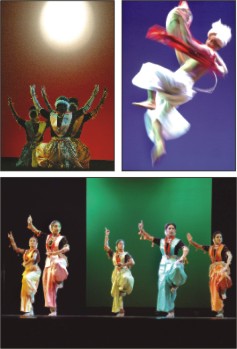
On the second evening (March 29) of the Dance Festival organised by Shadhona and UNESCO, Chhayanat -- one of the leading cultural organisations in the country -- staged Manipuri dance performances.Titled Manipuri Nartan Malika, the recital was held at the National Theatre Stage, Bangladesh Shilpakala Academy. Manipuri, one of the six classical South Asian dance forms (others being Bharatnatyam, Kathak, Kathakali, Kuchipudi and Odissi), is indigenous to Manipur (the north-eastern Indian state) and Sylhet (in Bangladesh). Manipuri dance was originally performed in temples and its objective is to provide a spiritual experience. Recognised as one of the most elegant and graceful dance forms, Manipuri highlights rounded movements and avoids jolts, sharp edges or straight lines. It is this trait that gives Manipuri dance its lyrical and soft appearance. Bipin Singh is acknowledged as one of the first Manipuri Gurus to bring this ritualistic dance form to the urban stage. Students of Chhayanat follow his style. At Chhayanat, under the guidance of Manipuri dance exponent Sreemati Shantibala Sinha, the dance form found a foothold in Dhaka in the early 1980s. After over two decades, Chhayanat can now boast of a fine group of dancers. 'Chitrangada', Chhayanat's department of dance, is now headed by Sharmila Bandyopadhyay. The seasoned dancer trained under Sreemati Shantibala Sinha, Guru Bipin Singh and his wife Sreemati Kalavati Devi. The evening started with Basant Prabandh. Prabandh in Manipuri means musical composition. Accompanied by dance, the composition is a celebration of nature's abundance in spring. Performed by Sonia Rashid, Samina Hossain Prema, Sudeshna Swayamprabha and Warda Rihab, the composition narrated sequences, including the eternal union of Radha-Krishna, that are familiar to a Manipuri dance enthusiast. Tanum (known as Taraana in North Indian classical dance) performed by Warda Rihab, was a demonstration of the different taal (rhythm) in Manipuri dance. Pung Cholom was performed by Nilmoni Singh. The energetic performance showcased the artiste's ability to concentrate on both pung (or Mridanga) and dancing. Dashrup Dashavatar enacted the ten incarnations of Vishnu -- Matsya, Kurma, Varaha, Narasimha, Vamana, Parshurama, Rama, Krishna, Buddha and Kalki. According to Hindu mythology, whenever the world needs a saviour, Vishnu takes up a certain form and descends among the humans to confront evil. The composition was performed by Warda Rihab, Afsana Islam, Fahmida Siddiqa, Sudeshna Swayamprabha and Sanjana Huq. The last performance of the evening was Matrika. Based on compositions by Tagore, Sree Aravinda and Bankim Chandra, the performance addressed a mother's ability to love like no one else can, her willingness to forgive and passion that enables her to go to any length to protect her child. All compositions (except for the last one choreographed by Bimbavati Devi) were choreographed by Sreemati Kalavati Devi. Under Tarit Bhattacharya's music direction, Kalavati Devi and Shuma Rani Roy did the vocals. Premjit Singh and Tomba Singh were on pung. Bhashwar Bandyopadhyay in charge of lights did a commendable job. One emerging dancer to watch out for is Sudeshna Swayamprabha. Her passion for the art form was apparent through every mudra, twirl and facial expression. At times during the performance, the young dancer was like a flash of lightning on stage. The festival ended last night with the staging of Kazi Nazrul Islam's Badolo Borishoney by Nrityanchal.
|