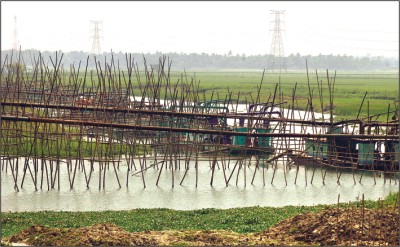
Ban on sand extraction sends thousands out of work
Although over 250,000 people in the sector are now out of work, the move to bring discipline in the sector is welcomed by environmentalists, who have long been fighting to save the flood-flow zones ar
Morshed Ali Khan
A Ban on sand extraction from the Meghna and Dhaleshwari rivers since February has stopped all activities related to land filling and sand trading in the city, sending thousands of construction sites idle with their workers. In the first week of February the joint forces banned extraction of sand from 130 sand extraction points in the two rivers. Over 2,000 sand laden vessels known as "bulkheads" operated day and night between the extraction points in the rivers and various projects and dumping sites in and around the city. According to sources, over 250,000 people, mostly day labourers, worked in the sector. To the relief of environmentalists the ban on sand extraction has however stopped indiscriminate land filling of low-lying lands earmarked in the city's master plan as flood-flow zones. At present thousands of dredgers and vessels along the rivers Meghna, Dhaleshwari, Buriganga, Turag and Balu are lying idle with the labourers. The extraction was authorised by the Energy and Mineral Resources Ministry for a token fee, while Bangladesh Inland Water Transport Authority (BIWTA), under the shipping ministry oversaw the operations. The BIWTA earned over Tk 1 crore every year from the sector renting out berthing sites. Sources in the shipping ministry said the authorities are now investigating whether the sector is depriving the state of revenues and also whether extraction at such a rate is causing any environmental degradation. With the construction sector booming in the city, sand extraction 'silently' grew phenomenally over the years. Although the past government talked about formulating a guideline but it took no step to do so. Sand extraction and its sale involving hundreds of crores of taka were never monitored by a single body, leaving the sector drift to near 'lawlessness', according to sources. Even some deputy commissioners issued permission for sand extraction without having any knowledge on its environmental impact. It has been alleged that a powerful political quarter, based in the city's Lalbagh area controlled the whole process of extraction, transportation and sale of sand in the city. Most of the city's construction sites are also severely affected by the current crisis of sand, price of which has rocketed since February. Before the ban, coarse sand sold for Tk 6 per square foot. Now the price is over Tk 12 per square foot, according to leaders of the Bulkhead Owners Association based at Amin Bazar. Normally the city requires over ten lakh square feet of sand every day. The biggest buyer of sand for land filling in the city was Rajuk for its Uttara third phase project, where it is filling up thousands of acres of low-lying land for plots. The Eastern Housing Pallabi project is the second biggest buyer. There are hundreds of other sites around the city where land filling was continuing day and night. The President of Bulkhead Owners Association in Gabtoli, Ebrahim Khalil Babul, said up to a quarter of a million people are now sitting idle due to the ban. He claimed that the owners paid up all taxes imposed on them. "We urge the authorities to investigate the entire process as soon as possible and tell us how to restart the sector and save livelihoods of lakhs of people," he said. "Most of the traders involved in sand extraction have bank loans to pay back, for nearly two months now we have no business. This is not a very good time for us," said Babul.
|