Amazing lines and colours in viscosity
Kalidas' workshop on printmaking ends
Fayza Haq
Sounds of dhol and shanai heralded the conclusion of Kalidas Karmakar's print workshop at Alliance Francaise Dhaka. The Japanese ambassador, Masauki Inoue, was the chief guest at the occasion. The products of the fortnight's progress were on display on the walls.Rashid Amin, a well-known printmaker, had participated at the workshop. He says, "It was wonderful to learn from Kalidas. I did abstract images in black, red and brown to show how one can experiment with the same plate." Nazia Andaleeb displayed her work -- dry point, etching and viscosity -- inspired by the techniques taught by Kalidas. One of her works is abstract and deals with impressions of a face. Next there is a female face along with figures of animals, with lines, and sketches and the last print has a female figure that has been turned into a lotus. "At the workshop I learnt printmaking -- in which a lot of lines are used -- which I'm sure will help my career," says Andaleeb, "I hope to combine oil painting with print in future." Tariq Zaulfikar, another upcoming artist, says, "The viscosity technique is something that helps one make colourful work at one go. My subjects deal with escape from prevailing social problems. One has two elfin-like figures speeding in different directions and playing the horn. A dancing man, done in red, orange and green, comes in the next print. Floating figures are featured in his last print while bars of green and yellow brighten the image. A print by Proshanto Karmakar shows Buddha meditating, placed on a giant lotus. Birds are included in the same composition. "The entire world needs to meditate, such is the prevailing situation today," says Proshanto. Green and orange dominate his work. The dove of peace has been brought in another creation and here too the artist has harmony in mind. Nagarbashi Barman, another artist, has brought in fish, nets, harpoons, boats and the sea in his work. Dry point and etching have been used in his black and white and sepia works. Qamruzzaman's print brings in drawings of worms, owls, vultures and human bodies that appear to be stitched at the back. "I bring in not-so-pleasant images to reflect the topsy-turvy political situation in the country," the young artist says, "I've brought in the nude figure too as I believe that's how nature intended man to be." He has worked in dry point and viscosity. Imran Ali in his prints tries to reflect his belief that humans have evolved physically but so much mentally. He has created figures within figures, one intermingling with another, in his effort to depict evolution of man. Afroza Sultana depicts a conglomeration of dragonflies; insects that she has been fascinated with since childhood. This is in dry point and in black and white. Her other image features masks, which Afroza believes is an integral part of our culture. Works by Sadia, another aspiring artist, deals with the bourgeois women's hang-up with beautiful garments and jewellery. Abul Barq Alvi, professor at the Institute of Fine Arts DU, commenting on the prints, says that the work, done in a brief period proves that the young artists can do well, given needed motivation and guidance. Hashem Khan, acclaimed artist too had high praises for the workshop.
|
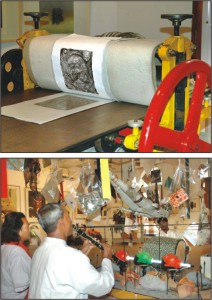
A demonstration of printmaking (top), musicians perform at the workshop. PHOTO: STAR |

