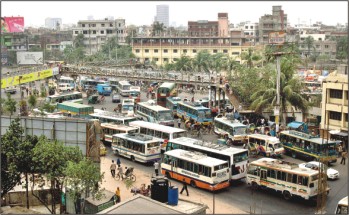
Public Transport
City buses plunge into further chaos
Raihan Sabuktagin
Passengers of public transport in the capital have no way but to continue putting up with immense sufferings as no mechanism exists to plan, coordinate, administer and monitor transport operators in and around the city.The transport sector is in chaos due to absence of coordinated operations and monitoring system as well as scientific planning of routes. A total of 3,693 buses and 6,110 minibuses are registered to ply 103 bus routes in the city serving 64 percent of city passengers daily. Even though many studies were done during past elected governments to find solutions to the sufferings of the city inhabitants and to establish an efficient transport system in the city, findings of the studies keep collecting dust on the desks of government officials. During off-peak hours, unmonitored buses from various operators on a single route continue to race each other for passengers and cause traffic congestions by blocking the path of the competitors' buses and at the same time try to fill up empty seats. Whereas during rush hours in the morning and evening, passengers are pushing and shoving each other just to grab the handle of the bus and put their feet inside. Passengers boarding a bus during rush hours at mid points of a route suffer the most as buses arrive at those stops already packed with passengers. Kazipara bus stop on Rokeya Sarani is one of such bus stops. Buses from Mirpur 1 or 12 or Gabtoli stop here on their way to downtown Dhaka. Amina Khatun, an NGO worker residing in Kazipara area and regularly commutes from this bus stop to her office at Paltan, shared her experience with this correspondent. "During the morning rush hours, by the time the buses reach this bus stop, they are already crammed with passengers. Most buses don't even stop here unless a passenger gets off here." "Passengers at Kazipara Shewrapara, Taltola and Agargaon bus stops stand in long queues in the morning hours, but they will not get any seat. It's like a war inside the bus. An overcrowded bus is really awkward for female passengers," added Amina. Jaidul Islam, another commuter from Shewrapara, told Star City that he boarded a bus at around 1:00pm on Thursday, but the driver waited at that bus stop for over 10 minutes as the bus was almost empty. Buses in the city do not maintain any time schedule, nor they follow any fare chart prescribed by the government. The buses do not ensure seats against tickets either. Moreover, there is no authority where public transport passengers can complain about harassments or mismanagements. A bus owner, Abdul Kalam, shrugged off any responsibility and said, "Of course there are anomalies and harassments of passengers, but negligence by Regional Transport Committee (RTC), responsible for maintaining and monitoring rules and regulations in the public transport sector, is to blame for the situation. Is there an authority to solve the problems? RTC did not hold any meeting to address the problems for a long time," Kalam alleged. Regular meetings to address the problems, implementation of the decisions taken at the meetings and regular monitoring could solve the problems, he observed. RTC is headed by Dhaka metropolitan police (DMP) commissioner. Representatives from DMP, Bangladesh Road Transport Authority (BRTA), Bus Owners Association and the civil society are included in the committee. A driver of a local bus service named Aminul said due the flawed transport system, he is compelled to wait too long at each bus stop during off-peak hours. "I have to keep pressing on the bus ahead of me at every stop to hurry so that I get to pick up passengers for my bus." Traffic congestion most of the time causes three or four buses of the same route to reach a bus stop at the same time and compete for passengers, Aminul explained. Traffic congestion, all city inhabitants having almost the same office hours, route violations by influential transport operators and absence of proper management and monitoring are a few of the reasons behind the disorderly state of the transport industry, experts said. Passenger sufferings during rush hours is caused by absence of proper route design and not setting any limit as to how many vehicles would be allowed on a particular route considering the passenger demand throughout different time of the day, a BRTA official told Star City. Violation of route permits is also playing a significant role, he added. Morshedul Anwar, deputy commissioner south of DMP and chief of RTC sub committee, emphasised the need to introduce a bus route franchise in the city where multiple companies or vehicle owners would operate under one single operator (or franchisee) on a particular route. He said the franchised bus route would eliminate the completion for passengers between the bus operators. Also, it would be more convenient for all. According a source at RTC, multiple operators competing each other on the same route are giving a rise to aggressive, wasteful and hazardous transport service. "Under the existing public transport system (not franchised), passenger comfort and safety is comprised. Besides, the system does not promote professionalism and improving managerial capacities in the public transport sector resulting in poor profit and time loss for the operator," he added. Dhaka Transport Coordination Board (DTCB) in November 2002 undertook a study on bus route franchise. A consulting team comprising both local and international consultants conducted the study. The consultants pointed out the benefits of the bus route franchise as well as shortfalls in the legal and institutional framework. The consultants proposed to start a pilot project of bus route franchise in a single route in the first phase. They also prepared the bidding document for competitive bidding. DTCB in early 2003 floated tender for selection of an operator under the proposed franchised route. A number of bidders participated in the tender. As of today, the government did not take any decision on the bid, nor did the government go for fresh bidding.
|