Portrait of an esraj player
Ekram Hossain speaks on his art
Ershad Kamol
The 200-year-old instrument esraj, a combination of sitar and sarangi, was found in the east-central India, particularly in Bengal. Esraj is mostly used as an accompanying instrument in Rabindra Sangeet. It is also played solo as well as an accompanying instrument in North Indian classical music, mostly in the Vishnupur gharana.A staff artiste of Bangladesh Shilpakala Academy, AFM Ekram Hossain, is one of the very few esraj players in the country. Besides playing classical recitals at concerts, based on lucid ragas such as ragesree, desh and khamaj, Ekram plays esraj as an accompanying instrument with commercial music, Rabindra Sangeet, and dance. Nupur and Nrityanchal, composed by Ekram, are the only available albums in the country for Kathak dance at present. Ekram has played both esraj and tabla in the albums. Moreover, as a member of the government delegation he has showcased his skills in esraj overseas several times. Recalling his early career, Ekram said, "Music runs in my family. I took my first lesson in music from my father Mohammad Saad Taqir, a tabla player of Radio Khulna. He insisted that I learn string instrument, as he thought tabla players have less scope in the country. Then I went to Ustad Shamim Sarkar to learn esraj. From then onwards I began to play both the instruments -- tabla and esraj." In 1974 Ekram joined Radio Khulna as an esraj and tabla player. Later, in 1978 he joined the transcription service of Bangladesh Betar as an esraj artiste. Ekram played esraj in 1978 in the BTV production of Tagore's popular play Raktokorobi, directed by Mustafa Monwar. Subsequently he joined Bangladesh Shilpakala Academy as an esraj player in 1979. Ekram faced several ups and downs, which left him utterly confused and he had little option but to take a temporary break as an accompanist. "Unfortunately, the popularity of esraj has been steadily declining. When I went to learn more on the instrument from Ustad Phuljhuri Khan, he discouraged me by saying that esraj players have no future in the country. And he suggested that I shift to some other instruments. That's why I gave up esraj and leaned towards tabla. As a tabla player of the government delegation I've travelled to many countries. "But, only a few years back, renowned composers like Shujeo Shyam, Mohammad Mannan and Maksud Jamil Mintu encouraged me to continue playing esraj, saying better days are ahead for the musicians. And now I feel that I've wasted my time playing tabla, leaving esraj. Nowadays I'm busy in the commercial field." As Ekram has no mentor, he practices esraj while listening to recitals by Indian gurus. However, he is doing some experiments. To quote him, "If, the mike of gramophone is added with the esraj, it produces a sound similar to that of a shehnai. I recreate the taar shahnai in this way."
|
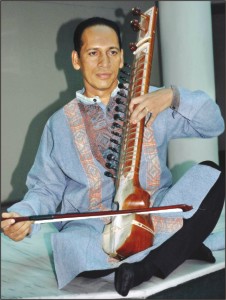
Ekram Hossain. PHOTO: STAR |

