British consultant dies 430m down Barapukhuria mine
Air poisoning most likely cause of death
Sharier Khan with Kongkon Karmakar in Barapukuria
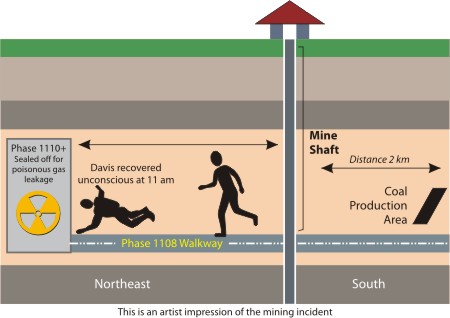
A British mining consultant died most likely from air poisoning inside the hazardously heated Barapukuria coal mine at a depth of 430 metres yesterday.The incident did not affect the mine's daily production that officially resumed on April 17. But this has hampered recovery of huge mining equipment which were abandoned in a danger zone in 2005. Mine ventilation expert Albert Banes Davis (62) and Nicolas Sharon Woodburn (26) alias Nick, both belonging to the mine's British consultant firm IMC, went down the mine at around 8:30 am to implement a recovery plan for the abandoned equipment in mining zone--1110. This zone was sealed off in October 2005 because of an alarming rise of deadly carbon-monoxide gas caused by combustion of extracted coal that was left unattended. A top source at the mine told The Daily Star that at one point of a newly developed passage under zone-1108 that led to the sealed off poisonous zone, Woodburn noticed that Davis was missing. Woodburn turned to the mine's communication system and alarmed the stand-by rescue team. The rescue team rushed to the spot and recovered Davis in an unconscious state. Davis was taken to Sayedpur combined military hospital at around 11:45 am, where doctors declared him dead at around 12:30 pm. Exact cause of his death was yet to be ascertained. "Poisoning by carbon-monoxide could be one reason. The other reason could be that the mine's air itself is so hot and humid that one can become seriously ill from it. In such a case, Davis might have lost consciousness and fell awkwardly on the floor suffering head injury that led to his death," the source said. As per the law, the body of Davis will be sent to England for autopsy and burial formalities. He came to Bangladesh on April 12. "The IMC will now investigate the cause of his death. Till this investigation is over, we cannot say for sure what caused the death," the source added. Expressing condolence at the death of the consultant, Petrobangla yesterday formed a committee asking it to file a report in this regard within seven days. In a press release, it said his body would be kept in a mortuary in Dhaka before it is sent to England. This is the first instance of a foreign consultant's death inside this hazardous mine, though not the first instance of death there. About eight years ago, a couple of local mining workers died in an accident. "The air and working condition inside the mine is now very hazardous even for a healthy man. It is so hot and humid that a few hours of stay underground can make you very ill," a mining official told The Daily Star. "The mine is constantly being flooded with water having a temperature of 48 degree Celsius, which we need to pump out round the clock. There are frequent roof collapse, and the mine's columns supporting the roof have developed alignment mismatches," he added. The hot water phenomenon is new and mysterious. But mining engineers believe there must be a fault inside the mining area that connects the water reservoir with a source of volcanic chamber. With a bloated price tag of over Tk 1,600 crore under Chinese Supplier's Credit, the mine stumbled due to numerous problems since 1998 because of poor project design and implementation by Chinese company CMC, and corruption by a local business house that profited from it. As a result, the mine's initial target of producing one million tonnes of coal has now come down to 500,000 tonnes (officially 700,000 tonnes), while the mine remains the country's most hazardous work place with alarming degradation of local environment. The first major disaster took place in 1998 when the mine became flooded with uncontrollable water flow from sub-soil reservoirs. As the CMC could not handle this problem, it relocated the underground mine's shaft. For the next three years, the mine's development progressed at snail's pace. The mining work resumed half-heartedly after 2001 but on September 30, 2005 it faced another blow when there was an alarming rise of gas in zone-1110. The authorities suspended extraction of coal and evacuated all workers, abandoning mining equipment. On October 5, sensing deadly carbon dioxide and burning methane underground in the mine area, miners sealed off an area of 450 metres by 120 metres. Carbon monoxide causes instant death. Mine sources said this disaster has happened because the Chinese contractor had left highly inflammable coal pits exposed to air since May 2005 and the mining authorities overlooked the matter. Mining norms dictate that coal pits should not be left exposed to air for more than 24 hours as this can lead to self-combustion of coal and emission of gas. The mine's work remained totally suspended between October 2006 and April 2007 as the CMC refused to work demanding various payments including one instalment of the Supplier's Credit taken by Bangladesh. This suspension also stopped power generation by the 250 megawatt Barapukuria power plant. Side by side with resuming mining activities, Barapukuria Coal Mine Company Ltd (BCMCL) had asked the CMC to recover the costly mining equipment. As part of it, the mine's British consultant IMC had brought in ventilation expert Davis. Meanwhile, sources concerned said the 250-MW coal-based Barapukuria thermal power plant just steps into full swing operation as they are now getting 75 percent of coal requirement from the BCMCL. The plant is importing the rest from India. The mine has a deposit of about 390 million tonnes of high quality bituminous coal within 6.68 sq km area, but less than 20 percent of it can be extracted using the underground mining method, sources mentioned. Barapukuria project was approved in March 1992 with the target of its completion by July 31, 2001 at a cost of Tk 887 crore. This cost was pushed to more than Tk 1,600 crore but the contractors have failed to hand over a productive and complete mine even six years behind the schedule.
|