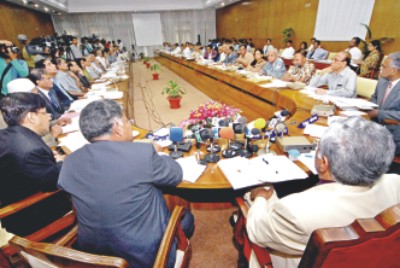
Dialogue on Reform Proposals
Govt unwilling to free EC sectt from PMO
CEC says constitutional amendment needed for this; 2 ex-CECs reject his view
Staff Correspondent
The chief election commissioner (CEC) yesterday said the caretaker government does not want to free the Election Commission (EC) Secretariat from the control of Prime Minister's Office (PMO) since it requires amending the constitution.But two former CECs and a few civil society members said there is no major obstacle to separating the EC Secretariat from the PMO, which is now the office of the chief adviser. The views came at a daylong dialogue over a set of draft proposals for electoral reforms at the conference room of the National Economic Council. Responding to suggestions placed by eminent persons for de-linking the front organisations, including the student fronts, from the political parties, the CEC said the EC will examine if there is any scope to insert any provision to this end in the laws for the political parties' registration. The government also wants to de-link the front organisations from the political parties and asked the EC to examine the possibilities, CEC ATM Shamsul Huda said. Over 40 eminent personalities, including educationists, economists, NGO activists and former civil and military bureaucrats participated in the dialogue. They unanimously supported strengthening the EC by separating its secretariat from the PMO and gave their opinions on the draft proposals for electoral reforms. The CEC said the EC will review the opinions expressed by the eminent personalities and hold talks with the editors of newspapers and senior journalists soon for their opinions on the proposals. He said the government interfered in the activities of the previous EC. "But I will not allow this. We [the EC] are independent...The government cannot interfere in our activities if we do not give them any scope," Huda said. In his inaugural address, the CEC said no reform proposal will be finalised without holding talks with the political parties since they are the main stakeholders. "We had planned to hold talks with the political parties first, but we could not do it because of the restriction on indoor politics. We will hold talks with them as soon as the government withdraws the restriction," he said. He said five consultants are expected to start working at the EC Secretariat to prepare a project proposal for simultaneously preparing the voter list with photographs and national identity cards. INDEPENDENT EC SECRETARIAT
About the much-talked-about demand for an independent EC Secretariat, the CEC said the EC is in favour of freeing its secretariat from the PMO's control. But it is not possible at this moment as there is no parliament to amend the constitution, he said. Talking to reporters after the dialogue, former CEC Justice KM Sadek, however, said he does not think it requires an amendment to the constitution to separate the EC Secretariat from the PMO. Former adviser to the caretaker government M Hafizuddin Khan, Shujan Secretary Dr Badiul Alam Majumder and a few other participants echoed the view during the dialogue. Former CEC Justice Abdur Rouf avoided any specific comment, saying, "The constitution has been bypassed many times and what is the problem if it is bypassed again?" Justice Rouf told the dialogue that the election commission secretariats in India, Pakistan and Sri Lanka have been separated from the executive branch. "Why it should not be done here [in Bangladesh]?" he said. Debapriya Bhattacharya, executive director of Centre for Policy Dialogue, requested the EC to find out solutions to ensure the separation of its secretariat from the PMO. CEC Huda said the EC will examine if it is possible to separate the EC Secretariat without amending the constitution. Senior journalist Syed Abul Maksud said it is the responsibility of the EC to hold the election as soon as possible so that an elected government can assume power. "There is a possibility that an unconstitutional government will emerge if the Election Commission fails to hold the election soon," he said. At the dialogue, a few participants opposed the EC proposal for providing tax exemption for the funds of the political parties. They also suggested imposing restriction on the parties' fund collection. The CEC said the EC has no specific information about the sources of the political parties' funds. "Talking to some political leaders, I understood that the major political parties do not face any problem raising funds. But the smaller parties do face problems and they want to reduce the election expenditures," Huda said. The EC does not want to be the "master" of the political parties and control them, the CEC said, adding that the EC only wants the political parties to follow some rules and regulations of the commission. A few participants, including former army chiefs Nuruddin Khan and M Harun-ur- Rashid, and Debapriya, opposed the proposal that says a civil or military bureaucrat or a statutory body official cannot participate in the polls before three years from their retirement. Some NGO leaders supported the part of the proposal for government officials but opposed the part that deals with the NGO officials. Woman participants of the dialogue demanded that the EC should include a provision in its proposal to make it mandatory for the political parties to nominate a certain percent of female candidates in the election.
|