Building construction in Bangladesh: Safety issues
Falguni Mallick
Building construction has every chance to be a dangerous and hazardous. Accidents can happen at any time, almost any where and to anybody. Because of the involvement of a huge number of workers and colossal sized construction tools, handling heavy loads, working with electrical equipments and moving machinery, vast supply of construction materials, and labouring them at different heights and so on; the construction workers are constantly at risk and have the probability of accidents. Safety issues need to be considered initially not only at the construction phase but also in the designing of building structures itself. Considering safety issues in the architectural and structural design of the building coupled with ensuring safeguards at the time of construction can help us to avoid construction related accidents. Clearly stating the safety policy to every employee, contractor, subcontractor and any other personnel on the site will go a long way in avoiding the consequences of construction-related accidents. But generally, sufficient safeguards to avoid construction-related accidents and ill-health due to hazardous environment are not taken until an accident occurs. The building construction process in the different cities of Bangladesh was surveyed by the author to get a scenario of the existing conditions of safety standards in those construction-sites. In almost every case both of the owners, contractors and workers are reluctant respectively to ensure safety measures due to lack of knowledge, experience and consciousness. Again the city management authorities are only concerned with the monitoring and controlling of set-back rules and height restrictions of building construction; they have no legal regulatory or monitory to ensure safety standards at the construction-site. Even new building construction rules and regulations are going to be implemented for Dhaka city that is FAR (floor area ratio) has a focus only on the controlling of building setback and construction volume. This new rule has no guideline for safety issues during construction. The construction industry of Bangladesh urgently requires standardization and regulatory control to ensure safety during construction. SAFETY APPRAISAL DURING CONSTRUCTION
Two types of safety precautions are required during building construction; one is against accidents and the other is against hazardous environmental conditions. i. Accidents associated with building construction-work - Fall of any person from elevation.
- Fall of any person on the same level.
- Fall through hollow shafts, ducts and chutes.
- Struck by falling materials
- Struck by moving vehicles or machineries.
- Struck against any hard object.
- Pierced by any sharp edge.
- Be trapped in a trench collapse.
- Be caught between scaffolds.
- Getting electrocuted.
- Fire related accidents.
- Accidents from mechanical failure.
ii. Hazardous environmental conditions - Excessive noise.
- Excessive heat.
- Inadequate ventilation.
- Improper lighting.
- Excessive smoke from ill maintained vehicles or machineries.
- Stock of waste materials and rubbish in and around the construction site.
Hazardous environment during construction may have minor effects on health are: headaches, stuffiness, irritation of eye, nose and throat. Serious effects are: respiratory infection, increased risk of cancer, and aggravation of blood disorders and heart disease. EXISTING SAFETY-CONDITION DURING BUILDING CONSTRUCTION IN BANGLADESH In Bangladesh, the construction process of the building structure is traditional; modern construction technology and equipments have not yet been well introduced here. As well as the safety measures during construction are not satisfactory as commented by the architects, engineers and site supervisors of different construction sites. In almost every case both of the owners, contractors and workers are reluctant respectively to ensure safety measures due to lack of knowledge, experience and consciousness. Again the city management authorities are only concerned with the monitoring and controlling of set-back rules and height restrictions of building construction; they have no legal regulatory or monitory to ensure safety standards at the construction-site. Existing safety-condition of the major events of building construction in context of Bangladesh are identified as follows: i. Scaffolds:
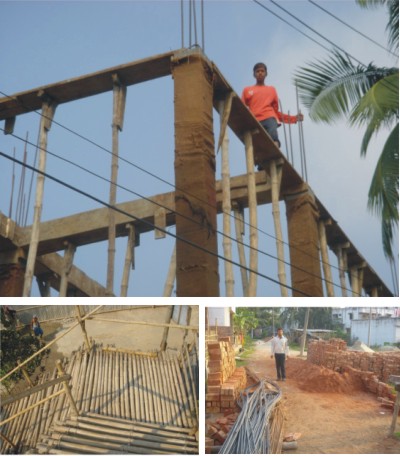
All scaffolds require to be designed and constructed to support the loads that may be imposed there on to ensure the safety of persons working on them or passing under or near them. Again scaffolds require to be provided with guard rails above the platform level so that workers or construction materials can not be fallen down from the side of the scaffolds. Planks used for the platforms of scaffolds should be strong enough and should ensure no chance of any skipping. But the existing scenario of our construction sites is very risky. In most of the cases, contractors use thin bamboo poles for scaffolds at their whim (not designed); even they have no idea about the load that is going to be introduced upon it. In most cases, scaffolds have no guard rails. Contractors are habituated with the reuse of poor quality old planks for the platforms of scaffolds for saving money, but there is no body to check its strength. ii. Overhead Protection
As the construction labourers work at an elevated position from the ground, there is always the chance of falling any worker from the height on the ground. More over fall of construction material or waste on the persons below can also cause accidents. According to the survey findings these accidents in Dhaka sites are frequent but not very severe. But unofficial reports of a few deaths by accidental fall from height were found which the contractors and family members of victims settled mutually to avoid hassles of legal procedure. On this type of settlement the company or the contractor has to accept compensation of an amount of Taka one or two lakh for each casualty, which is given to the family of the victim(s). The contractors in Dhaka usually build temporary 10 ft. to 20 ft. wide safety ledges (shades) projecting horizontally out of the building facades to stop workers or materials from falling directly to the ground, ... This ledge is usually made of corrugated iron sheet rested on truss frame of mild steel angle, which is normally welded with the steel bars of structural column and slab. Vertical netting made of Hessian or synthetic net is installed all around the structure, starting from the tip of projected ledge up onward to the level of ongoing casting. Sometimes this ledge is made with smaller projection that is less than 10 ft., and with bamboo, rope, synthetic net and Hessian cloth, which does not work as satisfactorily. But in case of other areas of Bangladesh except Dhaka, there is no arrangement of any over head protection most often. Even in Dhaka, sometimes the same picture can be seen, though not frequently. iii. Side Walk Sheds & Walk Ways
Whenever a building structure is constructed adjacent to the street lines, sheds of sufficient strength, height and stability to sustain safely the weight of materials that may be placed thereon and to withstand the shocks incident to the handling of such materials or their preparation for use and to the accidental jars from struck or delivering materials. In Bangladesh, mostly these sheds are made of bamboo skeleton filled with corrugated iron sheet. These types of sheds are not strong enough; at any time they may collapse on the side walk ways due to the pressure of the materials stacked inside. iv. Temporary Fence or Barricade
The construction site needs to be fenced for safety. The fence requires to be extended along the street line for the entire length of the building or site and each end shall be turned and extended to the building line. Fence shall be solid for its full length except the door openings. But in our context, generally this site-fencing is made very casually. Even sometimes there are some construction sites in Bangladesh we can see without any site-fencing while the construction work is going on at full swing. As a result noise, dust and other pollutants are affecting the surroundings of the construction site. v. Hoists (Lift-shaft, Ducts, Chutes & Other Floor Openings)
Hoists shall be enclosed on all sides and for their full height, except for the necessary doors for loading unloading; so that man or loose material cannot fall through. All floor openings shall be guarded on all sides by substantial railings. But in the survey the author has found that the contractors are most often reluctant regarding this type of safety precautions in our construction sites. During casting of floor slabs the areas of ducts, cores, shafts etc. are kept void and no edging or temporary railing is made around them for safety. The whole length of these unprotected ducts, a narrow vertical tunnel, remains open with labourers or technicians working atop. Slip of foot on the work floors due to fatigue, suffocation, claustrophobia or insufficient light into the ducts causes frequent and fatal accidents. Sometimes people drop from a considerable height and even pierced by the sharp edges that are exposed along the inside surfaces of ducts at different heights. vi. Stair Facilities
Until either permanent or temporary stairways are installed, suitable substantial ladders securely fastened at top and bottom need to be provided, so that when workers will walk up above it will not break down. Again this ladder needs to be so built that there is no chance of skipping or slip of foot. In our situation, most often these ladders are made of bamboos which round shape has a great chance of slip of foot. Some times the ladder has no hand rail even. Slip from the ladder is a frequent accident in our construction sites. vii. Fire Protection
Combustible materials (such as polythene) shall be stripped from the concrete and removed from the construction site as early as possible. Enough fire extinguishers are needed even while construction works progresses. Free access from the street to the fire extinguishers is required. In our construction sites, there is no minimum precaution for fire safety. viii. Welding & Cutting
Non combustible protective shields shall be interposed to protect materials and persons against sparks and hot metal or slag. Welding equipment shall be stored in clean locations away from grease, oil and excessive heat. Gas cylinders shall be placed away from heat and flame, oil or grease. As our labour is unskilled and unconscious about safety, most often they do not wear any safety gloves, shoes or helmets during welding and cutting. Even sometimes they do not wear any eye protection during welding. As a result injuries to fingers, palms, hands, feet, legs, eyes etc. is very common in our construction sites. ix. Storage of Materials
In our construction sites, it is a common picture that construction materials and equipments are stored on the side walks and streets without taking permission from the proper authority. Even there is no safety sign beside it. As a result the movement of general people on those roads and streets become unsafe. x. Disposal of Waste
There is no control on the management of waste in our construction sites. Contractors and owners are habituated to remove waste and rubbish from the site at the completion of total construction work to save. But waste materials and rubbish should be moved away as early as possible because they are the major source of fire and disease. xi. Lighting
All parts of the building even under construction need proper lighting for the safe movement of workers. In some cases, our construction workers are working under insufficient lighting condition which is causing accidents and injuries to health. xii. Accidents From Electric Short-circuit
Improper care in temporary wiring, faulty wiring, inefficient machineries, contacts between electrical wire and water especially in the period of curing and rainy season etc. are the main causes of this type of accidents. xiii. Accidents From Chemicals and Toxic Materials
There are some chemicals and toxic materials that we have to use in our construction works are injurious to our health. Cement, lime, anti-termite chemicals, polishing acid, toxic paints, refrigerants of air conditioners etc. are mentionable among them. But as our workers do not wear safety mask, gloves or shoes, their health is always at risk due to these hazardous materials and chemicals. xiv. Personal Safety Precautions
In our construction sites, most often contractors do not provide any safety gloves, shoes or helmets to the workers. On the other hand as our labour is unconscious about safety, they do not have any demand for it. In case of large scale construction, when these personal safety devices are supplied the workers are not interested to wear personal safety devices as they are unaware about safety. As a result injuries to fingers, palms, hands, feet, legs, eyes etc. is very common in our construction sites. xv. First Aid And Medical Attentions
Most of the construction sites of our country are without any facility of first aid and medical attentions. In case of minor injuries, workers are not habituated with any first aid treatment; as a result minor injuries sometimes create major disease later. CHECKLIST TO ASSESS SAFETY MEASURES IN A CONSTRUCTION SITE
Examine the safety measures and question the possibility of any of the following kinds of accident occurring: (A) Is there any chance that a person may fall from any dangerous height? (B) Is there any chance that a person may fall on the working level? (C) Is there any chance that a person may fall through hollow shafts, ducts or chutes? (D) Is there any chance that a person may be struck by any falling material? (E) Is there any chance that a person may be struck by moving vehicles or machineries? (F) Is there any chance that a person may be pierced by any sharp edge or any hard object? (G) Is there anything that a person can be trapped in a trench collapse? (H) Is there anything that a person can be caught between scaffolds? (I) Is there any chance that a person can get electric shock? (J) Is there anything that can cause fire related accidents? (K) Is there any chance of accidents from mechanical failure? (L) Are the workers well equipped with their personal safety devices against accidents? (M) Is there adequate facility of first aid treatment? Examine the safety measures and question the possibility of any of the following kinds of environmental hazard: (A) Is there any chance that a person can get exposed to excessive noise, high temperature, radiation, caustics, toxic or noxious substances? (B) Is there proper lighting and ventilation to work? (C) Is there any substance that may cause physical impairment in breathing or in other bodily function? (D) Is the working environment clean enough? Is there any garbage or any other substance that may cause any disease? (E) Are the workers well equipped with their personal safety devices against hazardous environment? RECOMMENDATIONS
In our construction sites, both of the owners, contractors and workers are reluctant to ensure safety measures due to lack of proper knowledge and awareness. Again there is nobody to monitor or control the safety situation in our construction sites. Even the records of accidents are not maintained. Most often contractors are not willing to provide any safety gloves, shoes or helmets to the workers On the other hand, the labourers, usually coming from the lower strata of the society, do not have any education or training to ensure personal safety in work. They are not aware of demanding personal safety equipments. There is no institution or provision of formal training or drill of the construction labourers for safety precautions. The immediate needs in construction sites for safety are: - To upgrade our safety rules and regulations.
- To ensure the execution of existing safety rules and regulations.
- To ensure the regular inspection of safety situation.
- To ensure to keep compulsorily the records of all accidents.
- To make both the owner, contractor and workers aware about safety issues through awareness programme.
- To provide formal institutional training on safety precautions to the workers and contractors.
Editor's Note: The author has acknowledged all relevant sources in his original paper
The author is Associate Professor, Architecture Discipline, Khulna University
|