Graft ups cost of doing business in Bangladesh
Dutch envoy tells Ficci meet
Star Business Report
Corruption leads to higher cost of doing business in Bangladesh, observed the Dutch envoy in Dhaka yesterday.There has been widespread corruption when it comes to doing business in this country, although it is possible to do business here without indulging in corrupt practices, Kees Beemsterboer told the monthly luncheon meeting of Foreign Investors' Chamber of Commerce and Industry (Ficci). He said, "If companies are not willing to pay bribes, euphemistically called 'speed money', in Bangladesh it may for example take a long time, as I have been told, to get goods cleared in customs or to get your contract enforced via the judiciary." Masih Ul Karim, president of the chamber, among other foreign investors in Bangladesh, was present at the meeting. The Dutch ambassador however lauded the present government's crackdown on corruption. The Dutch traders have faced barriers during the last few months due to slow speed of the administration, he said, pointing to the fact that although the Netherlands has regained its bird flue-free status in November 2006, the import ban on Dutch poultry is yet to be lifted. He listed power shortage and mismanagement in ports as the main bottlenecks being faced by the Dutch businessmen in Bangladesh. "I feel that the current government has already taken some positive steps. Still, more needs to be done to really overcome these serious bottlenecks, particularly the energy related problems," Beemsterboer said. The ambassador thinks that as the foreign business community in Bangladesh is a very large taxpayer, it has the right and obligation to voice a demand for change and hold the government accountable for policy measures and rules and regulations. "I believe that if all chambers would agree on a joint agenda, the voice of the business sector would increase manifold and structural changes would be achieved", the Dutch envoy added. In 2006, the Netherlands has a trade deficit with Bangladesh of 260 million euros. Total export from Bangladesh to the Netherlands was approximately 303 million euros, while import from the Netherlands to Bangladesh was 43 million euros in 2005. The Netherlands investment here during the period between 1971 and 2006 reached approximately 132 million euros as registered with the Board of Investment (BoI). In a bid to encourage Dutch investment in emerging markets, the Netherlands government has a programme called PSOM (Program for Cooperation with Emerging Markets). Recently, a memorandum of understanding (MoU) to this end has been signed to extend the PSOM in Bangladesh until 2009. "Along with other sectors, I see a big opportunity for PSOM in leather sector, mainly to reduce the environment pollution, which is a huge problem in Bangladesh," the Dutch ambassador said.
|
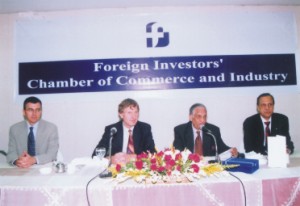
Masih Ul Karim (2-R), president of Foreign Investors' Chamber of Commerce & Industry (Ficci), speaks at the monthly luncheon meeting of the chamber in Dhaka yesterday. Kees Beemsterboer (2-L), the Netherlands' ambassador to Bangladesh, Carlo Cifiello (L), Ficci vice president, and MA Matin, chamber secretary, are also seen. PHOTO: FICCI |

