CPI and Bangladesh
Mamun Rashid
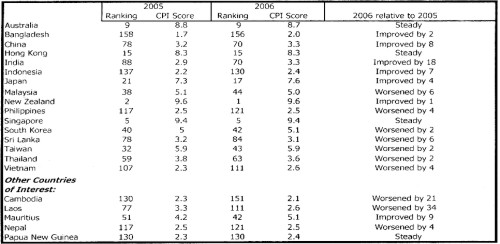
Every year Transparency International (TI) publishes a "Corruption Perception Index" CPI). Till 2005, Bangladesh was listed as the most corrupt country for consecutive five times. In 2006, Bangladesh improved a little bit in the ranking, although most observers feel that the improvement is mostly due to increase of corruption in a few other countries. The CPI report is widely regarded as a solid indicator of corruption in various countries, although some critics feel that the methodology used by TI does not always give a proper relative ranking. That is why it would be interesting to understand the methodology of preparing the CPI report.The Transparency International Corruption Perception Index ranks countries in terms of the degree to which corruption is perceived to exist among public officials and politicians. It is a composite index, a poll of polls, drawing on corruption-related data from expert and business surveys carried out by a variety of independent and reputable institutions, including newspapers. The CPI reflects views from around the world, including those of experts who are living in the countries evaluated. The TI CPI focuses on corruption in the public sector, and defines corruption as the abuse of public office for private gain. The surveys used in compiling the CPI ask questions that relate to the misuse of public power for private benefits, for example bribery of public officials, kickbacks in public procurement, embezzlement of public funds, or questions that probe the strength of anti-corruption policies, thereby encompassing both administrative and political corruption. The CPI, 2006, ranks 163 countries. In 2005, the CPI included 159 countries. Following is a list which shows the performances of some countries: Because of inherent structural problems, Bangladesh suffers from relative lower ranking, although the actual situation may be quite different. This is not to say that CPI is not a reliable indicator, and Bangladesh does not suffer from widespread corruption. Given the constraints provided, the CPI report draws quite an articulate picture of corruption in various countries, and we can understand from our own experience the extent of corruption in Bangladesh. However, many people would agree that, on a relative benchmarking, Bangladesh should perform much better than many other countries in the list. If we look at the list, we shall find that many countries which are hardly functional as states, and are not going through any economic expansion phase (specially in Africa), stand much higher than Bangladesh. This may be the result of higher expectation and more openness in the media and society than in Bangladesh, which makes the case of corruption perception in Bangladesh worse. This perception can be changed, especially with the on-going anti-corruption drive. Previously, we had seen such instances in Pakistan and Indonesia. In Indonesia, after the fall of the Suharto regime, the corruption perception was very low. In 2000, the Indonesian government issued a presidential decree to establish the National Ombudsman Commission. The Commission was established to help create and develop a conducive climate for the fight against corruption, collusion and nepotism. It has the mandate to receive, investigate and follow through reports from the general public concerning the protection of their rights and the services provided by the government. The continuous effort of this Commission has changed corruption perception in Indonesia significantly. Since then the standing of Indonesia in CPI has improved considerably. Similarly, Pakistan established a National Accountability Bureau, with the responsibility of implementing and coordinating the National Anti-Corruption Strategy (launched in 2002) and National Accountability Ordinance (amended in 2002). The continuous effort of this agency has improved Pakistan's standing in CPI significantly. Taking a clue from these instances, we can expect that the recently reconstituted Anti- Corruption Commission, with its cohesive and integrated approach as well as a clear aim, will be able to contribute significantly to improving Bangladesh's standing in the CPI list. We can't go back, we can only move forward, that is what all our liberation martyrs wanted and the struggling people of Bangladesh deserve. The writer is a banker.
|
|

