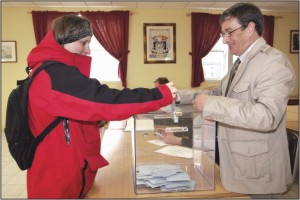
French voters last to know president's name
Afp, ap, Paris
Millions of French voters casting their ballots for the right-winger Nicolas Sarkozy or the socialist Segolene Royal may be the last to discover the name of their new president tonight. French electoral laws, among the strictest in Europe, ban the publication of any opinion polls, estimates of results or angled news reports from the day before a vote until the close of polls, to avoid influencing voters' choice. For Sunday's presidential vote, in which France chooses a successor to the 74-year-old Jacques Chirac, the ban runs from midnight (2200 GMT) Friday to the close of the last polling stations at 8:00 pm (1800 GMT). In France's overseas territories in the Caribbean and north Atlantic, which vote a day early, television screens went blank Thursday at midnight, with all cable and satellite news broadcasts suspended for 24 hours. National news programmes were carried with a delay, to allow editors to slice out any reference to the electoral campaign on the mainland. But though strictly applied in France, with fines of 75,000 euros (100,000 dollars) for offenders -- the rules are not enforced in neighbouring countries or for websites based outside the country. In practice, any French person with an Internet connection, or who can pick up Swiss or Belgian radio from across the border, can easily circumvent the law. From 1630 GMT on Sunday, the first projections of the results, conducted by polling firms based on a sample of votes cast but not designed for publication, will be sent out to political parties and the media. In the April 22 first round, these secret figures were leaked and released by foreign media almost two hours before official projections were published in France at 1800 GMT -- and the same scenario is likely this weekend. With French bloggers also threatening to post leaked estimates on their sites from 1630 GMT, the French media stand to be among the last to publish the estimated results of the country's own election. Critics in France, including AFP, argue that the law puts French-based news organisations at a competitive disadvantage in a globalised media environment. "We're in an awful situation," said Denis Hiault, global news director at AFP. AFP coverage of the first round was a success overall, Hiault said. "We're confident that our strength on the ground will make a difference at the end of the day," he added. Earlier final polls showed that Nicolas Sarkozy, who would warm up relations with the United States and prod the French to work more, was favoured to win today's presidential elections and to dash Socialist Segolene Royal's hopes at becoming France's first woman president. Despite Royal's fierce final blows Friday, all final polls suggested that Sarkozy will win Sunday's runoff and take over this restless, troubled nuclear power from the aging Jacques Chirac.
|