No thank you
Husain Haqqani
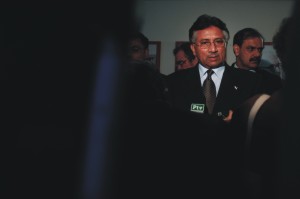
It is hardly surprising that Israeli Prime Minister Ehud Olmert politely turned down General Pervez Musharraf's offer of mediation in the Palestinian-Israeli conflict. Given Musharraf's current problems at home, it was his offer of mediation and the expression of willingness to visit Israel "to help bring peace to the Middle East" that was unusual. "We don't need someone to come from afar in order for me and Abu Mazen to meet," Olmert said, referring to Palestinian President Mahmoud Abbas. An official in the Israeli prime minister's office went a little farther, describing Musharraf's offer as "a little ridiculous," according to a report in the Jerusalem Post. "We have an Arab initiative. Why would we need a Pakistani initiative?" the official asked. Musharraf's mediation offer reflects a longstanding belief of Pakistan's civil-military establishment that the road to the country's survival and prosperity lies overseas. The belief is, of course, erroneous. It has been proven wrong again and again, most notably in 1971 when General Yahya Khan thought that his help in bringing China and the US closer would save erstwhile East Pakistan from becoming Bangladesh. But, as is often the case with folly, successive Pakistani rulers persist in thinking that they can extricate the nation from its troubles merely by playing a major role on the world stage. After making his mediation offer in an interview with an Arab television channel, Musharraf took off for a week-long four-nation tour that will take him to Poland, Bosnia, Spain and Turkey. In the meanwhile, the judicial crisis at home continues to brew. Demonstrations against Musharraf grow larger with each passing day, and there is no sign of stability returning any time soon. The situation in the tribal areas along Afghanistan's border has not improved, notwithstanding the government's effort to spin a conflict between some foreign fighters and Pashtun Taliban in South Waziristan as a tribal uprising against Al-Qaeda. The leader of the Pakistani tribesmen in the area has publicly declared that he would extend hospitality to Osama bin Laden if the international outlaw lands in his tribe's territory. The standoff with Pakistani Taliban in Islamabad, too, has not ended, notwithstanding Pakistani civil society's courageous demonstrations against the country's Talibanization. Musharraf's decision to travel abroad in the middle of a major domestic crisis has several precedents in Pakistan's history. Most significantly, late prime minister Zulfikar Ali Bhutto went off on an unexplained trip in June 1977 to six Muslim countries, including Saudi Arabia, Iran, and Afghanistan, in the middle of his negotiations with the opposition Pakistan National Alliance (PNA). By then, the country had witnessed violent demonstrations against Bhutto for almost three months over alleged rigging of parliamentary elections. Several rounds of talks between the government and the opposition had led to a basic compromise, the details of which were left unsettled before Bhutto's overseas tour. By the time the prime minister returned from his travels, the opposition's stance had hardened, and he was toppled in a military coup on July 5, 1977. Foreign relations are, indeed, important in the life of a nation, but more important than external affairs are the internal dynamics of a country. Pakistan has had a tendency since its earliest days to focus on a role on the world stage at the expense of resolution of issues at home. Soon after Pakistan's independence in 1947, veteran Life magazine photojournalist Margaret Bourke-White noticed a tendency among Pakistani officials to look for "opportunities for profiting from the disputes of others." In the process, Pakistan's establishment has developed a mindset that considers foreign policy a substitute for evolving national cohesion and improving the lives of the nation's citizens. The domestic cost of constantly looking overseas has been significant. Soon after independence, 16.4 percent of Pakistan's population was literate, compared to 18.3 percent of India's significantly larger population. By 2003, while India had managed to attain a literacy rate of 65.3 percent, Pakistan's stood at no more than 35 to 50 percent, depending on whose figures one believed. Pakistan ranks close to the bottom among 87 developing countries in the amount allotted to primary schools. Its low literacy rate and inadequate investment in education has led to a decline in Pakistan's technological base, which in turn hampers the country's economic modernization. Pakistan is also far from developing a consistent system of government, with persisting political polarization along three major, intersecting fault lines: between civilians and the military, among different ethnic and provincial groups, and between Islamists and secularists. Instead of continuing along the path of seeking international standing while ignoring the situation at home, it is time for Pakistan's establishment to turn inward. Ending polarization, building critical institutions of state, restoring democracy and reviving people's trust in their future as a nation should take priority over gimmickry in international relations. Husain Haqqani is Director of Boston University's Center for International Relations, and Co-Chair of the Islam and Democracy Project at Hudson Institute, Washington D.C. He is author of the book Pakistan between Mosque and Military.
|