Ambassador Sobhan goes to Washington
Tazreena Sajjad
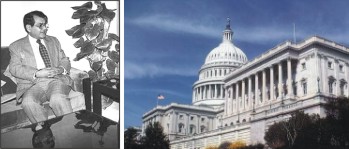
On a beautiful spring day, some of the who's who of Washington DC and representatives of many of the most established institutions in the state capital had assembled at the Carnegie Endowment for International Peace to hear Farooq Sobhan speak about Bangladesh. The title of the talk, interestingly enough, was changed at the last minute to "The Role of Bangladesh in South Asian Cooperation." The event was sponsored by the Carnegie Endowment for International Peace, Center for Strategic Studies, and the Hudson Institute. The critical timing of such a discussion notwithstanding, the fact that Sobhan's talk focused on external issues relating to Bangladesh as an emerging regional player, and the choice of the caretaker government to send him as a representative to the US government, gives one some cause for thought. After all, there is starting to be a general sense of unease in international circles about the motivations and goals of the caretaker government. Then, too, there is a growing level of skepticism about the direction the democracy project is heading in the country, given the current political developments, and the strong arm of the army making itself more manifest in domestic politics. A clever political maneuver, yet one that was not too subtle; the dispatching of a highly respected individual to both appease the US government and, at the same time, shift the focus of concern from the internal dynamics and tensions at the home front and focus attention on how Bangladesh can contribute through bilateral and regional ties to a more secure, stable and economically strong region. It was as if a message was also being simultaneously communicated, that this caretaker government was one with vision; and while tackling the numerous issues at the domestic front, it was also concerned about the role, image and contributions of this small country with tremendous potential in a volatile region. Ambassador Sobhan is the consummate diplomat. Succinct, eloquent, incisive, and convincing, he tackled a two-pronged discussion and managed to devote a significant portion of time discussing the current political situation in the country. The atmosphere alone was conducive to such a presentation, and highly welcoming it seemed from the points being made. If there was skepticism and hostility, they were very carefully camouflaged. After all, it almost seemed like an old boy's club where most people knew each other and greeted each other by their first names. The audience consisted of the crème de la crème of the diplomatic circle, including Ambassador Touqir Hussain, former Ambassador Tariq Karim, former Ambassador Teresita Scheffer (moderator), several representatives from the Indian and Bangladesh embassies, the Senate Foreign Relations Committee, US Department of Commerce, National Endowment for Democracy, National Democratic Institute for International Affairs, Asian Development Bank, American Bar Association, Bangladesh-US Human Rights Coalition, Foreign Policy Association, USAID, US Department of State, National Press Club, U.S. Commission on International Religious Freedom, International Republican Institute, the World Bank, the Brookings Institute, Henry L. Stimson Center, Amnesty International, several trade and commerce bodies as well as businesses like Chevron. Last but not least, Sajeeb Wajed, son of Sheikh Hasina, represented the Bongobondhu Foundation. In his thoughtful delivery, Ambassador Sobhan seemed to, at least on the surface, connect with all. As he outlined the reasons for the take-over of January of this year, he underscored that this caretaker government was a strong advocate of good governance and the head was a person of impeccable credentials, integrity and intellect, committed to ensuring that the democratic process was reinstituted in due course. The military, he emphasized, had to take over because they had no other choice; Bangladesh was fast descending into a "bloodbath," given the political turmoil since last year, and the military had to step in and declare a state of emergency so that the conditions for a free and fair elections for the future could be established. The damage done to some of the most critical institutions, including the Election Commission, the electoral roll and the judiciary, and the rampant and institutionalized levels of corruption, is the focus of the new caretaker government, and one that it has tackled with vigour. Already, according to Ambassador Sobhan, a new Election Commission has been appointed, a new electoral roll with photographs has been put in place using an advanced computerized system with assistance from technical experts from the UN currently in Bangladesh, and arrests are being made by the Anti-Corruption Commission to ensure that free and fair elections do indeed take place in eighteen months. He assured the audience that although in the past Bangladesh had reasonably fair elections, this caretaker government had a vision for the country beyond the election itself, and focused on the need to do so through pursuing the following additional measures: - Separating the Judiciary from the Executive.
- Establishing the independence of the independent Human Rights Commission.
- Ensuring that the freedom of the press remains intact.
- Enabling a transparency of accounts such that clean political candidates could compete in the elections of 2008.
Ambassador Sobhan reiterated throughout the course of his presentation: "General Moeen is not General Musharraf." As such, the general has no intention of integrating himself into the political sphere once the country is ready for democratic due process, but rather ensuring that the space is created for it to move forward without the obstructions it faced in the past. The question is, how can he assert this with such utter confidence? And what is really different about this military takeover, compared to others in the past? And what implications can be drawn from chief adviser Fakhruddin's insistence that it is his administration, not the army, that is at the helm of the governing authority? Is this the beginning of an internal tussle for power between the two faces of the caretaker government? Who really is in control? Listening to Ambassador Sobhan speak, it was evident that he was a man on a mission, and a very successful one at that, at least temporarily. As he addressed questions on Indo-Bangladesh relations on illegal immigration, labour migrants, the importance of coordinating intelligence units to fight terror at the regional front, of the increasing importance of Saarc in developing economic, trade, education ties, combating poverty, there seemed to be a pervasive sense of confidence of a small nation coming to its own and negotiating effectively with the giants of the region. The only problem was, the positive image pursued and depicted seemed to carry more conviction as the afternoon rolled on, and almost overshadowed the fact that, despite it all, Bangladesh is under emergency laws and its future continues to be uncertain. A few points raised about the domestic concerns of Bangladesh need to be brought up here, and this is where the role of Ambassador Sobhan became a little complex. Although was a delegate of the caretaker government and represented its views strongly, he seemed slightly cautious on a few issues. It seemed that he was concerned about the contradictions in his mandate and his relationship with the government. The most salient points that underscored the complexities of his mission are outlined below: Is there a military government in Bangladesh?
According to Ambassador Sobhan, Bangladesh today has a civilian, not military, government; a point he stressed emphatically, and one he said he had communicated well to the State Department. His rationale? The army is not involved in any of the 45 ministries, and although it is taking the decision as to who needs to be arrested, it is working in close collaboration with an advisory committee and the Anti-Corruption Commission, both of which are civilian bodies. Besides, "the aim of the military this time, having learned its lessons from the past" is to ensure the path to free and fair elections in 18 months, taking into account the religious and climatic considerations of the time frame; hence, elections will be held by November of next year, and the army will go back to its defensive role and cease its involvement in civilian matters. Nevertheless, the presence of the army and its executive decision making authorities, and the measures taken, clearly indicate that the current caretaker government very closely linked with the military. Second, when questioned about when the state of emergency would be lifted, he pointed out that he was not privy to what the government had in mind but there was an expectation that it would be lifted on May 8 and political activities could resume [note: it was not]. When will the state of emergency be lifted?
Ambassador Sobhan agreed that the state of emergency had to be lifted, and the fundamental rights had to be restored as soon as possible. Again, it seemed that he was aware of the contradictions between what the caretaker government was saying and the obstacles being put in place to institutionalize a policy of silence and limit the space for public dissent. Does the caretaker government have the human resources to tackle its multi-pronged agenda?
The ambassador had a nice, but in truth, rather unsubstantive response to this question, and focused on the importance of the return of young expatriates to enter parliament and be involved in the progress of the nation; again, while this could be a genuine call to arms, it remains a matter of speculation how the current administration would aim to fulfill all its duties. Dr. Yunus's entry and exit from politics
Ambassador Sobhan was of the opinion that Dr. Yunus was a national treasure, but his decision to enter politics was taken too hurriedly without any preparatory work. There was no hurry for him to enter politics at a time when the country was already in a state of emergency, he said. Dr. Yunus could have taken the time to make himself a more robust candidate when the elections were scheduled. Hence, his decision to quit politics was taken too quickly; nevertheless, it was clear that his evaluation of this particular issue was his own, not necessarily reflective of the caretaker government's position. US policy toward the current situation
In response to this question, former Ambassador Teresita Scheffer, who served as the moderator, explained that the US government was supportive of any process that would work towards a free and fair election. That perhaps explains the assumption that the US government has been largely uncritical of the current situation. The administration was also aware of the implications of the decision of the Parliament to extend the retiring judge's retirement age. The US government was impressed, for better or for worse, with the way the caretaker government had ultimately worked on previous occasions, and recognized that the task of cleaning house has become increasingly difficult, given the desperate measures taken by politicians to ensure their own victory. Nevertheless, the US government recognized the creativity of the political system that allows for the creation of a caretaker government and hoped that democratic processes would be reinstituted within the time frame given, despite the complexities and difficulties of the current situation. Role of BEI and CPD in issuing early warnings about the steps being taken to rig elections
Ambassador Sobhan portrayed a realistic picture of the civil-political relations in Bangladesh, which has yet to note the concerns voiced by think-tanks seriously. Hence, despite the numerous seminars constantly held in the country, statements and warnings by such institutions have had historically little impact on government's decision-making. So the government's immunity to constructive criticism or advice has been one of its most salient characteristics, which has consequently relegated much of the work and potential of such bodies to the margins. Where does this government get its legitimacy? Who monitors its time-frame which it has the power to expand?
Sobhan seemed uncomfortable with this series of questions, at a time when he had given the impression that there were no other alternatives for Bangladesh, and no greater promise of stability than the presence of the current army working in conjunction with the caretaker government. His response was that he was part of the civil sector, and would retire to his civil commitments, and that he was called upon only for this mission and had no further political ambitions. Second, the military government had to step in, given the throes of the crisis in January, to ensure what the constituents and the international community demanded -- a free and fair elections and an accountable government that was not marred by corruption. Third, in any situation there was always room for criticism and the current government was conscious of one thing, that is, at the end of the day, their legitimacy would be judged by their performance. Given this degree of awareness then, the current administration is focused on delivering what it has promised. Finally, to the question of how to have faith in a democracy that has not made a commitment to specific goals and has no time frame, Ambassador Sobhan was emphatic that there was a specific goal, that of free and fair elections in 18 months, which includes 6 months of preparatory process and 12 months to do field work for the elections. The work, he stressed, has already begun, with consultations with UN experts, and there was a need to order 8,000 laptops, 8,000 scanners, 8,000 cameras and 15,000 people to train to do the data entry work. This will all take time, but elections will be held before the end of 2008. And the caretaker government had committed itself to a democratic process that was robust. One could almost sense a palpable sense of hope, of confidence and honesty in the presentation. In the end, Ambassador Sobhan did what he was sent out to do -- pacify the nerves of many, appease a few, and provide an accountable face to Bangladesh politics, one that is committed to a future, and one that has an investment in the stability of an area larger than itself. He was very clear in communicating what he said was the vision of this caretaker government and dispelling speculation that Bangladesh could be on the brink of developing a Musharraf-style government. Yet, when all is said and done, there is still room for a degree of skepticism. Perhaps, where this government gets its legitimacy still remains an unanswered question, although some were quick to point out that it has been derived from the people's courts, where the arrival of the military brought relief from the frustrations of many. There may be some who wondered as to where Farooq Sobhan truly derived his legitimacy from, to represent a military-backed government that is holding its constituents under a state of emergency. Surely, his moments of discomfort and pensiveness, when pressed by tough questions, points out the complex nature of his mandate, and he has been placed in the precarious position of having to speak on behalf of the government while he still trying to also be the voice of the civil society. Perhaps, one can speculate as to what extent his assertion that Bangladesh is being ruled by a civilian government is correct, if the military is in charge of the continued imposition of the emergency laws and is the major decision-making authority. The question of how to trust a suspended democracy if there is no understanding of where it is finally headed, was answered weakly in terms of investigative teams for corruption, laptops and scanners and cameras. One wonders if this is the same information that has already been communicated to the general public in Bangladesh. Certainly, the numbers themselves did not dispel the uncertainties of what lies ahead for the country where it is hoped that clean politicians can suddenly flourish after all political activities have been frozen for an unspecified period of time. The questions regarding some of the recent activities of the army, whose mandate is set by itself, and whose legitimacy is derived from itself, somehow hung silently in the afternoon air, where many cheered the progressive attitude with which Bangladesh is trying to take a stance as a regional player and clean its house, while some wondered about the credibility of all the promises made. Ultimately, the messages relayed to Washington that democracy shall be returned and fundamental human rights restored seemed to have left an impression, because assurances had been given that the interests of the people underlie those shared by the caretaker government. The urge to trust in authority and one that speaks the language of democracy and human rights continues to be enticing. Yet a small voice of caution demands more as the current government enters areas of questionable jurisdiction. For now, Washington might be slightly mollified. The more critical questions of how, when and where, and who controls the reins of the message and what other sacrifices will need to be made on fundamental human rights may continue to be asked for now, only in the smaller circles of human rights groups. Till then, one can, like Bangladesh itself, wait patiently and see. The author is a contributor to Drishtipat Writers' Collective.
|
|

