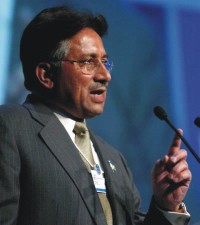
Musharraf digs in
Husain Haqqani
Recent events indicate that General Pervez Musharraf has no intention of becoming the first ruler in the history of Pakistan to relinquish power, without first trying to hold on to it by all means, fair or foul. Instead of allowing politics to take its course, Musharraf is once again insisting on his indispensability. It appears that he hopes to do so with threats of violence ignited with the help of allies in Karachi, some of whom have now taken to shouting the slogan "Pakistan without Musharraf is unacceptable." By most accounts, backed up by video footage, the violence in Karachi was initiated by the pro-government Muttahida Qaumi Movement (MQM), which claimed that it "controls" Pakistan's financial capital and the largest city. The MQM said it would not allow the opposition to hold a rally in support of Chief Justice Iftikhar Muhammad Chaudhry, a blatantly anti-democratic stance. Even if, as the MQM asserts, the majority of the people of Karachi are not with the opposition parties, surely they have the democratic right to march in the streets peacefully and voice their opinions. General Musharraf's refusal to go with the flow of politics was also reflected in the government-sponsored lackluster rally organised for him in Islamabad. Speaking from behind a bulletproof glass wall, Musharraf repeated his call that the chief justice issue should not be politicised. Musharraf repeated his assertion that Pakistan had progressed economically under his rule. He then claimed he had the support of the people and insisted that he would be elected for a second term as president. Considering that he was not elected under the constitution for a first term, and given his refusal to take off his uniform and contest a free and fair election on a level playing field with the opposition, both claims rang hollow. The arbitrary dismissal of the chief justice by a president in a general's uniform is clearly a political issue. The reason Musharraf and his allies are unwilling to see it as such lies in the deep-rooted antipathy towards politics cultivated by Pakistan's ruling oligarchy. The generals, technocrats, senior civil servants, international bankers and global businessmen, who virtually controlled the fate of Pakistan under long periods of military rule, have also worked hard to de-politicise discourse about governance in Pakistan. Occasional outbreaks of violence, often orchestrated by groups nurtured by Pakistan's ubiquitous security services, are meant to prove that politics is "dirty," and that only non-political leaders such as a coup-making general have the country's best interest at heart. Before the military's direct intervention in government under Field Marshal Ayub Khan, in 1958, Pakistan's politics were, by and large, non-violent. Patronage, protest and policy differences were all factors in the political process, as they are in any non-authoritarian system. But Ayub Khan began a process of demonising politics and politicians that continues to this day. Pakistan's military men (as an institution) and their assorted supporters have almost never accepted the value of the political process. They seem to have embraced the view of the country as a corporation. In this view, military rulers are measured by their ability to improve GDP growth rates and civilians are condemned for lower productivity or corruption. In Pakistan's chequered history, rulers have insisted on applying the accountant's criteria to measure national leadership. This has proven to be a major stumbling block to understanding the dynamics of politics and history that shape nations. A careful study of Pakistan's history would reveal that methods such as muzzling the press, arresting and harassing political opponents, using government machinery to frame, intimidate and humiliate opponents were widely practiced (and many even originated) under Ayub Khan, without much complaining from the military-bureaucrat-technocrat class. Ayub Khan's governor, the Nawab of Kalabagh, did not hesitate to threaten the president's opponents, and used Intelligence Bureau (IB) personnel to plot assassinations and blackmail. The institutional role of the army, and the permanent state structure, in undermining normal democratic politics in Pakistan is only now being fully debated. Pakistan's greatest problems are its institutional imbalance, the pattern of military intervention and the recurrent political problems. The refusal of the Pakistani elite to accept the principle of elected civilian leadership keeps drawing the country into crisis after crisis. It is time for Pakistan's military officers, professionals and business classes to withdraw support from the past pattern of military rule and accept the principle of institutionalised political process. Mobilising street thugs to combat a people's movement for democracy may be part of Pakistan's unfortunate history, but it does not augur well for the country's future. Husain Haqqani is Director of Boston University's Center for International Relations, and Co-Chair of the Islam and Democracy Project at Hudson Institute, Washington D.C. He is author of the book 'Pakistan between Mosque and Military'.
|