Complexity over so-called student politics
Khandakar Qudrat-I Elahi
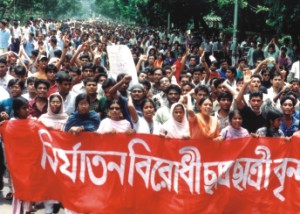
Our debate over student politics, was originated by former President Shahabuddin Ahmed during 1997 and revived recently, for a permanent resolution, by the current interim government. The UGC, in its 20-year plan, has recommended banning of politics by students' and teachers' organisations. Then, at the request of the law adviser Barrister Mainul Hosein, the EC raised the issue in its meeting with the members of civil societies on April 26. These suggestions have elicited sharp reactions from leaders of both, the students (current as well as former) and the teachers. Even the celebrated members of our civil society could not provide any constructive suggestions to the EC on this burning issue. Finally, on April 29, Barrister Mainul Hosein outlined government's plan to reform our political system by severing the link between political parties and student and other professional associations. In this regard, the law ministry has sent a note to the Election Commission to incorporate four points in the Representation of People Order (RPO): (i) political parties will not be allowed to form students wings in any educational institution, (ii) they will not be allowed to form teachers wings in any public educational institutions or private educational institutions receiving public funds, (iii) they will not be allowed to organise party forums in any public or private financial, commercial and industrial institutions and (iv) in case any political party violates these restrictions its registration will be cancelled. Apparently, this so-called student politics is most controversial and confusing. To make some fresh inputs, this writeup will examine two aspects of the debate. First, it is important to examine the meaning, or perceptions, of so-called student politics to unearth the nature of controversy. Second, a criterion or principle needs to be developed to analyze the problem. The term "student politics" has entered into ordinary vocabulary. This does not mean that everyone uses the term in the same sense when engaged in argumentation. For the sake of simplifying the analysis, we may divide student politics into two periods. The first refers to the Pakistan period, or the pre-liberation period. The second is obviously the post-liberation, or current, period. The history of student politics during Pakistan period is all glorious. The student organisations provided leadership role in all national movements: 1952 language movement, 1962 anti-education policy, 1969 11-point movement and, eventually, the liberation war. However, this glorious history gradually got tainted after liberation. During this period, students' organisations became front units of different political parties, and their leaders' main job was executing the agenda of their parent political parties. These agenda included promoting their own party programmes as well as preventing the programmes of other parties. Besides, they became associated with different unsocial and criminal activities -- terrorism, illegal payments etc. Those who are in favour of banning student politics define the activities of the latter period as student politics, while those who oppose the move refer to the earlier activities of student organizations. To understand this debate we must appreciate these differing perceptions of student politics. What is really encouraging here is that the government has made its perspective abundantly clear. For example, the law adviser Barrister Mainul Hosein told journalists (DS April 30) that the government simply wants to end the political parties' current practice of opening front units in the premises of educational institutions and other private and public establishments. In other words, the government wants to free non-political associations from political parties by cutting out the current linkage. This brings us directly to the second point: what principle or criterion can we use to justify this legal action? In this regard, we can get guidelines from the UN's Universal Declaration of Human Rights. Regarding the formation of non-political or professional associations, the document says: "Everyone has the right to form and join trade unions for the protection of their interests. These unions or associations must be formed according to laws of their institutions and operate accordingly. They can also form federations with similar unions to promote their professional interests." (For details, interested readers might look at the document). This principle has been developed on the basis of the fact that a state is composed of innumerable associations, which are organised around specific institutions. Three points are worth noting here. First, the nature of institution defines the nature of association. For example, three kinds of associations can be formed in an educational institution -- student, teacher and employee. On the other hand, government is a political institution. Therefore, an organisation which is concerned with its activities, must be of political nature, i.e., a political party. Second, the activities of an association are limited by the scope of the institution around which it is organised. Thus, the teacher or the student association of one university cannot interfere or get involved with the activities of another university. On the other hand, the scope of a political party is the entire country. They cannot open their office on the premises of any institution. Finally, the main objective of an association is to protect and promote the interests of its members within these institutions. For example, the main purpose of a students' association is to promote the interests of students; while the main purpose of a teachers' association is to look after the interests of teachers. In the same way, it can be said that the main purpose of a political party is to get its members elected, and to control government. In examining the connectivity between the two types of organisations, the point to be looked at is whether this connection conforms to, or is in conflict with, their objectives. If the connection conforms with the objectives of the colluding parties, then this relationship must be supported because it is socially desirable. In case the objectives are in conflict, this connection must be prohibited through legal procedure. The Election Commission has already adopted this principle in proposing the electoral reforms. If the EC applies the principle here, it will find the desired answer. And since this is a general principle, it can be applied to examine the relationship between all kinds of organisations, including political and non-political associations. Finally, some people, particularly some teacher leaders of Dhaka University, have castigated the law adviser and the EC for initiating this important reform agenda. However, because organising elections is the constitutional responsibility of the EC, it also has the responsibility for determining the code of conduct of our political parties. In other words, the EC is the right government institution to frame this law. Khandakar Qudrat-I Elahi lives in Guelph, Canada. He used to teach at Bangladesh Agricultural University and BRAC University.
|
|

