TechFocus
Open source lets you excel in creativity
Edward Apurba Singha
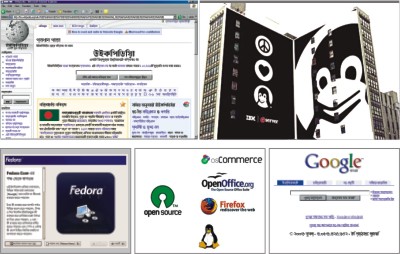
Suppose you are running a business, having thousands of employees and several branches in different locations. As an entrepreneur you have implemented information technology (IT) in your business to coordinate entire operations and ensure better performance. After a certain period of time, when you are planning to expand activities you discover the necessity to upgrade your company's software. So you contact your foreign vendor and they ask an exorbitant amount of money for adding extra feature. This cost is a huge burden on your current expenditure. But you have got no other option but to give in to the foreign vendor. This is called vendor lock-in. It is a common phenomenon small and large businesses often confront. This happens because we generally use closed source software. These types of software do not give you the power to unilaterally modify or upgrade their functionalities. So some particular vendors are your ultimate destination. But the scenario is totally different when it is about open source software. As the name implies, open source software gives you the freedom to exhibit your imagination. Not only this, you can minimise your cost and at the same time can reduce dependency on others. Open source software, however, always means not free software. Under a licence a user can use it for private or commercial ends. In each case, the user has the right to control everything. The concept of open source gained popularity with the development of the internet. Nowadays many open source software are available on the internet for free download. The term came into the limelight when Netscape licensed and released their code as open source under the name of Mozilla. Researchers at Advanced Research Projects Agency Network (ARPANET) used a process called Request for Comments (RFC), which resembles open source standards. It is used to develop telecommunications protocols. However, IBM in the 1950s distributed operating systems in source format to a user group to facilitate the exchange of source code. Nowadays the concept of open source is not limited to software solutions. It has become universal and encompasses many interesting ideas such as open source government, open market, open document, open source movie production, open-IPTV etc. Open source unveils a new horizon in Bangladesh. It is not possible for all in this developing country to buy legal software at high price. This is why the local market is flourished with pirated software. This practice totally violates Intellectual Property Rights (IPR) and at the same time compels people to purchase below standard products. Embracing open source software will bring in some strategic benefits, including developing local capacity/industry, reducing imports/conserving foreign exchange, enhancing national security, reducing copyright infringements, enabling localisation etc. Open source software began its aggressive journey on the internet. Some open source software applications are Linux Kernel-operating system kernel based on Unix, Eclipse-software framework for 'rich-client application', Apache-HTTP web server, Tomcat web server-web container, Blender-3D graphics application, Moodle-course management system, Mozilla Firefox-web browser, Mozilla Thunderbird-email client, OpenOffice.org-office suite, Open Solaris-Unix Operating System from Sun Microsystems and Mediawiki-wiki server software, the software that runs Wikipedia etc. The price of open source software is not as high as that of proprietary software. So people can easily buy it and customise it to their needs. But in practice, many people in our country are not familiar with this concept. Moreover, simple user-friendly interface of proprietary software enthrals people more rather than the command mode approach of open source software does. So dissemination of information on open source is a necessity now to bring in widespread implementation of open source in the country. Several organisations are already working on this technology and have come up with many innovative solutions. Bangladesh Open Source Network (BdOSN) is such an organisation which was born out of a vision to create a unique platform for open source developers. BdOSN is a non-profit, voluntary initiative of Bangladesh Fundamental Research Institute (BdFRI). It was launched on 24th October 2005 in Dhaka. The initial idea of it is to create a broad organisation where the Open Source and Open Content volunteers and professionals can exchange their ideas and embark on new initiatives. One of the most successful open source projects of BdOSN is Bangla wikipedia. Bangla wikipedia is still at its nascent stage and continuous effort is on to enrich its contents. Though the number of entries in Bangla wikipedia is already over 9000, most of these are stubs (i.e. incomplete articles). According to BdOSN, very soon Bangla wikipedia will be a complete knowledge source in Bangla language. Another organisation, Ankur, is also doing some promising taks to promote open source in the country. Ankur Group has already started work on Bangla OpenOffice.org. They have already achieved significant progress and OpenOffice.org 2.0 is already visible with most of the menu entries being translated in Bangla. Future versions of OpenOffice.org will have more and more modules in Bangla. Other projects of Ankur include Mandrake/Mandriva Linux Bangla Translation Project, Redhat/Fedora Linux Bangla Translation Project, SUSE Linux Bangla Translation Project and Bangla Google. All the above-mentioned tasks clearly indicate the recent surge in open source awareness in Bangladesh. If this trend goes on it will definitely have unprecedented impact on the socio-economic arena of Bangladesh.
|