TechNews
Researchers store data in bacteria DNA
Ap, Fujisawa
These days, data get stored on disks, computer chips, hard drives and good old-fashioned paper. Scientists in Japan see something far smaller but more durable bacteria.The four characters that represent the genetic coding in DNA work much like digital data. Character combinations can stand for specific letters and symbols so codes in genomes can be translated, or read, to produce music, text, video and other content. While ink may fade and computers may crash, bacterial information lasts as long as a species stays alive possibly a mind-boggling million years according to Professor Masaru Tomita, who heads the team of researchers at Keio University. Tomita's team successfully inserted into a common bacterium Albert Einstein's famous 'E equals MC squared' equation and '1905,' the year the Nobel Prize-winning physicist published the special theory of relativity. Genetic coding is so massive that information say, a Shakespeare play can be stashed away somewhere in the gene without affecting an organism's overall appearance and other traits. But mutation could distort stored data. Tomita says data are stored in four places in the bacteria so the data stay intact, though Katsumi Doi, bacteria expert and Kyushu University professor, is skeptical. "We may need more time for practical applications," Doi said. "But I love the idea." Translating the Einstein message would require solving the code. But Tomita is the kind of freethinking scientist intrigued by the notion that an extraterrestrial might come across it in the distant future and naturally possess the superior intelligence to quickly solve the code. Tomita shrugs off the obvious question: "Who in the world is going to read bacteria?" "Many people never even thought about storing data for thousands of years," Tomita said. "This may sound like a dream. But we're thinking hundreds of millions of years."
|
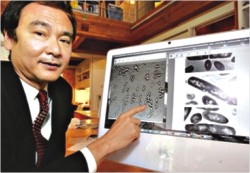
Keio University Professor Masaru Tomita, speaks about his study to use bacteria as a data storage medium, while showing images of parent bacteria his team used for the research at his laboratory |

