Afsan Chowdhury's four-volume history of 1971
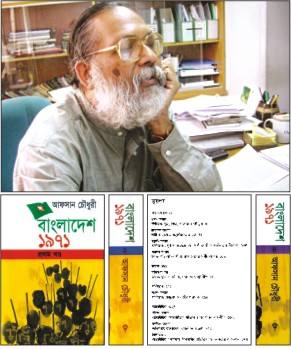
Seeing Afsan Chowdhury invariably reminds me of our student days at Dhaka University in the early '70s. All of us 'batchmates' in different departments were habitués of Pedro's, a thatched tea-shack that used to squat where today the modern languages institute sits. It was actually owned by Sharif Miah, but we called it Pedro's in honor of its urchin-boy waiter. Pedro's was our real classroom. It was there that we escaped from lectures for the watery tea, adda, debates and arguments, sitting in a long line by a tree-shaded low wall running alongside. Afsan of course was a regular there, noticeable not just for his beard and height, but for his laugh, which was frequent and--if somebody had yanked loose Pedro's lungi and exposed his bare butt--very long. Those kinds of things amused him vastly. They still do. But he was also somebody willing to get into a serious exchange, any time. Back then, not having met many who were, I remember being impressed by his bi-linguality, of being at home in both Bengali and English. Given that he could draw on these twin sources, and not just in terms of books and authors, but also with regard to friendships and associations, he tended to be the most informed amongst us on certain things. Huge addas, especially on left politics, were also held at all hours of the day in the drawing room of his house at Magh Bazar, but which I didn't attend since I was more a working class Pedro's line man, not a drawing room kind of guy. Memories of 1971 were still fresh then, and all of us certainly thought and talked about it far more than we do now, but Afsan's thoughts and talk about it, I remember, were qualitatively different than ours. He certainly brooded on it far more. Today, having re-connected with him after a very long gap, I am equally impressed by the fact that he has remained true to that brooding, the fruit of which so many decades later is a four-volume history of our year of grief and liberation. And if they only knew about it, I am sure equally impressed would be Pedro and Sharif Miah, who represent the common man (inclusive of woman here) on whose behalf this history-writing effort was conceived and undertaken. Below is printed Farhad Ahmed's talk with Afsan Chowdhury about his project and 1971. ---The Literary EditorFarhad Ahmed: You recently published your 4-volume Bangladesh 1971, a labour of some twenty years even if the actual work began in 2002. Why did you feel the need for such a prodigious effort? Afsan Chowdhury: Work on this book probably began in 1978 when I joined the Bangladesh War of Independence Documents Project. So it's a fairly long journey, nearly three decades long. The first part was formal, i.e., Dolilpatra project work; the second phase was media work relating to 1971 for the BBC and other independent media outlets; then came the part dealing with the book. We worked for five years to complete the book, the 4-volume, project. It was a sense of obligation that motivated this work. I was very disconcerted to see the domination of politics in narrating the 1971 history. I did feel that, as someone who could think independently without occupying a political space, I should do something. The subject of 1971 was also being approached by all as a 'sacred' topic and not intellectually explored. It was more religious than intellectual and as it often happens nationalism had taken on religious garbs. History is one of memories, private, individual and collective. I could see the loss of memory custodians. Because I was doing a lot of work for the BBC Bangla service I was keenly aware of the loss of history sources. So I felt I had two obligations. An obligation to produce a work that was free of politics. And an obligation to produce a history that explored a society and their citizens beyond that of the civil and military leaders. Our work is hardly complete, but it's also the first comprehensive book of the history of 1971 spread over 25 chapters and 3000 pages long. That has been done , flaws notwithstanding. FA: How did you go about researching it? Was there some great research framework, or did it evolve as you went about your project? AC: I did have some familiarity after working for nearly 25 years on the topic and the main work was to ensure that what we were getting was accurate. Memories can be both the truth provider and deceiver, so we spent month, even years, in verifying know that what we had was as close to facts as possible. People at the bottom end of a social level tell the truth more because memory has no purpose to them other than to recall, while to the privileged memory is a tool to gain space and advantages. So we recognized the limitations of both and worked accordingly. To us, the ideological implications of the sources were also very clear. The underclass remember in private while the upper class write records and publishes. We trod carefully between the various sources and their limitations. Because we had no ideological or nationalistic axe to grind we were free to just say what happened. FA: How did you finance it? It is after all a personal effort. AC: Raising funds was very difficult but very necessary to ensure independence. Our work lasted over 5 years and we raised over 7 lakhs. This is a small sum of money but a lot for us. We once calculated the cost of our venture as per government rates and found it would have cost a minimum of 5 crores. A big chunk came from selling a precious heirloom. Everyone involved in the project worked at different assignments and deposited the fees earned. We got some donations but in the end we just took from our pockets and spent it till we ran out of funds. But the project was possible because a bunch of mostly young people worked selflessly simply because they wanted to be involved with such a project. It's they who made it possible. We took no institutional or corporate donations. FA: We know that you worked on Bangladesh's official history of the liberation war. What are the principal ways in which your work is different? AC: We do believe that no official history of 1971 can be written. This is because our official and state culture does not have any objective space. I worked in the Dolilpatra project under Hasan Hafizur Rahman, a Ministry of Information venture which had a two-volume history writing plan. In the end, the idea for writing such a history was dropped for the very same reason I just cited. This was the project's rather than the government's decision. Bangla Academy tried doing this several times but it didn't work out and the BNP government's attempt too floundered. This is because official history writing is a political exercise, not a research one. There are many academics willing to do this but that doesn't alter the essential fact that history can be written only in an independent intellectual space, free from all controls and non-academic ambitions. Our work is about intellectuality, not patriotism. FA: You have written that our national memories about 1971 "are almost gone," that you "speak about ghosts and phantoms and not many hear that voice." Can that be true, given the fact that 'Ekattur', while being a site for political contestations, nevertheless has been firmly inscribed into the national narrative? AC: 1971 itself is a multiple narrative and we think the main problem of history writing lies in the contests between essentialism versus multiplicity. We were very enthusiastic about the social history part of 1971 in the beginning, but at the end of the journey, by our research's internal logic, it became a meditation on the relationship between state and society. A great part of our work is occupied by narratives of state-making of Pakistan and later Bangladesh and the contest between an ailing and an emerging state. Farhad Ahmed is a free-lance contributor to The Daily Star.
Azfar Aziz
Bangladesh 1971 (4-volume set) by Afsan Chowdhury; February 2007; Dhaka: Mowla Brothers; Tk 2,800. There is a maxim that a minimum distance of 40 years is required to get a dispassionate history of any epoch-making event. And the more sagacious of historians subscribe to this saying, not from any belief in the esoteric significance of the number '40' but because they know the psyche of anyone attempting to write a history of an event or period that radically changed the course of a country or a nation will still be too raw, not yet completely healed of the effects of its experiences, and too close to the subject to come up with an account devoid of personal or institutional bias, whether emotional or ideological. Afsan Chowdhury informs us about some overstatements in the Liberation War Documents of Bangladesh edited by Hasan Hafizur Rahman (Ministry of Information, Government of Bangladesh, first edition, 1978) in the chapter, 'Readers Aid,' of his 3,104-page monumental work titled Bangladesh 1971, because 1978 was too near to 1971 not to suffer from both myopia and emotional exuberance. In the Introduction to this first-ever comprehensive history of the Liberation War, he writes, “The sense of constraint of various generations about the historiography and writings on 1971 prompted this [4-year] project. We felt that in many cases fortifying political positions rather than presenting facts and accounts became the aim or purpose of the historiography…. After persistently monitoring for some decades the search for historical information and practices, we came to the conclusion that in many cases the historiography of 1971 was over-influenced by politics as well as the age-old idea of state-centric history. They tell us only about the statesmen but rarely show the faces of the masses. It appeared as incomplete history to us and it seemed through this process the status of common people in history was marginalised (translation mine).” Those are some obvious flaws in any history written or commissioned by the agents or actors involved in the historical event. Presenting a true history requires independence from involvement, stake, interest, emotion, ambition, theoretical presumptions, and proximity to the event. After 36 years, it is about time Bangladesh got such a historical account of its liberation and one is hard pressed to think of somebody else other than Afsan Chowdhury as most fit for the job. He had worked with Hasan Hafizur Rahman in compiling the 16-volume Liberation War Documents of Bangladesh, produced a 6-episode radio series titled 'Women and '71' for BBC in 2000, a 2001 documentary on the same subject titled 'Their War', and interviewed a number of Indian and Pakistani nationals in 2003 for yet another BBC radio series. The research for the present work began in 2002 and continued, as he says, until almost the very day of its printing. All that groundwork, experience and expertise are reflected in this work, which brings to the fore hitherto neglected aspects of 1971, namely the emergence of the nation through the centuries and the aspirations and attempts of various groups historically to establish a separate state for Bengalis that actually laid the foundations and forms the larger background of the Liberation War; the diverse, critical and key roles played by women during and in the struggle for independence without which our society might not have survived the assault; the unselfish yet forgotten participation and sacrifices of the ethnic minorities in the war; the various local bands of partisans that fought the Pakistani occupation forces independently, as did the Maoist communist parties; the unappreciated contribution of rural Bangladesh that nourished and sheltered freedom fighters by forming a human fort against the besieging Pakistani forces; an objective socio-economic analysis of the roles of peace committees, Razakars, and Biharis; analyses of the existence of parallel forces and their inter- and intra-relations in the Mujibnagar Government; the regular and irregular forces under and beyond its command fighting the Pakistani forces and sometimes even one another; the Indian central and state governments as well as the foreign governments; and much more. Bangladesh 1971 has seven parts comprising of 22 chapters. The first six parts are spread over the first three volumes of the work, with breaks in the parts occurring in between the volumes. Only the fourth volume coincides neatly with the seventh part. Once the reader accustoms her/himself to the book's design the reading gets easy. Given the scope of the work it seems that there was no other choice. The First part comprises of three chapters on the emergence of a nation under the rule of foreigners of diverse origin, the initiatives to establish an independent Bangladesh, and the disparity between the two wings of Pakistan and the growing popularity of Bangali nationalism. The Second part is on the political, military and diplomatic aspects of the Liberation War. It has six chapters dealing with the non-cooperation movement and first phase of resistance to Pakistani crackdown in March 1971, formation of Mujibnagar government and organising resistance, the structure and activities of Mujibnagar government, Mujibnagar mass media, pro-liberation movement of Bangladeshi expatriates, the backdrop, organisational structure and operations of liberation forces, and the roles of left political forces in Liberation War. The Third part is a significant and distinctive one, extending itself on to subject matters most other histories tend to gloss over, dealing with the social context of 1971. It has five chapters: rural society and 1971; torture: reasons, areas, extent and background; women and 1971: portraits of diverse role players; the issue of non-Bengali communities in East Pakistan; and lastly, indigenous peoples and Liberation War. The Fourth part comprises one chapter that narrates and analyses the military, political, aid and diplomatic roles of India. The sole chapter in the Fifth part, on the other hand, briefly looks into the problems Pakistan was born with in 1947 which ultimately resulted in its split in 1971. The Sixth part consists of three chapters on roles of international actors. They are the international relations and political stances of the super powers; the Bangladesh issue in the United Nations: politics of aid, and international media: reflections of the reactions and opinions of peoples across the globe. The Seventh part, as mentioned before, occupies the entire fourth volume and consists of only one chapter but it is the most live one. It is a compilation of 15 reports and 132 in-depth interviews collected over a period of about seven years. The interviews are grouped into those of Liberation War organisers, veterans and social workers, villagers, women, Indian politicians, civil and military bureaucrats, cultural activists, journalists, and two social workers, non-Bengali Pakistanis stranded in Bangladesh, Pakistani intellectuals and academics, and miscellaneous persons of various nationalities. The brief outline above does not do justice to the heroic attempt of this work to present as all-encompassing view of our war of liberation as is possible under the circumstances, and I leave it to readers to find it out for themselves. This work, with its historical focus on the experience of the common wo/man during our war of liberation, will no doubt in the days ahead become the standard against which to measure 1971 history writing by. There are some flaws in the entire set of books ( probably because of the publication haste in order to meet the Ekushey Boi Mela deadline), spelling mistakes, and different spelling of same words that indicates a need for a sort of standardization of language, as contributors to it are many, in the next edition. The reader's guide, which is common to all the four volumes, repeated a page in the copy of Volume 4 that I read. One looks forward in the future to an immaculate publication and hopes the country at last will find this to be a history where the role of the common man and woman in their country's birth is re-instated in all its human glory. The book reminds and returns us, by degrees, to the roots of our war of liberation. Azfar Aziz is a journalist and free-lance contributor to The Daily Star literature page.
|
|

