Non-Fiction
Yet Another Ghost Story
Shahid Alam
The following account is true, or, at least, it is as factual as my experience goes. The reader may take it at its face value, or may interpret it as s/he sees fit.I have frequented the Bangladesh Shilpakala Academy for a number of years. My visits would depend on my mood and available time to fritter away in the company of a few friends working at the Academy. Since they would be on duty, I would invariably time my trips to coincide with the end of office hours, meaning, during late afternoon. Fortunately for my indolent inclination, my friends would stay back till late evening, and we would all have a good time, sipping tea and munching on shingaras or jhal moori bought from shacks and lean-tos that mercifully dot the Academy vicinity, talking about seemingly everything under the sun (and the twilight) before breaking off and heading towards our next destinations. My visits began with the old circular building--much more welcoming, comfortable and idler-friendly than the new structure, the modern glass-and-concrete entity, more clinical and somehow with less of a soul, that is the present home of the Academy's Fine Arts department, my particular interest, as well as the workplace of my adda-inclined friends. And the constant constituent of that limited circle has been Simon Robert Pereira. Simon and I go back a long way, from the time we were classmates, first at St. Joseph's High School, and then at Notre Dame College. After I registered as an undergraduate at Dhaka University, and he enrolled as a student at the College of Arts and Crafts (now the Institute of Fine Arts), our contact dwindled drastically. I heard from a mutual friend that, not too long after graduation, he had flown off to the Soviet Union to pursue higher studies in filmmaking. A strange set of circumstances brought us together, after a hiatus of almost quarter of a century, at the Shilpakala Academy, and we have remained in touch since then. He has turned into an ascetic-looking individual with a suitable moustache-and-beard to match, but a quiet nature and occasional cynicism have continued to define Simon Pereira. And he has a wealth of knowledge about world cinema, especially those generally considered to be classics, but, and maybe this has been a regrettable loss to Bangladesh's inventive film industry (practically nonexistent, as it is), he has been thwarted, or has thwarted himself, from turning his knowledge and acquired skill in the USSR into tangible products, commercial or otherwise. One afternoon, just after four o'clock, I strolled into the Academy premises from the eastern entrance, fully prepared to have a couple of hours of verbal free-for-all with Simon and anyone else around. I walked to the front of the reception area, trying to decide whether to take a left turn and end up in the cavernous room that housed Simon's work station, or make a small right and continue on to the Fine Arts department director's office, where Simon would sometimes hang out after office hours. My mind was made up for me by Gomez. "Sir, they are all there in that room." I looked to my right, and Gomez was standing there, in his familiar, faded black trousers and white shirt--more accurately, off-white, due to the combined effects of long use, dirt and grime, and repeated washing. He was pointing to the director's room, and I lost no time in heading towards it. I spent about two hours there, and came out happy at the end of a terrific adda. And then, for a couple of months or so, a variety of engagements kept me away from the Academy. Inevitably, however, I homed in on it at the first available opportunity. Nothing had changed. Simon was in the cavernous room, in the company of two or three Academy officials, and did not even mention anything regarding my rather prolonged absence. Hardly had I settled down, and was in the first stages of what promised to be an animated conversation, than Simon remarked to one of the academy's personnel: "We need some tea. Can you get Razzak?" Razzak was a office staff member who would usually bring us tea and snacks. "He's gone out on an errand, Simon-da. He'll be late," came the anwer. All of us were crestfallen. And so I offered my own solution. "Why don't you ask Gomez?" Gomez, as a member of the office staff, had also done it before. They stared at me for what seemed an inordinately long time, until Simon broke the silence. "Gomez is dead." It was my turn to stare at him. "What do you mean? I saw him only the other day." "When was that?" "The last time I came here. Two, three months ago." Now they were all smiling. "You must be mistaken," said Simon. "Gomez has been dead for more than six months!" Now I was really confused. I pride myself on having a sharp and precise memory, but here I was, based on the information just given, trying to figure out if I had not really miscalculated, and that my last visit here had really been more than six months back. But, no, my memory had not failed me! That last time had been two or three months back. "Look, don't joke. If you are, it's a real bad one. You don't joke about someone's death." "But I'm not joking. Ask them." And the others, with dead serious faces, attested to Simon's statement. "You must have seen someone else and thought him to be Gomez," offered my old schoolmate. "Look, I know Gomez. I know what he looks like. I know his voice, dammit! He was wearing his black trousers and white shirt. I could not possibly mistake him for someone else. Until you told me right now, I did not even know he was dead. And I've been here at least a couple of times since he died." "Yes, but he never came up for discussion during those times." Right, he had been merely a lowly menial employee, noticed only when we needed him to get us something. But I could see Gomez in my mind as if he was standing there right in front of me. A slightly-built man, dark-skinned, with thinning, jet-black hair broken only now and then by slight wisps of gray, parted on one side; his most striking feature was a sardonic grin that displayed uneven yellowish teeth. And he seemed to be perpetually clad in that off-white shirt and loosely-fitting, discoloured black trousers, his feet in a pair of decrepit black sandals, worn with age and encased in dirt. Whenever he spoke, which was not very often in front of the Academy officers, he would be pithy, businesslike, and would use the Bangla dialect of his ancestral district. Outside of my brief encounters with him, Gomez did not register in my mind. And now he was dead. He used to sleep in a small space inside the Fine Arts building premises, and one morning some of the other employees found him lying dead. Those were the bare bones of the story I got from Simon and the others. There you have my experience. I consider myself to be level-headed, and not given easily to nerves. But there was no question of nerves in my encounter with Gomez, or, as it turned out, his manifestation, if only because I had no idea that he was no longer in this physical world. And I saw Gomez, as plainly as I had seen him so many times before. And I had heard his voice, as clearly and recognizably as I had heard before on a number of occasions. I would like to think that my encounter has exorcised the place of any supernatural presence, and that Gomez is resting in peace, since I, or, for that matter, anyone else connected with the Shilpakala Academy have not come across Gomez's manifestation since that one time, one afternoon, at the Academy premises. The author is a writer and teacher at Independent University, Bangladesh in Dhaka.
|
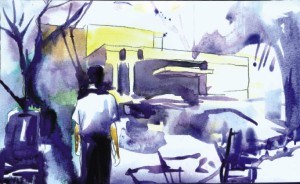
artwork by apurba |

