US loses credibility
Mahmood Elahi, Ottawa, Canada
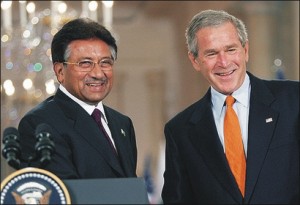
Re "Silence is better," by Husain Haqqani (May 23).After the botched-up US invasion of Iraq to dismantle its non-existent weapons of mass destruction, US President George W. Bush made bringing democracy in Iraq his new goal. But he failed to realise that democracy cannot be imposed by high-altitude bombers and laser-guided weapons and that the marines are ill-equipped for any democratising mission. Democracy is a participatory system of government which must grow from within through a long-period of trial and error. In fact, by invading Iraq on a flimsy pretext, the United States might have done great harm to any transformation of Iraq. As for Bush's contention that post-war Germany and Japan are examples of successful American military intervention as a prelude to democracy, it must be pointed out that Germany was a democracy before the war and Hitler was himself elected by the German people. In fact, Hitler is an example that a democratically elected leader is no guarantee to his turning against democracy when it suits him. Japan was also undergoing democratic transformation since the Meji Revolution in the 19th century before ultra-nationalists general took control in the name of the emperor. In any case, the United States went to war against Japan in response to its attack on Pearl Harbour, and not to bring democracy. By justifying a failed military intervention as a democratising mission, the United States might have done great harm to democracy. The American invasion has only exacerbated Iraq's Shia-Sunni cleavage and now a sectarian civil war is raging there. Once-dominant Sunni minority see the election as the only a means to impose the Shiite majority rule and the Shiite majority are now determined to dominate in the name of democracy. The Shiites seem to have forgotten that democracy is not a tyranny of the majority, but a participatory from of government in which minority rights must be protected. Surge in American troops has only led to a surge in sectarian violence which the American forces have failed to stem. It should be clear to all, that the United States has lost its credibility as a force for democracy. America is increasingly going back to the Cold War days when the so-called real politic -- supporting friendly dictators -- was the corner stone of the American foreign policy. Prof. Husain Haqqani writes: "Ambassador Boucher's characterization of Pakistan under General Pervez Musharraf is even worse. To say that the "Pakistani government is moving forward" so soon after the government-orchestrated massacre of opposition supporters in Karachi is nothing short of an insult to Pakistanis marching in the streets of the country's cities for rule of law and restoration of democracy." But he may be reminded that America also supported Gen. Augusto Pinochet, a brutal dictator, because he overthrew the elected Marxist President Allende of Chile. A capitalist dictator was far more preferable to an elected communist! As long as Gen. Musharraf can convince the Americans that he is fighting al-Qaeda, he will enjoy the American support in the same way Gen. Pinochet enjoyed massive American aid because he convinced the Americans that he was fighting the communists. With al-Qaeda replacing the Marxists as America's main enemy, support to autocrats will be justified in the name of fighting the new enemy. America is now engaged in a hot war against al-Qaeda and it will justify its present support for the autocratic regimes in the Middle East and the world as long as they remain loyal. Bringing democracy is only a propaganda tool in this new war against terror. Pakistan will have to find its own way to achieve even nominal democracy.
|