DCC Dayaganj Building Collapse
Telltale accounts of negligence, defiance and corruption
Tawfique Ali
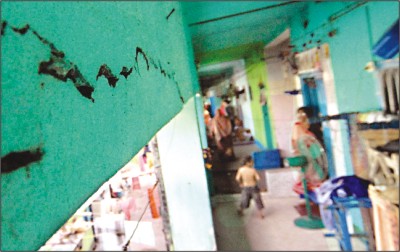
Use of substandard construction materials and negligence in treating the foundation soil might have caused the structural failure of the newly built six-storey building on Friday night in Dayaganj sweeper colony in Sutrapur, said civil engineers and geo-technologists. Dhaka City Corporation (DCC) sweepers for whom the building was built alleged that the authorities undermined the lower level employees like them in developing the house that collapsed days after completion. "The incident clearly suggests authorities' negligent attitude to us as a community of lower social echelon," said an elderly woman living in a tin-shed in the colony. The building collapsed only a week before it was supposed to be open for 60 families of the sweeper colony. Top engineers held DCC responsible for the incident, as DCC never obtains Rajuk approval for the plan of any of its buildings. This is a structural failure apparently because of poor quality of building materials, said a top civil engineer of Bangladesh University of Engineering and Technology (Buet). The incident is similar to that happened to Spectrum building in Savar, he said. There are two reasons behind such failure, said a top engineer of the public works ministry. One is that the foundation soil was originally a ditch or a waste dumping ground and it was not treated adequately before construction. Usually, incineration is applied to settle organic soil layer by layer over time. Any soil must be tested properly before construction to determine its load bearing capacity. "But in this case, it appears, authorities ignored such measures and soil treatment remained inadequate, as the building was meant for a sweeper colony," he said. Use of substandard building materials might also be the reason behind the incident. "Three elements -- proper design, quality materials and consistent supervision -- are crucial for construction of a building," said the engineer. Structural weakness and geo-technical fault are on the list of probable reasons behind failure of the building, said Prof Sekender Ali, head of civil engineering department of Buet and leader of an expert team assigned to find out the reasons for the collapse. "We have to detect exactly what triggered the failure," he said. It might be geo-technical fault of inadequate piling or structural fault or substandard construction materials. Prof Ali said that the five-member team, comprising two professors of Buet, one engineer from army, one from Public Works Department and chief conservancy officer of DCC, would look into what was the condition of foundation soil and whether the piling was adequate in keeping with the soil condition. A detailed and comprehensive examination of building materials used in the building and soil test would be carried out at Buet. According to a source, it was most probably organic soil on which the building was built. DCC engineers and the construction contractor carried out 40 feet deep piling for the construction, said the source. But now it has to be re-examined whether it was adequate for that particular foundation soil to bear the load of the building. There are several reasons that might have triggered the failure, said Prof Md Zoynul Abedin, a geo-technologist of Buet and member of the expert committee. "Basically, soil settlement and poor quality construction materials are two factors that may have caused the collapse," he said. "A building may lose structural stability due to poor condition of foundation soil or substandard materials." All the columns in the ground floor have broken down very strangely almost in a symmetrical manner. The expert team will carry out laboratory tests of soil, iron rod and concrete at Buet to determine what exactly triggered the failure. Experts said that geo-technical test (soil test) carried out randomly here and there is not reliable. Negligence to such vital tests, to save a little amount of money, may result in catastrophic consequence. Building owners and other concerned have a tendency to get soil test carried out at a cheaper rate. Technical tests done in this manner are usually inaccurate and unreliable. One can get a soil test done at a cost of around Tk 2,500 to 3,000 per boring in the market. But it costs Tk 30,000 if carried out at Buet. Generally, a construction site may require tests of three to four borings involving around Tk 1 lakh if done at Buet, and only Tk 10,000 if done elsewhere. Mayor of DCC Sadeque Hossain Khoka said the contactor did not do piling properly and the engineers responsible for the work did not monitor the construction. "No we have to know the lapses through investigation of the expert team and then take action," he said. "I hope to remove the collapsed building and begin construction of a new one within a month or two." Meanwhile, the DCC suspended three of its engineers following the incident. They are executive engineer Mezbahul Karim, assistant engineer Mojibur Rahman and deputy assistant engineer Nirmal Chandra Dey. Payment of the contractor Atiqullah Khoka of Atiq Construction Limited has been held up and the firm would blacklisted, the mayor said. Chairman of Rajuk KAM Haroon said though any person or organisation has to obtain approval of building plan from Rajuk within its jurisdiction, according to building rules of Rajuk, it has become a tradition not to obtain approval. It is a public knowledge that the government agencies have not complied with the rules so far, he said. The city mayor said in response that there is no need for DCC to obtain approval of building design from Rajuk because it is not in practice. Meanwhile, the existing old five-storey building of the colony has developed multiple cracks due to 'forced vibration' caused by the collapsed building. Shabita, whose tin-shed house is within three to four yards of the collapsed building, narrated the Friday night incident. It was around 10:15 pm. Electricity went off. It was very dark all around. Within a few minutes, we heard a frightening big bang. Soon we discovered the newly built building had broke down." Panicked residents of the sweepers squatters raised a hue and cry and started running to and fro with a storm of dust and darkness all around. Dulari, one of the sixty families who were supposed to occupy the building on June 3, said, "I cannot even imagine what would have happened had it collapsed after we occupied the building." The new building is divided into two blocks with 30 rooms at each of them for 60 sweeper families. The north block collapsed. The south block of the building is of same design, materials and on same soil. Swapan Das, another resident of the colony said that the contractor has not yet visited the site ever since the incident occurred. Construction began in May last year.
|