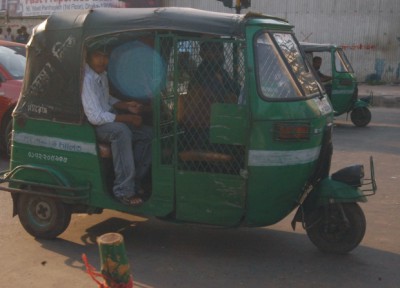
Taxicabs, CNG three-wheelers always defiant
Rizanuzzaman Laskar
Authorities' efforts to streamline the public transportation system in Dhaka have done a little to ease public sufferings as drivers of taxi and CNG-run three-wheelers continue to defy rules, charge outrageous fare and refuse to take trip as per passengers' request.Although the government recently introduced new structures of fare and drivers' daily payment to the owners, there are no rules to oblige the drivers to follow them. "As there are no specific laws on the violation of the rules of meter use in CNG-run vehicles, we have to penalise the offenders by applying existing general traffic regulations," said Jashim Uddin, joint commissioner of traffic department. With rickshaws, city commuters' favourite mode of transport, banned on several important thoroughfares of the city, commuters are left helpless and have little choice but to virtually beg the taxi drivers for taking them to destinations. Nurul Islam, a student of Independent University and a resident of Dhanmondi road-6, was getting late for his exam and was desperately looking for transportation to his university on Wednesday. After requesting more than a dozen autorickshaw drivers to take him to his university at Uttara, one CNG autorickshaw driver finally agreed to take him for a fare of whooping Tk 180, three times the regular fare. An infuriated Islam approached the nearby police sergeant who ignored him saying that he would look into the matter later. "I had a midterm exam that morning and I virtually begged to them (CNG drivers) to take me in," said Rashid. "The meters are meaningless and even if the drivers ask for the extra fare nobody is bothered by that and just complies with it," he added. Like Nurul Islam, thousands of commuters face the problem every day. Given the dimensions of the transpiration problem, travelling within the city is nothing sort of a nightmare for the thousands of helpless commuters, which is getting worse by the day. CNG-run vehicles carry the telephone numbers of the police control room on their back for the convenience of the passengers to report complaints, but commuters alleged that complaints comes to little use and is more of a nuisance. "Filing complaints is more of a wastage of time as nobody seems to do anything. It seems more logical to just comply with the increased fare," said a commuter. However, officials at Dhaka Metropolitan Police (DMP) control room told this correspondent that that they receive around 10 to 15 complaints each day and take appropriate actions. "We inform the nearest on-duty sergeant to deal with the reported matter and take action," said Jamaluddin at the DMP control room. "Usually it takes quite a bit of time for the on-duty sergeant to locate the spot, and may lose the complainant or the accused driver. Therefore, it may not be possible to take actions against the rules violators all the time," he added. Mohammad Selim, an on duty traffic sergeant at Sonargaon intersection told this correspondent that they have to penalise the offenders by using section 159 of the traffic act that is applicable to all kinds of general traffic offences. "Under this law the offenders are usually charged with a fine of Tk 50 to 500 for violation of traffic rules. Some vital cases require bail from the traffic courts in exchange of a fine of around Tk 1,000 to Tk 1,500," said Sergeant Selim. "It would have been valuable if we had individual laws tailored just for the CNG fare related issues, then we could ensure public convenience more effectively by giving a bold message to the offenders," he added. While the city dwellers continue to suffer, the CNG-run vehicles drivers and owners blame each other for the exorbitant fares. General excuses used by the drivers to defend their errant behaviour include high amount of daily deposits they pay to the vehicle owners and price hike of essentials, while the owners said the maintenance costs of the vehicles are very high. Several CNG-run autorickshaw drivers said they are being compelled to pay an amount of Tk 550 to Tk 600 as daily deposit to the owners even though the government fixed the new ceiling at Tk 450, raising it from Tk 300. Citing an example, some drivers alleged that a section of owners maintain two daily ledgers --one showing Tk 450 as daily deposit from each driver while the other reads Tk 100 under miscellaneous heads. "They (owners) threatened us not to disclose the actual amount of daily deposit we pay, otherwise they would not let us drive the vehicles," said Mamun, a taxicab driver. Nazmul Hasan, owner of 10 CNG three-wheelers from Uttara said, "Maintenance cost of the vehicles has increased tremendously and we do have to make profit after bearing all the expenses. Therefore it's not possible to reduce the daily deposit." According to Jashim Uddin, DMP joint commissioner (traffic), although traffic officials are doing their best to ease the commuters' sufferings, the fact that powerful associations of drivers and owners of the public transport vehicles tend to override the normal enforcement of laws makes it immensely difficult. "As it is not possible for the police alone to improve the entire system, the owners' associations should come forward and offer some assistance to the traffic department to ease public sufferings," he added.
|