Much ado about voter list
Mustafizur Rahman
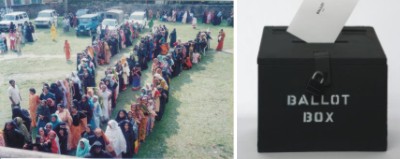
The Constitution gives the Election Commission the mandate to prepare an authentic and verifiable voter list, without any exclusions, for each constituency. As the election commissioners also point out, preparation of national ID is not in their mandate or jurisdiction. In fact, a project for preparing national ID was taken up by the Ministry of Home, but did not materialize.To avoid occurence of proxy votes, absentee votes by pre-registered fake voters and multiple-registered voters, the idea of a voter list with photographs has now been well accepted. To pre-empt ballot box stuffing, the idea of transparent ballot boxes is being explored. To eliminate chances of declaration of wrong or fabricated results, the declaration of results at every voting center is going to be adopted. To avoid intimidation of voters, the election code of conduct is being reviewed, and a method for protection of voters is being devised. The Representation of People Order (RPO) 1972 is being amended to effectively curb indiscipline in, and disruption of, the election. The Election Commission also has the mandate for delimitation of constituencies so that all votes carry acceptably uniform weight in each constituency. Election is not a new exercise for Bangladesh, and people know very well its importance and purpose. The problem has been the betrayal of public trust by the people entrusted with the election process. A voter list with photographs just adds one item of biometrics. A digital camera makes it a very simple exercise. Even when the digital camera was not available, and the personal computer was not in general use, correct voter lists and national IDs had been prepared manually in many countries, especially where the local government system prevailed, family registration system was practiced, and individual citizen registration was in vogue. If we speak of a nation, every national must be identifiable by a unique citizen number. The issue seems to be big just because we are going to start a system for the first time without properly set institutions. We shall have to do it, and we shall have to set effective institutions in place. The question of preparing voter list by visiting door to door, or asking the eligible voters to go to camps for photographs, is coming up again. We have paras, village, union, upazilas, zilas, wards, municipalities, towns, and city corporations which people belong to. Union parishad, upazila parishad and zila parishad have elected local public representatives. If the local government system is made strictly non-party based, they can guarantee authenticity of documents related to any citizen or voter. Most city dwellers have their origin or link in the rural areas, though it may gradually change over coming decades. A record of the permanent and present addresses of all citizens must be maintained. One way is to register all voters at their permanent addresses, and transfer the registration to the present address at the written request of the person concerned. The registration system may require that any change of residence must be reported to the local office concerned, so that official documents are transferred internally as a matter of routine. The citizen registration may be recorded at the union or upazila level. All members of a family living in Bangladesh or abroad (as Bangladeshi citizens) should be registered with permissible and required information, including photographs, without causing infringement on privacy protected by the Constitution or any law. No information shall be recorded without the knowledge of the person concerned. The law, as in most countries, may regulate the protection of private information. All births and deaths must be registered within, say, 30 to 90 days. This record is not with the Election Commission. The Election Commission shall ask the local government authorities, through the competent ministry, to furnish the list with photographs or other permissible biometrics of those above eighteen years of age, as of a certain date, to prepare the voter list. The Election Commission shall prepare a voter list for any national or local election, check its authenticity for each constituency and correct the discrepancies, if any, with intimation to the local government office concerned. Based on local governments' citizen registration record, plastic or other smart or IC multi-functional cards may be issued. A copy of the relevant part of the voter list with photograph, which may serve as voter ID for the time being, may be sent by EC to each voter by post or other means. This should be an important part of the EC's entrusted service. The EC seems to be inclined to think that it is authorized to command the citizens to go here and there for photograph or registration. It suggests a fine or imprisonment for discouraging a voter from registering. A qualified citizen may be too old to move, or may not feel like taking the trouble. Some ladies may not like to be photographed, or cannot go out for such a purpose. The EC is basically a service institution, and it must first be oriented toward providing service to the free citizens of a free nation. Once the system of citizen registration is functional in five to ten years, it will become regular work for the local governments to maintain records for providing various services to the citizens, such as old age pension, health insurance, child healthcare, schooling, training, employment orientation, education and re-education service, etc. As the system is not yet in place, the services of the armed forces and volunteers may be necessary to get the system operational in a year or two, though it may take decades for it to mature. This time the process may need new equipment and extra manpower, but future voter list preparation will not involve any significant cost. The major cost is borne by the local government, and it must given sufficient funds and logistics in the initial period. Many may rightly think that the local government institutions we have may not be able to deliver the result. A non-party local government system must be established in this opportune period. For a healthy political system, people must have a wide choice to elect their representatives from. Lack of money should not prevent any capable person willing to serve the people and the state if the election campaign process is rational and election campaign costs can be brought down to the equivalent of, say, ten month's remuneration. The state may reimburse the election cost of upto, say, Taka three lac per constituency, in proportion to votes earned by the contesting candidates. This payment may continue every year until the end of the term of the parliament. It is difficult to think of political activities without political parties, which, however, must be registered juridical entities with their own democratic constitutions, and registered with the EC for election purposes. They must account for their earnings and expenses, under certain restrictions on fund raising. Students or professional societies may be barred from using their position for practicing politics of any political party. Political parties shall not violate other's rights, and shall not call hartal or disturb public peace. Parliament membership is supposed to be a fulltime position. All candidates must relinquish their office of profit, if any. The author has already some publications on the subject and improved RPO 1972. The EC suggestion for inclusion of 33 percent women executive members in the party may not merit any consideration. Ability shall determine their position. Party formation or registration, and participation in election, cannot be arbitrarily restricted, except when conflict of interest may arise. The EC, with the help of law enforcement and administrative agencies, shall conduct election in a peaceful atmosphere, but it may not be given disproportionate powers. An election review board with judicial power may be established to expeditiously dispose of election law violation cases, and cancel or reverse election results for gross violation of election law. Having done everything necessary for a fair election, is there any guarantee that a government to serve the people will be in charge? The Constitution has built-in scope for the government to give a damn to the people, silence the party members, harass the adversaries and turn the parliament dysfunctional. Unless the Constitution is amended to eliminate all weakness in management of the affairs of the state with people's interest at the top, our future may again be hostage at the hands of another group quite soon. The author published a number of papers on constitutional amendments to safeguard national interest for rapid development peacefully. Introduction of a Provision on People's Right of enactment on direct initiative may provide the people an alternative way of reacting to government misdeeds without hartal. As readers may well understand, it is not elaborated here. From discussions with the EC, it is evident that local self-government restructuring is not within its mandate, though it showed its support in principle. It was not optimistic about public fund allocation for election campaigns, or reimbursement of cost to the candidates in proportion to votes received. We must understand that the merit shall outweigh the small cost in eliminating present and future money politics, before the trend can be firmly rooted for escalation of the growth of economy. For desired long-term development, we need systemic overhaul. We must have the courage to say that the administrative system that dragged us backward, and kept us that way for last 36 years, is not fit for development of a free nation. We have to select and revamp our policy instruments to guide us to our cherished goal in this unevenly competitive world. This is the time for us to get together to launch the systemic reform for development initiatives. We need fresh ideas about industrial, educational, economic, fiscal and monetary policies, we need austerity for some time, and we need legal system overhaul. The advisory council and the president, backed by army, can go into the depth of the problems to solve them with national vision and courage. I am confident all sensible and patriotic people will look forward to it with great hope. Dr. Mustafizur Rahman is Chairman of Institute of Development Strategy (IDS).
|