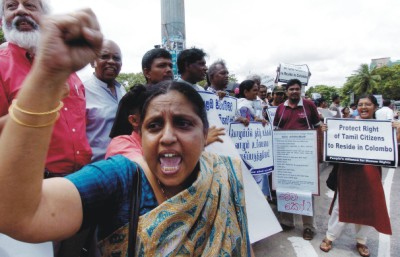
Lanka court halts Tamil evictions
Rights groups blast Colombo for evictions
Afp, Colombo
Sri Lanka's Supreme Court yesterday ordered a halt to the eviction of minority ethnic Tamils from the capital, as rights activists attacked the use of "collective punishment" to fight Tamil rebels. The Supreme Court intervention followed a complaint by a political lobby group that Thursday's police swoop, in which hundreds of Tamils were dragged out of hostels and bused out of Colombo, was a violation of basic rights. "The court will hear the case on June 22, and in the meantime the police Inspector General was restrained from carrying out any eviction of Tamils," a court official told AFP. Police and troops pulled Tamils from their sleep early Thursday, bundled them into overcrowded busses and left them at a displaced persons camp in the conflict-wracked area of Vavuniya, 260km north of here. The unprecedented move came as Japan's peace envoy to Sri Lanka, Yasushi Akashi, was visiting the island in a bid to bring the warring Tamil Tigers and the government back to the negotiating table. Sri Lanka's defence ministry insisted the operation was necessary to prevent bomb attacks by the Liberation Tigers of Tamil Eelam (LTTE), who have been fighting for separation from the island's Sinhalese-majority south since 1972. But opposition lawmakers described the swoop as ethnic cleansing and similar to Hitler's action against Jews in Germany. The United States -- a key backer of the Colombo government -- also condemned the operation. The US embassy said in a statement that while Washington "understands and supports Sri Lanka's obligation to defend itself against terrorism... this action can only widen the ethnic divide" on the war-torn island. "We call upon the government of Sri Lanka to stop the forcible removal of its citizens from Colombo, to make public the destinations of those already removed, and to ensure their safety and well-being," the embassy said. Rights activists also warned the anti-Tamil action had added to the already serious humanitarian crisis in the country and would fan ethnic hatred. "Nothing could be more inflammatory in Sri Lanka's polarised climate than identifying people by ethnicity and kicking them out of the capital," Human Rights Watch said. "Tamil Tiger crimes don't give the government the right to engage in collective punishment," the New York-based group said. "By evicting thousands of Tamils, the Sri Lankan government is sending the dangerous message that it views most of its Tamil citizens as a threat to security." Nine people were killed in and around Colombo, a city of 600,000 people, in two blasts last month. The rebel infiltrators were believed to have used cheap lodgings similar to those targetted in the police raids. Officials said more than 350 of the displaced Tamils had sought food and shelter at a public building in Vavuniya, which borders rebel-held territory. The Supreme Court ruling issued Friday made no mention of those who had already been evicted, but the Centre for Policy Alternatives lobby group said they were planning to make a fresh plea to secure redress for them. Meanwhile, Sri Lankan police commandos yesterday uncovered a powerful bomb in the capital Colombo, the defence ministry said. The seven-kilo (15-pound) Claymore mine was wrapped in a sleeping mat and left just a few metres (yards) away from a police station and a school, the ministry said in a statement. Police quickly removed it from the scene. The discovery was made a day after the government forcibly evicted hundreds of ethnic minority Tamils from the city, saying that the move was to prevent bomb attacks by Tamil Tiger rebels.
|