Prachyanat's production of "Raja"
Introducing multimedia theatre to Bangladeshi audience
Ahsan Habib
Theatre group Prachyanat is all set to launch the first ever multimedia theatre production in Bangladesh by bringing to stage a Tagore classic, Raja. Prachyanat's production, "Raja...ebong annannyo ("King of the Dark Chamber" ... and others), is an experiment pushing the boundaries with politically and socially relevant ideas, as well as visually stimulating live performance that is accessible to a wide-ranging audience," said Azad Abul Kalam, director of the play.The production utilises media technologies as an integral component to connect actors to the audience and create a virtual space. "In this digital age, use of electronics and multimedia can become a significant part in modern theatre for greater connectivity with the audience," believes Azad. Explaining the conceptual design of the play, Azad informs that, throughout the performance, the audience will experience performance by actors interspersed by audio-visual clips of contemporary world events. Moreover, a ramp will be used to introduce certain characters as modern day individuals in the context of showbiz reality. Themes are drawn from the Tagore's classic Raja. The story evolves in an imaginary country, in somewhat ancient times, portraying a utopian governance where no one sees the king of the land but his presence is felt in every sphere of life. There is no exploitation, justice is always upheld without discrimination and humanity is cherished. "The underlying theme of Raja relates to the contemporary time in the sense that it contradicts the existing socio-political structure to a large extent. In this age of power abuse, exploitation, and aggression at every level, the benevolence of one 'Raja' mirrors the exact opposite. As we struggle to claw our way out of a web of geo-political victimisation, Raja helps us define the void and provides future directives. Rabindranath Tagore's Raja bears strong relevance to current world politics," Azad explains the reasons for turning to Tagore's classic text. "Breaking away from the structure of traditional Tagorian performance and adopting a modernistic approach are much needed in order to represent Raja in the current context and to make it relatable to the audience," says Azad. The play is largely generated during the collaborative rehearsal process when all the elements -- concept, text, designers, performers, and directors -- have the opportunity to interact with and influence each other. Everyone enjoys freedom during this creative process. "My job was more of a conceptualiser than of a director. I have incorporated my concepts and placed the story in contemporary global situation. I have taken elements from the original work, as much as I need. It is a kind of an exploration," Azad explains his role in the play as the director. "The fusion of real and virtual space, the mixed-reality performance," argues Azad, ruptures the demarcation of the real and the virtual, creating a new kind of space. The relationship between the performers and the participants, within this structure, involves a two-way flow of information. The play has that scope of interaction with the audience. Azad shares his experience of being a part of collaborative works in Denmark and Japan in multimedia theatre and hopes, "Audience here will have an entirely new experience of watching a performance where theatre and video come together and complement each other."
|
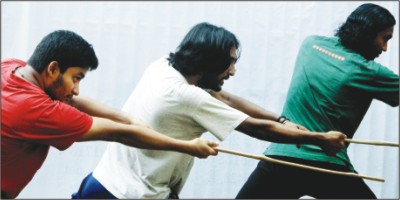
Actors of Prachyanat rehearsing for the play. Photo: Amirul Rajiv |

