TechFocus
Magic Pen reads Tona Tunir Galpa
ZAM Khairuzzaman
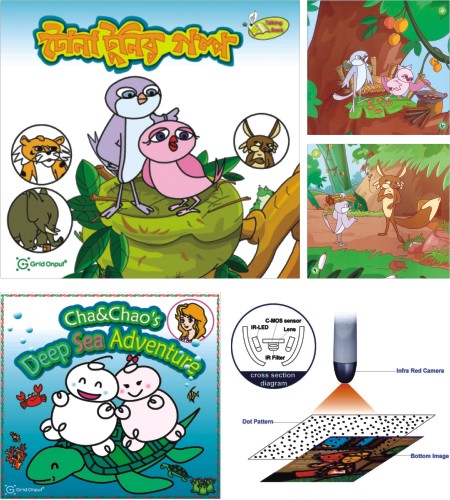
Magic sticks were used to wake up and help get to sleep the princess in fairy tales. Down the generations these tales have whetted the imagination of the kids. Though nuclear families are increasingly becoming the norm of the day, the art of storytelling is still a monopoly of grannies, at least in our part of the world.Our society, however, is fast catching up with the trends of the advanced economies. The time is not far away when kids here will no longer have their grandmas to take them to the fairyland. What's waiting for them in a nuclear family? In developed countries, technology is serving people their needs for a long time. The manifestation of development in Bangladesh is also visible in certain areas.... cities are growing with multi-storey buildings, joint families are mutating into nuclear ones and, importantly, both parents are developing careers in a variety of fields. At present, most children in the fast growing segments of Bangladesh society are left with no option but to grow up in isolation because of the disintegration of traditional extended family structure and the absence of necessary technological assistance to help beat their loneliness in nuclear families. An assortment of technologies offers people in developed countries the opportunity not only to break through isolation but also to help kids grow with technology. “Hopefully children of Bangladesh will also get some assistance from technology as do their peers in the developed countries", said Mohammad Kamruzzaman, managing director of Visual Magic Corporation (VMC). In Bangladesh context, we have experimentally developed the story of Tona Tunir Galpa (story of sparrows) with animation and digitisation, said Zaman. The VMC is already contributing in developing kids' learning tools for foreign countries, he added. "Response from people at the experimental stage has been quite encouraging", he said adding that they would soon start marketing their Tona Tunir Galpa in the country. Software loaded gadget, looking like small piece of a stick or a pen, makes books talk, be it a storybook or a pre-school book for toddlers. When the magic pen touches any section of the story, relevant animation appears on the computer monitor along with corresponding sounds and voice, Zaman said, explaining how the gadget works. With direct input from some Bangladeshi scientists, a Japanese company and its Bangladesh counterpart, VMC, developed the technology that makes a book talk, said Zaman. The talking books have already been successfully introduced in Japan, he said adding that this latest development in IT has been especially designed for kids from 4-6 years of age. Elementary kids' books, including storybooks, musical chart, painting etc., have also been developed using this technology and they are now being used by pre-school kids and elementary-level schoolchildren in Japan, he added. Reading out the book is not the only thing the magic pen does. Along with voice, visuals also appear on the computer screen. In some cases, the melodies of instrument can be heard when the device touches the picture of an instrument. Besides, kids can also paint an object by touching the colours given in a chart. During a demonstration, this correspondent witnessed how the magic pen operates. The device starts talking after the lead is connected to the computer and the script of the book touched. When the pen touches a particular picture or item in the book, it appears on the computer monitor and a sound introduces the item. All that one has to do is to touch the page of the book and the reading will follow. The visuals also start showing up on the screen. The items of Tona Tunir Galpa get alive on computer screen and the characters start talking once the animation of the book is touched with the magic pen. As the story goes on, Tona asks Tuni to go on an outing which Tuni refuses. Tona then goes out alone and finds a farmer's wife who was preparing pancakes (pitha). Tona returns home and asks Tuni to prepare some pitha for him. Tuni hands him a list of items to be brought for making the pitha. As Tona goes out to collect the items, he comes across the elephant, tiger, frog and cat. They all ask him the reason for collecting those items. Tona tells them that Tuni would prepare pitha and invites them all to join the pitha utsab. The story ends with a big party in the jungle in which all the jungle animals show up. They enjoy and appreciate the pitha Tuni has prepared. The book ends with a game, where all the characters of the story appear in a ladder. Scoring and losing points take one up and down the ladder. Tona and Tuni are the main characters here and they come across the frog, tiger and cat as the game goes on. The successful one finds the farmer's wife preparing pancakes. Cha and Chao's Deep Sea Adventure is the English rendering of the Japanese version of the story that deals with the rescue of a princess at sea. 'The story is very popular in Japan and is considered one of the best books available in the market there', said Zaman. Books in this method have been devised in such a way that the process of learning does not get monotonous; it rather becomes entertaining, he added. In the painting section of Cha and Chao's Deep Sea Adventure, sketch of a turtle is given with some shapes around it. Any given shape gets painted on the back of the turtle when the pen touches one of the shapes and is placed on the turtle's back, the figure will take the same colour of any of the painting brushes chosen by the pen and touched on to it. The musical instrument shown in the picture will start playing their tunes as soon as the pen touches them.
|