Book Review
The past always comes back
Farah Ameen
"...'We have art,' Nietzsche said, 'so we shall not be destroyed by the truth.' The raw truth of an incident never ends, and the story of Coop and the terrain of my sister's life are endless to me. They are the sudden possibility every time I pick up the telephone when it rings some late hour after midnight, and I wait for his voice, or the deep breath before Claire will announce herself. For I have taken myself away from who I was with them, and what I used to be. When my name was Anna." Thus begins Divisadero, Michael Ondaatje's latest novel: an intricate tale of love, longing, betrayal, violence, loss -- and, above all, the repercussions of a single event on a family's future. It opens in the 1970s near Gold Rush country in northern California, weaves through the casinos of Nevada and then moves on to south-central France, several decades earlier. Sprinkled with evocative imagery, this is a quiet story of interconnected lives that spans years, even centuries. Anna and Claire, born within a week of each other, are sisters from the day they're brought home from the hospital. Both their mothers died in childbirth, and Anna's father decided to adopt Claire: "The dead mother of the other child had no relatives . . . perhaps that was how he was able to do this. It was a field hospital on the outskirts of Santa Rosa, and to put it brutally, they owed him a wife, they owed him something." The girls grow up almost like twins, working the land beside their father and Coop, a neighbor's son. Coop had been taken in after witnessing his own family's violent death at age 4. In exchange for his new life, Coop helps with the farm and acts as the girls' quasi-brother. Their life is spare, quiet, uneventful: "Most mornings we used to come into the dark kitchen and silently cut thick slices of cheese for ourselves. My father drinks a cup of wine.... A father, his two eleven-year-old daughters, and Coop, the hired hand, a few years older than us. No one has talked yet, there's just been the noise of pails or gates swinging open.... Coop was an open soul in those days. We realized his taciturn manner was not a wish for separateness but a tentativeness about words. He was adept in the physical world where he protected us. But in the world of language he was our student." Even the calmest existence needs a shake-up, and the case is no different for this makeshift family. As teenagers, Anna and Claire still share a tight bond, until they start diverging and growing into their own. They "reflected each other, competed with each other." Claire is happiest on her horse, riding the wilderness. Anna's world involves Coop. What begins as innocent visits to his cabin changes one rainy day, developing into a angst-ridden affair. Overwhelmed by new experiences, she keeps them close to her chest. They "remained mysterious to each other," the author says in retrospect. "They'd really been discovering themselves. In this way they could fit into the world." It turns out that Claire has always known their secret: "She had lived in mid-air all those weeks. She'd witnessed Anna returning, sometimes as late as dusk, to the farmhouse, wild-eyed, her face holding nothing back, full of certainties and knowledge, scared of everything. . . ." Then, on a stormy day, everything changes. Anna's father discovers the truth about Coop and his daughter. Enraged, he drags her away, but not before dealing with the farmhand's betrayal. Hours later, Claire finds the broken, beat-up Coop--and realizes that both he and her sister are lost to her forever. As Ondaatje's narrative continues through the casinos of Nevada to France, the consequences of the past haunt his characters every step of the way. Somehow, running away makes no difference; they seem to seek similar lives wherever they go. To escape her demons, the adult Anna reinvents herself, crossing continents to go to southern France, where she delves into the life of a once-famous French writer, Lucien Segura. But, mirroring her past, she has just moved from her father's farm to Segura's farm in France, the last place he lived. She meets Rafael, a man who, like Coop, lives off the land, playing his guitar, quietly existing. Anna takes comfort in her work and in Rafael, using them to bury her memories. And slowly, the reader comes to see the analogies between Segura's life, so many centuries ago, and the lives of Anna, Claire and Coop. As he did in his Booker Prizewinning novel, The English Patient, Ondaatje once again takes readers across continents, even decades. In Divisadero, he deftly moves between past and present, with his characters trying to carve a future but forever haunted by their painful past. As Anna puts it: "With memory, with the reflection of an echo, a gate opens both ways and we can circle time. A paragraph or an episode from another time will haunt us in the middle of the night, as the words of a stranger can. . . . So that I find the lives of Coop and my sister and my father everywhere . . . as they perhaps still concern themselves with my absence, wherever they are . . . It is the hunger, what we do not have, that holds us together." Although Ondaatje draws the same story from start to finish, as the haunting similarities emerge, you realize the strength of the novel lies in their quiet intensity. It left me with the question of fate: Do attempts to escape a damaged past always end in a re-creation of that past elsewhere, or is the act of re-creation a coming to terms, a finding of peace? And for people like Anna, Claire and Coop, is the damage irrevocable? Farah Ameen lives in New York.
|
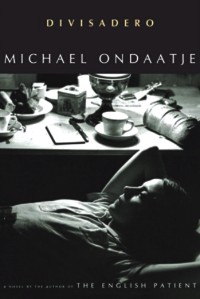
Divisadero by Michael Ondaatje; New York: Alfred A. Knopf; 2007; $25 |

