Book Review
A 1971 poem
Sohail Ahmed
Conversations with Suleman is a long poem, a prose poem, by Afsan Chowdhury about a crippled ex-Mukti Bahini named Suleman. The author, according to the introduction, often encountered Suleman seated on his wheelchair roaming "the lanes and alleys of Mohammedpur...(in a) wild, dirty, disheveled" state, "foul words spewing from his mouth." Suleman's rage was the rage of those who felt used and torn up, those who fought to re-make history and yet were betrayed by it. Accordingly, the poem is narrated in two voices. One is that of Suleman, the freedom fighter who lost his legs in the war, later lost his hands and hung on for some time on bummed cigarettes and 'foreign' charity, driven insane by the advent of a new dawn:"I have sores everywhere and they smell bad.
The nurse, a whitey woman,
Puts talcum powder on them regularly,
So that you can come and smell something nice."
"Even sitting on my chair
I have been wounded so many times,
In endless wars with shadows and smoke,
That won't let go the arms of my reluctant life...
And you dare ask Suleman the king
About wars and scars?
Show me, you bhain----- bastard,
What you did with your arms that still move?
Are they good for caressing my ass
Now crawling with bedsores?"
while another voice stands outside of Suleman, looking on
with a mixture of despair, sorrow and guilt at
what might have been, and what had actually happened:
"And Suleman lies spent on his bed of memories,
where the war never ends and bullets still fly
and he whimpers in jagged pain as he rages on,
watching his life on the telly pass by,
wanting his guns and grenades,
so that he can roll on the ground
and fire again and again..."
The poem may not be everybody's cup of tea. It is an angry poem, with a large part of the anger directed towards the safe, secure, smug middle-class-constructed fictions about our war of liberation, but perhaps the important point to remember here is that in doing so it provides a necessary corrective to such comforting myths. It also reminds us, however imperfectly (and here one has to mention that the unnecessary Americanese in the poem such as 'gonna' are jarring to read) that a primary function of poems and fiction is to enable us to see things in a new way. If Conversations with Suleman succeeds in making the "few who will read it (to) contemplate on a strange past and even stranger present" then the author will have reason to be satisfied. Sohail Ahmed works in an NGO.
|
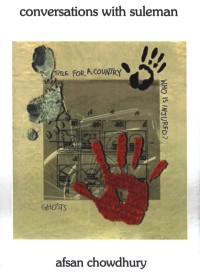
Conversations with Suleman by Afsan Chowdhury; Dhaka: Shrabon; 2007; pp. 35 |

