Call for global efforts to fix minimum wage
Roundtable discusses problems of Bangladeshi workers abroad
Staff Correspondent
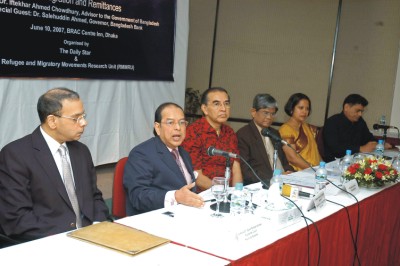
Adviser for foreign and expatriates welfare ministries Iftekhar Ahmed Chowdhury has proposed a global collective effort to set minimum wages for migrant workers at different levels of skill and experience. "No country can implement the minimum wage policy alone. The global community must come forward to make it a reality," he said while speaking as chief guest at a policy dialogue on safe migration and remittance at Brac Centre Inn in the capital yesterday. The speakers at the dialogue jointly organised by The Daily Star and Refugee and Migratory Movements Research Unit (RMMRU) urged the government to immediately ratify the 1990 UN Convention on the Protection of the Rights of All Migrant Workers and Their Families. They also stressed the need for ensuring minimum wage for migrant workers, skill development training, formation of an international bank for expatriates, special incentives for regular remitters, enactment of a consumer protection law for expatriates, mobile banking system, e-mail connectivity to all bank branches and sending marketing officials abroad for exploring new labour markets and increasing the flow of remittance. The speakers said over five million Bangladeshis live abroad and they send around $6 billion remittances every year, which is the major source of the government's foreign currency earnings. But the expatriate workers often face a lot of harassment and the government policies are seldom directed to their needs. There is no budget allocation for the welfare of the expatriate workers, they pointed out. They demanded punishment to the recruiting agencies that are involved in exploitation of the migrant workers. Iftekhar Ahmed Chowdhury also called for concerted efforts to ensure that the migrant workers receive health and life insurances from their employers. "Temporary labour migration will become safe and we will be able to maximise its developmental impact if we can ensure a minimum living wage for our workers," he said. He also highlighted some of the crucial problems the sector faces including high migration cost, pervasive information gaps and misplaced expectations. The market imperfections are often evident in biased and unfair labour contracts, he noted. "Recruiting agents often reap abnormal profits, largely at the expense of the migrant workers' interests. Language barriers and a lack of understanding of the host country's legal system can make it difficult for migrant workers to seek legal remedies against unfair labour practices." The unhealthy competition among recruiting agencies from different developing countries often exacerbates the situation, the adviser said, emphasising massive dissemination campaigns to make prospective migrant workers fully aware of the costs and benefits of overseas employment and their rights and obligations. On the issue of ratification of the 1990 UN Convention on the Protection of the Rights of All Migrant Workers and Their Families, he said the government will definitely examine the issue with an open mind. The adviser said during the first trimester of this calendar year, 1,91,806 workers went abroad, marking a 99 per cent increase compared to the corresponding period last year. The remittance from the migrant workers will reach US$ 6 billion this year, he noted. Referring to signing of Memorandum of Understanding (MoU) with UAE and South Korea, he said these arrangements would ensure safe migration and protect certain basic rights and interests. Speaking as the special guest, Bangladesh Bank (BB) Governor Dr Saleh Uddin Ahmed said only about five per cent of migrant workers from Bangladesh are well paid professionals, while the majority are low wage workers who send small amounts at regular intervals. The flat fees charged by the banks and money transferors for these remittances tend to be high relative to the amounts received, he said, adding that such high costs through the formal system results in large volume of remittances of migrant workers being siphoned off by illegal informal channels. A Challenge Fund provided by the British DFID under Remittance and Payments Partnership Project being implemented by the BB will improve the delivery of remittances and other financial services to the underserved population, he said. Speaking as the special keynote speaker, former adviser to the caretaker government Rokia Afzal Rahman said checking exploitation of the migrant workers is the most important issue to be looked into in detail. "If I were in the government, I would declare the manpower as the thrust sector," she said stressing the need for enhancing skills of the workers. If only a 6-month training is provided to the workers before going abroad, the remittance would be three times the present amount, she added. The government should try sending the returnee skilled workers to the developed countries for better jobs, Rokia said, adding, "It would open a new era for Bangladesh if it could train up the nurses and send them to various developed countries." Highlighting the importance of the ratification of the UN Convention on the migrant workers, RMMRU Chairperson Prof Tasneem Siddiqui said the convention provides a comprehensive definition of migrant workers including those who are engaged in a remunerative activity in a state of which they are not nationals. "For the first time the convention recognises migrants as the social beings rather than looking at them as economic entities," she said, adding that it ensures full applicability of human rights to all workers -- male and female -- as well as their family members. Making a strong demand for ratifying the convention, Dr Tasneem Siddiqui said there are misconceptions that ratification of the UN convention will damage labour market for Bangladesh, but the fact is Sri Lanka and the Philippines which ratified it have not faced any adverse repercussions regarding labour migration. Migrant workers face hardship at home due to fraudulent practices of a quarter of recruiting agencies and at the destination countries due to arbitrariness of the employers and discriminatory policies of those countries, she said. Even after returning, their plight continues due to the absence of institutional opportunities for economic reintegration, Tasneem Siddiqui pointed out saying the UN convention therefore would be a tool to address these issues. The Daily Star Editor and Publisher Mahfuz Anam, who moderated the first part of the dialogue, said the migrant workers are immensely contributing to the economy of the country, but their concerns were not properly considered. The recruiting agencies engaged in malpractices, that lead to exploitation of the workers, must be punished, he said, adding, "This is an area you cannot leave untouched… If money talks, then this sector should talk." The remitters of around $6 billion yearly, however, do not have a strong voice, he said, urging the government to take strong steps to ensure their fundamental rights. Speaking at the dialogue, Manusher Jonno Foundation Executive Director Shaheen Anam expressed her surprise that instead of receiving respects migrant workers are being exploited when they are giving life to the economy of the country. The workers in agriculture, garments sector and migrant workers do not get due importance as they do not have the bargaining power, she said, demanding strong steps to punish the unscrupulous manpower export agencies that are responsible for the exploitation of the workers. The speakers at the working session on reforms in the banking sector for encouraging increased flows and efficient utilisation of migrant remittance pointed out that remittance flow is often hindered due to procedural complicacies. They pointed out that the flow of remittances could be doubled to $12 billion from existing $6 billion if procedural complicacies were removed and bank branches were brought under electronic connectivity. They demanded special incentives for regular remitters, formation of a new bank for expatriates, mobile banking system, enactment of a customer protection law for the migrant workers and allowing bank officials to source countries to explore new areas for remittance earning. The speakers said the incentives should not only be for those who send larger amounts but also for those who send smaller amounts and provide significant contribution to the flow of remittance. The banks still handle remittances using the old system and most of the bank branches in the rural areas lack e-mail connectivity. The mobile banking system also can make significant contribution in this regard. Khandakar Muzharul Haque, executive director of Bangladesh Bank, chaired the session. An international bank for Bangladeshi expatriates can solve a lot of problems which they have been facing for long, said Baizid Sarker, an official of Bangladesh Bank. He pointed out that such a bank could even play as an alternative to the World Bank. The bank would be able to finance mega projects like the Padma Bridge, Deep Seaport and Jamuna Bridge, which are now being financed by the World Bank, he explained. They suggested the formation of a separate bank in the name of International Bank for Expatriate Bangladeshis. They said lack of e-mail connectivity in bank branches delay the delivery of remittances in rural areas. They suggested the Bangladesh Bank allow the private banks to send marketing officials in large numbers to source countries for exploring new areas of remittance and reducing the money flowing into hundi, illegal money transfer channel. Dr Jamaluddin Ahmed of Bangladesh Bank underscored the need for customer protection law for the expatriate workers. AKM Mosharraf Hossain of Bangladesh Krishi Bank said the private banks cannot give services to the rural people as most of their branches are located in the urban areas. He underscored the need for diversified products of the banks for wage earners. Mohammad Abdul Mannan, deputy executive president of Islami Bank Bangladesh, observed the contribution of the recruiting agencies should not be ignored as most of the migrants went through them. He pointed out that the unskilled labourers send more money than well-educated skilled workers as the later section spend a lot of money abroad. Meanwhile, the unskilled poor workers send home maximum of their earnings for maintaining their families, he pointed out. Nazrul Islam of Agrani Bank said the remittance payment systems in banks are very old and complicated. It often takes 10-15 days in depositing remittance money from one bank to another. Many expatriates send money through unofficial channels due to complicated system in official channels. There are a number of obstacles that cannot be removed instantly due to procedural complicacies, he explained. Acting Foreign Secretary Touhid Hossain, Dr CR Abrar, Dr Syed Refaat Ahmed, Syed Saiful Haque, advocate Fayazuddin Ahmad, Afsan Chowdhury, Brig Gen (retd) Shahedul Anam Khan of The Daily Star, and Sheikh Romana also took part in the dialogue.
|