Saying it with miniatures
Delicate strokes of miniatures
Fayza Haq
Waseem Ahmed from Pakistan recently held a miniature workshop for Britto Art Trust. In it Naima Haque, Nasreen Begum, Syed Hasan Mahmud, Fareha Zeba, Saleh Mahmud, Sulekha Chaudhury, Saurganga Darshandhari, Yasmin Jehan Nupur and Rafiqul Islam took part. Their work was recently exhibited at Drik Gallery. Waseem who is from Lahore, and teaches at the National College of Arts, says, "I taught them the technique while the idea of the subjects were the artists' own. I explained how to prepare the paper, make the squirrel brushes, and prepare the colours like with tea stain hue. The artists used synthetic colours too along with the white and beige. They made one painting each as they had limited time." Syed Hasan Mahmud says, "I do abstract work and did this in miniature. This is different from our normal concept of miniature and we divided the work in four stages of preparing our tools. We did 'rangai' (placing colours on the surface), 'tipai' (is used for correction and completion),'gholai' (brings in the light and shade) and lastly the 'pardah'. I increased the transparency with every stage of work. This work is like meditation. There are aspects to miniature more then merely being small in proportion. This has its origin in Persian and Moghul art." Nasreen says," I did not give the subject much importance. However, I dealt with cactus growing out of a woman's head, meaning that women face the world with all its problems bearing a brave smile. It symbolizes women's role in life. It took me two hours to complete my work. The preparation of colours and other equipment took the rest of my time. Waseem brought powdered colours from overseas and that helped. We used gum Arabic and glycerin too. All around my work is tea stain. Green, yellow and red are the dominant colours in the portrait." Saleh Mahmud did a surrealistic work with fish that looks somewhat like an aeroplane. Below are submarine life. Yasmin Jahan Nupur says," I learnt to make folds of clothes and other minute depictions. My subject is a dancing girl, intoxicated with the concept of having an evening out. Doing the different levels of the work like 'tipai' and 'rangai' wasn't easy." Saurganga Darshandhari says," I've tried to depict the feelings of a lady who has the prospect of sharing her apples with others around her. She sits on a green background and there are green outstretched hands trying to get the fruit. The theme of the painting is the good work of women in society." Rafiqul Islam Suvo has eyes as his subjects. They were shown as if taken from some fantasy world and placed in a dream-like fashion. Naima Haque deals with a traditional saying and illustrated it with elephants. Fareha Zeba has a woman's face set off by giant tropical leaves. Sulekha Chowdhury had her world of cockroaches on the small range paper. It is interesting to see how prominent and up coming artists are both enthusiastic about their apprenticeship in miniature making.
|
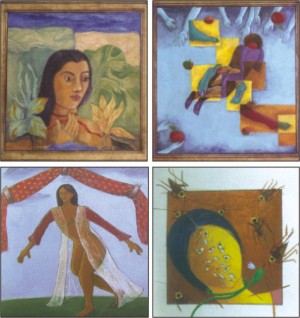
(Clockwise, From Top-Left): Fareha Zeba, Saurganga Darshandhari, Sulekha Chaudhury and Yasmin Jahan Nupur |

