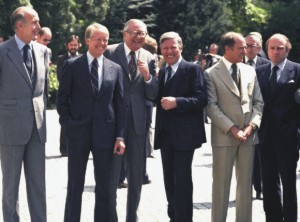
Heiligendamm G8 Summit -- nothing spectacular
Mahmood Hasan
The annual summit of the eight richest countries, G8, has just ended (6-8 June) in the German Baltic resort of Heiligendamm. The economic recession of the 1970s spurred the six most industrialized countries (US, UK, Germany, Japan, Italy, France) to close ranks to find a solution to the crisis. The collapse of the fixed exchange rate (Bretton Woods) and the first oil crisis pushed the leaders of these six nations to meet informally in 1975 at Rambuoillet, France, for the first time. The primary objective was to find measures to sustain the global financial system. Canada joined the Group in 1976 -- G7, and then in 1998 Russia joined to make it -- G8. What began as a club of the richest countries to address the world's economic and financial problems has now turned into a kind of an extended Security Council, without any definite terms of reference. It now discusses any issue that it feels is important. The G8 produces two-thirds of the world's social products, accounts for nearly half of world trade, provides three-fourths of global development aid, and contributes 73% subscription to international organizations. Therefore, the decisions taken by G8 have tremendous influence on world-trade, global financial markets, environment and development. The 33rd Summit President Angela Merkel, Chancellor of Germany, invited non-G8 participants for the "outreach sessions." Leaders of emerging economies -- China, India, Brazil, Mexico and South Africa -- and from Nigeria, Egypt, Algeria, Senegal and Ghana (Chair of African Union) were all there as observers. The UN Secretary General and the EU President were also in attendance. Angela Merkel chose "Growth and Responsibility" as the theme for this year's Summit. The agenda broadly covered three main areas -- - Global economy.
- Climate protection.
- African development.
The issue of "security," though not mentioned openly, has been a major preoccupation for all the leaders. The Summit was held under the shadow of rising tension in relations between Washington and Moscow. The US plan to extend its missile defense system over Poland and the Czech Republic invited a sharp reaction from Russian President Vladimir Putin. George Bush clarified that the plan to deploy missiles was aimed at containing "rogue states like Iran and N. Korea." Putin reacted quickly; saying that if US went ahead with the plan Russia would point missiles at European targets. At the Summit, however, Putin mellowed down and offered to build a joint defense system in Azerbaijan. Tension was also there when the US rejected the German proposal on climate change. Germany, supported by EU, proposed a 50% cut in greenhouse gas emissions by 2050, to limit the rise in global temperature to two degrees Celsius this century, and a 20% improvement in energy efficiency by 2020. USA, which did not sign the Kyoto Protocol, was opposed to such mandatory targets. The much-hyped about "agreement" on global warming, that was reached on the second day of the Summit, is dismaying. It only recognizes the need to cut down on the emissions of these evil gases. It does not set down any timetable, or any target, for the reduction of the gases. It was essentially a declaration of intent. Social activists also created a great distraction during the Summit. More than 100,000 anti-globalization protesters from all over Europe went on round-the-clock vigil around Heiligendamm. Many of these demonstrators were peaceful but many more were violent, giving the police security nightmares. These social groups wanted their voices to be heard by the G8 leaders. They were critical of the hypocrisy of these leaders, who made promises only to break them. At the Gleneagles Summit in 2005 they promised $50 billion as development assistance -- of which only about $20 billion was disbursed. There has been no progress on writing-off $40 billion of Africa's debt. The Heiligendamm decision to spend $60 billion for controlling disease in Africa is also vague. When this fund will be made available, or within what time frame it will be spent, is not clear at all. The G8 addressed security issues from their own perspective. Since the disagreement on Kosovo could not be bridged, the leaders agreed to remain in contact until a solution for Kosovo's independence was found. On Iran -- all the leaders expressed "profound concern" over its nuclear program. As for the M-E conflict, the G8, as usual, sided with Israel, calling upon the Palestinians to stop firing Qassam rockets, and to release the abducted Israeli soldier. There was no mention of the targeted missile strikes on the Palestinians by Israel. The Summit condemned all terrorist acts, and the sectarian violence in Iraq. It called upon North Korea to return to the NPT, from which it had walked away. Trade and development issues are vitally important for the developing world. The G8 stressed the need for achieving an ambitious, balanced, and comprehensive agreement on the Doha Development Agenda (DDA). As for "Growth and Responsibility of World Economy," the Summit agreed on the active promotion of social standards of corporate social responsibility, and on the need to strengthen social security systems in emerging economies and developing countries. In other words, the richest countries shall continue to dominate the flow of capital investment and development assistance to the countries of the South. The outcome of the Summit has not been spectacular. If we discount the media-hype, its achievement can at best be called moderate. Summits of this kind are actually not meant to solve world problems -- but to take note of the issues and start a process. On climate change, at least, the UN shall now start a process with the involvement of the US. The leaders also promised not to go back on the promises made to Africa. High-level meetings such as the G8 provide an opportunity to its leaders to understand each other better, and also to be flexible. If stakeholders of global issues are increasingly involved in these processes the results will undoubtedly be more productive. The G8 leaders could also have helped the developing world if they had given support to the Millennium Development Goals (MDGs) set by the United Nations. Mahmood Hasan is a former Ambassador and Secretary.
|