War of Liberation
Recognise role of women to give history a new dimension
Academics, freedom fighters tell publication ceremony
Staff Correspondent
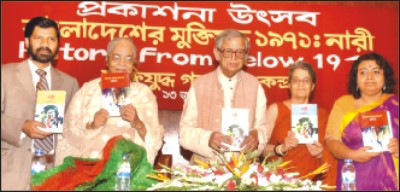
The history of the liberation war will remain incomplete if the contribution of women to independence is not fully recognised, academics and freedom fighters said at a publication ceremony yesterday.Their accounts should be documented to give the history of the war a new dimension, as women's role was no less important than men's, they said. The publication ceremony of a book titled 'Muktijuddho 1971: Nari, Prottokkhodorshi O Angshogrohon-karir Bibaran' (three parts) and its English edition titled 'History from Below 1971: Accounts of Participants and Eyewitnesses' was held at Begum Sufia Kamal auditorium of the National Museum in the city. Shamsunnahar, a social activist, unveiled the cover of the book at the ceremony. The Centre for Research on Liberation War of Bangladesh published the books sponsored by Citibank NA and supported by The Daily Star. Dr Sukumar Biswas compiled and edited the books. "The liberation war was actually a war of the people and men and women took part in it directly or indirectly, but the contribution of women was not portrayed properly," said Prof Salahuddin Ahmed, chairman of the Trust for Research on Liberation War of Bangladesh. The professor, who presided over the discussion, said the books, which contain the accounts of experiences of 113 women during the liberation war, would help write the true history of the war. Novelist and researcher Selina Hossain said women were everywhere -- at home, in camps and battlefield -- during the war in 1971, but war literature only reflected the contribution of men. The new generation, however, is now capable of protesting the distortion of history, she said, adding that Tahmima Anam, who wrote a novel on the liberation war in English, is only one example. Appreciating the English edition of the book, she said this would stop the misinterpretation of the war that it was merely a civil war and internal conflict. Selina, who also wrote novels based on the liberation war, said the newly published books contain a lot of new elements of the history. They analysed the situation of the confined and occupied Dhaka during the war, she noted. "The (political) leaders should never say that women have lost their 'ijjat' (chastity) during the liberation war, because tortures like rape and so on were war crimes. Rather, they fought to snatch victory," Selina said. Eminent rights activist Dr Hamida Hossain said it was a fight for women to cope in the families and communities during the war and that was part of their fight. War does not mean only fighting with arms, she noted. "If we can revive memories through oral history, we can also learn the values of humanity during the war," she noted, urging all to make more publicity of such books both at home and abroad so that misconception about the war could be eliminated. Speaking on the occasion, Mahfuz Anam, editor and publisher of The Daily Star, expressed gratitude to Sukumar Biswas for the book. It was a reflection of narrowness of men that the contribution of women to the liberation war has not been portrayed properly, he said, adding that the attitude of men towards women should be changed. "Our challenge is to stop distortion and destruction of the liberation war history," he said, urging all to uphold the spirit of the war and transmit it from generation to generation. "Forgetting the war means our failure," he added. The Citibank NA Acting Chief Executive Khandker Rashed Maksud pledged to contribute to upholding the core spirit of the nation and said it is necessary to take steps so that the new generation could also learn more about the war. Assistant Editor of the daily Prothom Alo Mashiul Alam said the history of the country will turn into myths after one hundred years if the governments continue to distort and use the history of the liberation war for their partisan interests. Researcher and social worker Meghna Guhathakurata said war means occupation and silence, the experience of which can effectively painted only by the women who found it challenging to maintain normalcy in families and communities during the war. Moyeedul Hasan, member director, Trust for Research on Liberation War. and writer Zobaida Nasreen also spoke at the discussion moderated by prof Qazi Madina.
|