Another example of ignorance
Aftab Alam Khan
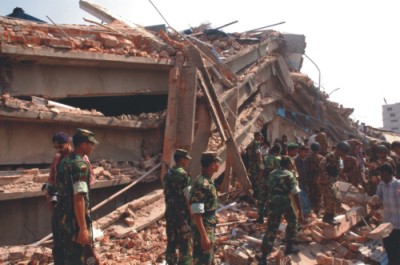
When the Spectra building at Savar collapsed it was said that it was due to structural failure because of construction flaws and material manipulation. When the Phoenix building at Tejgaon collapsed on February 25, 2006, it was said that the failure was due to faulty design. When many other buildings in various parts of Dhaka city tilted and sank, it was again construction flaws and material manipulation that were blamed. When a six storied building collapsed at Jatrabari, no official statement was given about the reason of failure. However, we geologists look for reasons that are not apparent to non-geologists. The reason for the collapse of the Spectra building, according to structural engineers, was a defect in the construction of one of the major columns. But, unfortunately, no attention was given to the incised channel located just below the collapsed building! Neither was any attention given to the enormous withdrawal of groundwater from very shallow depths, nor to the vibrations produced by the heavy machinery installed in the building. Similarly, the reason for the Phoenix building collapse at Tejgaon has not been looked at from a geological point of view. It is really unfortunate that none of the non-geologists ever directed his line of thinking towards geological causes and effects, as the Phoenix building is located at the edge of an incised channel, Mahakhali khal! There are many more incised channels situated within Dhaka metropolis. Begunbari and Kalayanpur khals are in the process of being incised. Dholai khal, Diabari khal, Narinda khal, Motijhel khal, Jatrabari khal, and Pathapath khal have already been incised. Incised channels are avenues for continuous seepage of sub-surface water, and can make such a site highly susceptible to liquefaction. Not only earthquake vibration, but also constant, gentle, ambient vibration can generate potential local liquefaction pockets at the construction sites. Underground scouring is one of the common processes that can create underground cavities slowly and, eventually, the cavities get enlarged with time. The ambient vibrations and enlarged cavities can remove soil from the base of the building located at that site, causing the building to collapse. A six storied building at Dayaganj sweeper colony has very recently collapsed. This building is a long rectangular one, having a length of about 200 feet and width of only about 20 feet. Every structural engineer will opine that this type of building is of the worst type. Had it been constructed on very firm ground, the building might have lasted longer. However, the worst thing is the site of the building. The entire building is aligned in a north-south direction. There is a long, narrow, parallel depression behind the building, which gives the impression of an incised channel. Looking at the paleo-channel map of Dhaka city, the impression turned to reality as the building is situated over the filled area characterized by incised channels. Local people say that the backside of the northern part of the building stands on black soil. Black soil is deposited by artificial fillings or by channel fillings. In addition, there is a graveyard, covering a relatively large area, situated at the back of the collapsed building. The graveyard is situated over the depression. Each grave is covered by removed and filled loose materials over the incised channel. Underground seepage through the incised channel can redistribute the filled materials, creating potential underground scours and cavities. It is not possible to identify an incised channel or its seepage status at the construction site simply by testing soil samples. It needs geological sub-surface imaging. Any disaster related to some natural processes, whether it is building or bridge collapse, gas or oil-well explosion, mine disaster, road or railway track subsidence, or river bank erosion, needs geological evaluation. Non-geologists can perform these tasks only if they are educated from a geological perspective. If the need for geological evaluation continues to be ignored, the ultimate outcome will continue to be failure. Aftar Alam Khan is a freelance contributor to The Daily Star.
|