My views on music as an art form
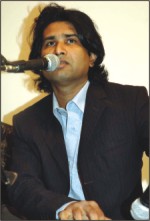
Swani Zubayeer
Why do we compose music? Why do we involve ourselves in this field of art? Is it something we possess as a gift from the Creator and destined to continue throughout our lives? If not naturally gifted, could someone just wake up one fine day and realise that this is what he or she is meant for? My mind is always engrossed with these questions for two reasons. Firstly, somewhat 18 years ago I happened to participate in an essay-writing exam held by Springston University in USA, and the subject was "Whether or not music should be included as a basic course in the junior level at schools". My stance was "no". My view on this issue has not changed in 18 years. I firmly believe music or any form of art cannot be imposed on anyone. It's a decision that should not be influenced by external elements. The gift of music cannot be achieved by force. Secondly, after studying in Europe (Sweden) for years I came to know about quite a few globally renowned composers who started their careers in other professions but eventually became successful musicians and contributed to the development of modern music. For example Hungarian composer Xenakiswas was an architect by profession and American composer Bryan Fernihough started as a mathematician. Both of them have made significant contributions to modern classical music. Having said all that, my predicament is that I feel I have failed to appreciate most of the music composed during the last 50 years. The melody somehow seems displaced, harmonies broken into pieces as if a crystal palace has been bombarded with a cannon. I've always believed that mathematics and music are inseparable. If I may compare these two with the human body then math would be the skeleton and the flesh and face over it would be music. It seems to me that for the most part, music created in the last five decades only have skeletons. That is, it is so vigorously based on the mathematical part that the passion has been robbed off. The industrial revolution played a key role behind these complications. Today's music is basically constructed with a high focus on expression of sounds. Some the noteworthy contemporary composers are: Sven David Sandstrom and Per Lindgren of Sweden (Trombone concerto composed by the latter should be mentioned), Lars Ekstrom for his Ocean of Time and Toru Takemitsu of Japan. The simplicity, even in their definitive complex structures comes across so evidently that it touches the heart. I am bringing up these examples because a composition can be extremely complex in its structure but the outcome of it should move even those who do not have an analytical ear. After all, music should be for everyone. It took me years to get a proper understanding of the language of western classical music. The same can be applicable to a westerner trying to understand our music. In Indian classical music the raga and the taal system are unique. I believe it would be interesting to use the modes of raga and the divisions of taal in the western set-up. From chamber to orchestral music these eastern elements can be used with the counterpoint technique (a technique Palestrina used in the 1600s) or in a harmonic way. There are many things still left unexplored. One can only start by delving deep into the world of music. The author is a music composer-singer and has completed his Masters in Western Classical Composition from the Royal University College of Music in Stockholm
|