Chittagong on the precipice
Kazi S.M. Khasrul Alam Quddusi
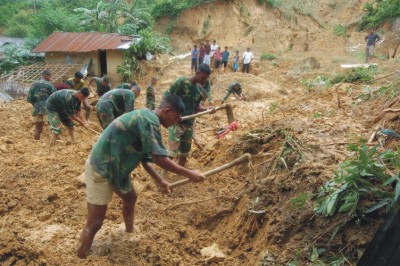
The city of beauty suddenly becoming a city of death! More than hundreds of people, including women and children, were buried under walls of mud and washed away in the current, with many others still missing. And millions have become homeless due to such horrific mudslides. At a rough estimate, the loss in property may be more than Taka one thousand crore, mainly because of water logging and inundation. Yes, Chittagong was once at the fore. Both geographically and commercially such was the presence of Chittagong from time immemorial, and its importance has hardly lessened ever since. Over and above, the natural beauty of Chittagong and adjoining areas has always been a treat to watch for people of the whole country and beyond. Chittagong has been a real melting pot for quite a long time now, with substantial influx of people from other regions of the country mutually benefiting and complementing each other in the process. Though Chittagong still lags far behind the capital city in terms of facilities and opportunities available, it has very rightly been regarded as a better place to live in vis-à-vis Dhaka. But whoever saw the havoc caused by nature a few days ago has every reason to be worried about the future of Chittagong city and adjoining areas, if not the whole of Chittagong region. Vested quarters in Chittagong had played so willfully with nature during the last three decades that she has shown us a trailer to give us a measure of what damage she can cause in the not-too-distant future. This apprehension -- which some might think is exaggerated -- is hardly unfounded. Small-scale tremors have become a regular phenomenon in Chittagong and adjoining areas. They have been taking place with such frequency these days that the general people and the government alike seem to have taken them for granted. But the experts have repeatedly warned of a disaster if the situation is not attended to without delay. Yes, the culprits behind the recent tragedy have been identified; ruthless hill-cutting being the prime reason, followed by unplanned urbanisation and blocking of the city's sewerage system due to grabbing of ducts by big shots. In a survey by Chittagong University geography professor, Dr. Islam, it was found that more than one hundred hills of Chittagong have vanished due to indiscriminate hill cutting during the last 30 years. His report very precisely pointed out the places like Khulshi, Panchlaish, Nasirabad, Pahartoli, Sholoshohor, Bayezid Bostami, Foy's Lake, Lalkhan Bazar, Oxygen and Polytechnique areas. Truly, whoever has visited those areas must remember the ruthlessness of the hill cutting. Though the hill cutting has been temporality stopped now, there was unholy competition to deplete the hills even a few months ago, as if the wealth-mongers had declared a war against hills of all sorts. Sadly, however, wholesale hill cutting has so tilted the ecological balance of Chittagong to the vulnerable side that the possibility of a catastrophe of unforeseen nature can hardly be overstated. It might even take place -- God forbid -- so quickly that there might be little time to even take stock. Unfortunately, very few big guns stayed away from the brisk business of mindless hill cutting in Chittagong. They ranged from truck owners, contractors, brick kiln owners and real estate developers to local hooligans. They were ably supported and guided by political leaders and government officials and, above all, ministers. Even Mayor Mohiuddin Chowdhury jumped onto the band wagon (!). The hilly areas of Foy's Lake and Pahartoli being some locations of his so-called housing development schemes. Though I had a soft corner for Mr. Chowdhury, I was really appalled to see City Corporation bulldozers pitilessly leveling the hills in Foy's Lake area for a residential area named Lake City Residential Area. Meanwhile, blocking of the sewerage system by grabbing of drains and establishment of various structures over the same gained ground in the previous years, and that, too, under the aegis of influential leaders and incumbents. Though the City Corporation is supposed to maintain the sewerage system in a city, some of its structures over the big ducts choked the system, triggering inundation at the slightest rainfall. Premier University is such a structure of Chittagong City Corporation. Expansion of education facilities calls for quality private universities, and such a move by the City Corporation is appreciable, but the university could well have been built somewhere else. Though influential people have gobbled up many other drains, such acts by incumbents have angered the people more. The caretaker chief, Dr. Fakhruddin Ahmed, has visited the affected areas and used strong words against the elements responsible for hill cutting. He has also called for forestation in the depleted areas. But, equally important is the immediate creation of stringent and effective mechanisms to stop hill cutting permanently, because that is the best possible option for removing Chittagong from the edge of the precipice. Kazi S.M. Khasrul Alam Quddusi is Assistant Professor, Department of Public Administration, University of Chittagong.
|