Depletion of forest by the forest lord!
Indiscriminate exploitation must stop
Md Asadullah Khan
Most of the news about the environment either here in Bangladesh or elsewhere in the world is distressingly bad. Reports of disappearance of forests, destruction of wetlands, diminishing of coral reefs and extinction of other natural resources come with frightening frequency. While all countries outside Bangladesh celebrate the World Environment Day every year on June 5 with much fanfare by achieving some environmental progress, the environmental situation in Bangladesh unfolds a dismal picture. Against such a backdrop the Chief Adviser Fakhruddin Ahmed while inaugurating the National Tree Plantation Fair at Tangail on June 3 last exhorted every individual in increasing forest wealth by planting trees and protecting these by all means. Paradoxically the Chief Adviser's inspiring address came at a time when all eyes were focused on Osman Gani, the forest boss of the country who denuded the forest to amass huge wealth through selling both promotions and transfers of forest officials as well as forest resources, now detected by the law enforcers. The week before last a horrified citizenry watched images of the forest lord's plundering of the forest wealth in the country and realised the futility of the move when a protector turns usurper. Reports allege that while serving as conservator of forests in Khulna, he sold out 368 lots of sundari wood without any auction showing only Tk.33 lakh as the price that would have yielded Tk.3 crore and 51 lakh.. Starting from the Sundarbans to Madhupur to Rangamati to Jugalchari reserve forest -- forest lands and forest wealth have been devoured by Osman Gani and his syndicate and all this went on during the last five years without creating a ripple in any quarters of the past government . Unsurprisingly, when he had to buy his promotion at a hefty price of Tk. 80 lakh, that was shared by high-ups in the past government, nothing could possibly stand in the way to his insatiable greed of denuding the forest through rampant illegal logging. Home to 330 species of plants, over 270 species of birds, and 42 species of mammals including the majestic Royal Bengal Tiger and the spotted deer, the Sundarbans went under assault systematically during the last one decade. The biggest mangrove forest in the world that once comprised 10,000 square kilometers is now left with only half of that. Once the rulers of the forest, the tigers are now prisoners of human intruders and disappearing faster than any other large mammal. Inside the forest, they are succumbing to poaching and relentless pressure of human population around the forest territory. Nearly 60 percent of the world's tropical rainforests including the emerald mangrove forest of the Sunderbans have been lost and what remains is under extreme pressure from logging and human population growth. Precisely true, once a forest is cut down, many of the living things it has harboured will be driven to extinction. Realizing that it's impossible to guard every tree in every place, Mittermeier, the president of the CI (Conservation International) suggested a focused, two sided strategy. One priority, based on the ideas of British conservationist Norman Myers, is to protect the world's "hot spots," areas that are disturbed by human activity but still exceptionally rich in animal and plant species found nowhere else. CI has identified 25 hot spots throughout the world where preservation efforts could have maximum benefit The island of Madagascar and the Atlantic forest region of eastern Brazil figure out prominently in their selection because of the vast resources these two places offer . The other priority is to watch over tropical wilderness areas relatively untouched by people. These include the upper Amazon and the Congo basin in Central Africa. In both hot spots and wilderness regions, CI suggests demarcation of key reserves like the one that was intended to be developed in Jugalchari in the Khagrachari district in our country and which has now been denuded to feed the greed of Osman Gani and his syndicate, the present day human predators. The idea was to keep these forest regions off limits to agriculture and industry forever. But just as important is the nurturing of other territories where healthy forests and human enterprise can coexist. CI has a message for developing countries like ours: your forests are valuable intact and alive than they are chopped down and dead. Profits could come, for example, from the marketing of exotic foods, chemicals and medicines found only in the rain forests and from the largely untapped potential of ecotourism. CI set up a private trust fund, with contributions from around the world, to help Suriname (the former Dutch Guyana situated in the north of Brazil), guard and manage the protected area. Outside the reserve, CI has worked with local Maroon tribes to limit farming to certain slash- and- burn areas and not disturb most of the forest surrounding their villages. Coincidentally think of Bangladesh with such a big forest like the Sunderbans with lush green trees intact extending over several thousand kilometres! But who will invest in protecting and developing the forests in a country where much of the 3000 crore taka placed for the purpose were misappropriated by corrupt and unscrupulous forest officials. The story of the destruction of Rangamati forest is equally distressing as revealed by Dr. Ali Reza Khan, an expert and author of several books on wildlife, in a forum arranged by the Environmental Journalists of Bangladesh in the year 2000. Over the years government effort to turn Jugalchari into a reserve forest by spending about Tk.12 crore has ended in a fiasco through embezzlement of fund and allowing illegal logging and timber trade with the direct patronage and blessings of the corrupt forest officials. Almost 10000 hectares of the reserve forest lands of Rangamati that once comprised 60000 hectares have already disappeared. Along with it are gone the massive civet trees, about 150 feet high, and sundari and garjan trees. Assault has come from many directions as reports suggest. People from the plains were made to settle there in 1983 even after it was declared a sanctuary, and in consequence many plant species of invaluable importance, and trees like Sal and Segun were chopped off and went into the market through devious means as usual. The report further says that out of 80 species of birds found in the Rangamati forest in 1980, only 43 species including owls and common Mainas remain there. Fish population in the wetlands has also declined. Telapia, an alien species, as we all know dominates the wetlands harming the native species of fish. Indiscriminate felling of trees or plundering the forest without permit and payment of revenue to the proper authorities has been going on unabated with the direct help of the forest officials allegedly in exchange for hefty bribes. Forest department officials seldom venture out to the ranges for routine inspection and monitoring because of such unholy alliance. Nobody knows till now what action was taken against the officials at whose instance and help 17000 cubic feet of teak wood, all properly sized, were being smuggled out from the Baghaihat forest and brought to a halt by the intervention of the army in 2000. People feel that the patronage and protection these corrupt officials enjoyed from the high-ups only emboldened them and reinforced their belief that they could carry on such unfair business unhindered. Speaking about the Sunderbans and its surrounding areas, almost four million people depend directly or indirectly on this forest for their livelihood. Overfishing and over exploitation of plant and wildlife species are placing increasing amount of stress on the viability of this delicate ecosystem. During my visit to the Sunderbans last year I have seen hundreds and thousands of small fishing boats in the Shela river inside the deep forest area engaged mainly in catching shrimp fries and in the process other fries or small fish that come up are discarded dead or alive because shrimp fries fetch higher price than other catches. While cruising through the shallow canals and rivers flowing deep inside the forest ranges, one feels impressed to see the lush green emerald rain forests that present an unspoiled showcase for the diversity of life. In lush territory at the mouth of the Bay of Bengal there was hardly a break in the canopy of 150 ft tall trees and virtually every acre was alive with the cacophony of all kinds of insects, birds and monkeys. But beyond the river shore deep inside the forests, I was told by the driver of the launch, there were breaks and empty spaces because forests in this region have fallen to lumbering. Other than slash and burn practices resorted to by a group of criminal gangs of businessmen, illegal quarrying has stripped the earth of its foliage which like deforestation loosens silt that eventually clogs the rivers and waterways and worsens flooding. Environmental reports say silting has caused the bed of China's Yellow River to rise by more than four metres over the past four decades. In almost all places, including ours, greed, shortsighted environmental policies and corruption cause much of the damage. Perhaps the worst culprit is the indiscriminate logging, much of it illegal, around watersheds. As already mentioned, cutting trees loosens the topsoil reducing the ability to retain liquid. Such indiscriminate felling of trees from natural forests has been stopped in neighbouring India by an order of the Supreme Court. The recent move by the caretaker government in stopping pilferage of the forest resources of the country through arresting the chief conservator of forests for his unbridled corruption brings hope that situation in Bangladesh may change for the better now. However, people would be happy if the country's apex court played the role of jungles' messiah. However, the practice of deforestation as a means to poor people's livelihood is assuming serious proportions throughout the world. Much of the world's land is too rocky, arid or salty for agriculture. Forests that have not already been cut deserve protection: they harbour the habitats of earth's endangered wildlife. This has to be done because we are not yet aware of the full dimensions of the bio-diversity that are hidden in the forests and the problems that lie ahead of us. Fewer than two million species of animals, plants, and micro- organisms have been identified till this date. Yet tens of millions more may exist -- in oceans, rainforests and everybody's gardens. In fact nature does not seek to make a connection with us, nature does not care if we live or die. The hard truth is that we can't survive without the oceans and the forests. Forests temper climate and capture and store water. Their timber has been a springboard of economic development. Forests store 40 percent of terrestrial carbon and can slow the build-up of carbon dioxide in the atmosphere. Deforestation in mountains can worsen floods in grasslands or agricultural lands below, as was the case in China and Madagascar some years before. The extinction of forests has come in the wake of unprecedented population boom, especially in the Third World. Much of the land becomes less arable by the minute it is assaulted by urbanisation, chemical pollution, desertification and overuse of limited water supplies. The exhaustion of land in many areas has created a new class of displaced person known as "environmental migrant." While wars have so long been fought over territory, the future may see "green wars" triggered by shortages of such basic resources as topsoil or water or greenery. Md Asadullah Khan is a former teacher of physics and Controller of Examinations, BUET.
|
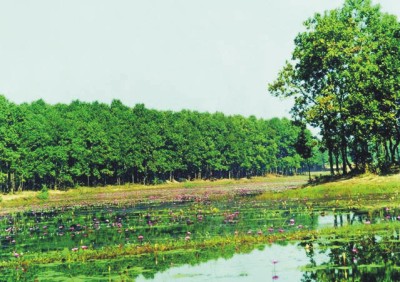
No indiscriminate exploitation, please |

