Govt to jeopardise its legitimacy if polls not held at earliest
Butenis tells 'The Daily Star'
Ashfaq Wares Khan
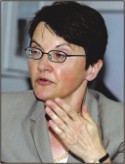
Outgoing US Ambassador in Dhaka Patricia A Butenis said on Thursday that she would like to see Bangladeshi democracy return to its "full fold" at the earliest, otherwise the legitimacy and legacy of the government will be jeopardised.In a parting interview, Butenis reiterated her support for the caretaker government but said she will continue to speak out against human rights violations and that the ban on politics should be lifted to allow political parties to engage in electoral reforms. Recounting her experience during the political turmoil leading up to the declaration of state of emergency on January 11, Butenis said she "begged" the Iajuddin Ahmed-led caretaker government not to hold a one-sided election, and pleaded, in vain, with the major political parties to reach a compromise. Butenis was appointed the US ambassador to Bangladesh 14 months ago and is leaving prematurely for a high-level post in Baghdad. In an exclusive interview with The Daily Star at its office, Butenis said although she supports the government reforms, "There is a limit to what one can do in a limited period of time." The government would jeopardise its legitimacy and legacy if it denies the people the right to elect its leaders at the earliest, she added. Reiterating US support for the caretaker government, Butenis said, "I think they are going in the right direction. We are going to continue to speak out, mostly privately and sometimes publicly, where we think it's going wrong." Stressing the need for a level playing field for all political parties, she said, "People are telling us that they are being pressured to leave their party and join this third party. "I think there is a lot of activity there, which seems to be allowed to go on. I think the other existing parties should be allowed to operate," she added. Asked for her thoughts on the "minus-two" theory that both Khaleda Zia and Sheikh Hasina should be sent into exile, Butenis said, "I will say, as I have said before, I think political parties have to change. I don't know if they understand that or not. They say they do...I think it will be hard--and it is hard--for political parties to change with the current leadership in place. "I think sometimes the political parties feel that they own politics--that anybody who isn't a politician had no right to even offer an idea," she said. She also said since political parties are a key element of any democracy, "You can't reform politics without getting buy-in from political parties." Citing popular support of the two major parties, she added, "Whatever changes they should make, they have to be engaged on some level. "I really do think that even the Election Commission is ready to talk to the parties," she said, but "The parties are afraid of discussing things, because they fear they might be violating the ban. "We have a kind of a paralysis right now. I don't think anything imposed is going to work, frankly," she said. On political future here, Butenis said, "Part of me wants to say 'who knows', because it is so hard to predict where we are going." Recalling her experience during the intense political negotiations preceding the declaration of state of emergency, Butenis said, "All I ever did, and I did it constantly, was to beg people, to beg them, 'Can't you compromise? Can't you come up with a solution that would be acceptable to the opposition so they would participate in elections to ensure there is some sense, it is fair?'" Butenis said she pleaded with the then Iajuddin-led government, "Why do you want to go ahead with one-sided elections which people will find impossible to believe as credible?" She, however, denied having a formula for a political compromise: "That's not my job. My job was to say, 'Please, can't you sit down and work this out?'" Butenis expressed disappointment at the breakdown of the Mannan Bhuiyan-Abdul Jalil talks in September. "Nobody was willing to do it. We tried. I was the promoter and trying to facilitate dialogue early in September," she said, adding, "I had no idea whether the political parties were serious. They agreed to talk. I had no idea if they were genuine. I chose to accept that they were trying and I tried to facilitate that." The outgoing US envoy named political parties, business leaders, civil society members and journalists and said she spoke to "everybody" during the politically chaotic period. However, asked if she had also spoken to the military at that time, Butenis skirted the question, repeating she had spoken to "Everybody." Citing the scorn of major political parties towards Nobel laureate Prof Muhammad Yunus' efforts to form a party, Butenis said, "It was with the same attitude that 'This is our and the only option for the public on voting day is to vote for either A or B'. This was shocking to me." Butenis said she also brought up a worst-case scenario of a military-takeover with the political leadership in order to make them understand the possible fallout from their deadlock, but she said the BNP did not expect the military to intervene while the Awami League felt it would be in its favour for the military to prepare the voter list. "My response was, 'Why would the army come in and clean up the mess the parties made and hand it back?'" she said. "So, if the political parties could not even predict that we would be here, much more so can I," she said, but added that the US and other countries' support for the return to a "fully elected government" may guide the government. Butenis said Bangladesh has a lot of potential to act as a "bridge" between two regions, but cited politics as the main obstacle. She also spoke of further cooperation between the US and Bangladesh regarding counter-terrorism.
|