Reform imperative for political parties
ABMS Zahur
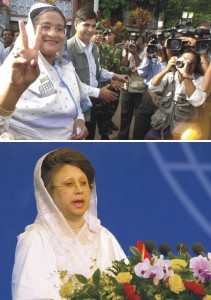
A government can never work well without efficient leadership. A bureaucracy can neither effectively discharge its duties nor can it provide quality plans or policies when lacking clear direction from leaders. During the last 15 years of democracy run by two lady leaders it has been proved beyond doubt that (i) without clear and neutral direction a government cannot reach its goals, (ii) catchy political slogans or sentimental statements are more useful for befooling the common people, and (iii) statecraft in any LDC with politically sensitive population is not only a serious matter it also needs high level skill. For effective implementation of ideas it is essential that the leader is popular. But this perhaps is not enough.Both Sheikh Hasina and Khaleda Zia were dragged into politics due to exigencies of the situation created by assassinations of Sheikh Mujib and Ziaur Rahman, respectively. Their only contribution appears to be saving their respective parties from disintegration. Normally, even a high calibre politician has to work hard to attain prominent position in the party. A party leader must understand clearly what is good for the party. If leaders are carried away by sycophancy no talent can save them from making blunders. These leaders have shown their serious weakness for sycophancy. We do not say that nothing has been achieved during the last 15 years. Despite rampant corruption, nepotism, terrorism the rate of growth on average was better during the period as compared to Ershad regime (5.9% against 3.9%). There was also distinct improvement in the common man's participation in facing natural disaster. This was particularly seen during Bangladesh's longest flood in 1998. Furthermore, there has been a remarkable decrease in dropouts in primary schools. In the health sector the improvement was satisfactory. In fact performance in this sector is better than India. Even in sports, road communication or telecommunication clear improvement is evident. However, we find not enough evidence to exclusively congratulate these ladies for the said successes. Notwithstanding appreciable cooperation of the people performance of these governments could not reach the desired level mainly due to poor leadership. Sheikh Hasina spent most of her time in recalling the glory of AL in the liberation movement, pointing misdeeds of razakars during war of independence and highlighting sacrifices of her family in attaining independence. She could hardly utilize her time for reforming her party through democratization. By ignoring the upcoming new generation of politicians her party was deprived of the necessity for dynamism, freshness and virility. Even the grassroots level leaders were not given adequate time. Frequent visits abroad to gather honours did not serve interest of the party. She never regretted for poor governance of AL in 1972-75, wrong decisions like introduction of presidential government, severe restriction on freedom of press and Baksal. The main factors behind Khaleda's meteoric rise were: Zia's dedication and honesty; shabby handling of 1991 election by AL; leading role taken by her in mass uprising against dictator Ershad. Performance of BNP was somewhat satisfactory in 1991-96. This was possible due to her reliance and trust on more experienced, able and mature politicians, display of reasonable degree of tolerance, much less reliance on politicization, corruption and dictatorial behaviour. She exposed her weaknesses and incapability during her second term. The blunders include: partnership with fundamentalist parties; total lack of skill in handing alliance partners; inefficiency in choosing ministers/advisers; insatiable thirst for power; underestimation of opposition members, particularly AL; and allowing close incompetent and greedy relations to thrive (through various malpractices. Her latest decision to appoint her brother Sayeed Iskander vice president of BNP indicates a blind faith in dynastic rule). Reform has become unavoidable for political parties to make them more democratic, dynamic and vibrant. Feeble attempts of some parties were not successful in the past. As we are going for a democratic election in which all the parties will compete in a free, fair and credible manner to elect honest, able and committed persons, we strongly feel the need for reform which may be done by political parties themselves. However, no provision for dynastic rule or family centric politics can be considered. It is heartening that some front ranking leaders of major parties are showing keen interest in reforming their respective parties. ABMS Zahur is a former joint secretary.
|
|

