TechFocus
Intel plans it big for Bangladesh
Nafid Imran Ahmed
What does Intel think about the Bangladesh market? To know about Intel's insight into our market, we recently spoke to John McClure, director marketing, Intel South Asia, who was in Dhaka on a short visit. The following are excerpts from his exclusive interview with The Daily Star.Technology adoption
Considering consumer and business segments, McClure believes the Bangladesh market is in fact a little different from other emerging markets. "The percentage of technology adoption of mainstream and high-end products is a lot higher than the other emerging markets," he said. First-time buyers in this market are keen to do a lot of research prior to their purchase. In other countries such as Brazil, Mexico, China or India, the first-timers also do a lot of research before they make the purchase. They ask their tech-savvy cousins and friends about the technology, visit IT malls, get a lot of feedback and finally make the decision. And it all takes 2½-3 weeks. "My first major observation is that the consumer and business market adopts technology at a little higher level within our roadmap than other markets," McClure said. His other observation is that relative to other emerging markets the government's role in accelerating ICT adoption is not quite strong. "They've not been as aggressive as other countries have been, relative to pushing the utilisation of PCs in schools, pushing for a very aggressive broadband policy and getting broadband roadmap up quickly, playing active role in bringing technology to the rural communities," he said. "There're other governments that we have worked with...are much more involved, aggressive and have put aside a much larger amount of budget to drive such initiatives," he added. Intel's roadmap
According to McClure, Intel has been engaged with a lot of development agencies. "Given the present government's interim status, the ability for them to drive a long lasting programme is not known to us. So right now, we are engaging with development agencies such as the United Nations Development Programme, Asa and Grameen to drive these types of programmes," McClure mentioned. The marketing director also added that broadband is one of the major growth engines for IT for any developing country. And once you get broadband connection available at 256kbps and above for less than $15 a month, lots of great things start to happen new services pop up, new ways of education and healthcare can take place. Aside from the general consumer and business benefits - e.g., more entertainment, more movies, music, photo sharing with friends and relatives, e-commerce - you also get some development elements relative to education, healthcare, agriculture services. So broadband really gets things going. "A focused government that sees and believes in the utilisation of ICT to make their country more competitive, I think, is the second major market accelerator that we have seen. And the third, I believe, would be a robust local ICT ecosystem for companies that make PCs, not just the multinational but also local companies, having a strong software ecosystem for companies that develop applications, ISVs, strong systems integration ecosystem so that companies can drive large projects and get things deployed," McClure added. Vision for the local market
Intel's objective in the Bangladesh market is to keep it growing at a 20 plus percentage point, and this is what IDC is also forecasting that Bangladesh grow at. "It seems almost easy to do that because it's growing at 20 percent without broadband. Once broadband comes in, the opportunity for acceleration gets much higher," he informed. So McClure plans to keep the market growing at a healthy rate and do three important things that are important for market acceleration. Intel first plans to figure out how it can accelerate broadband, and the giant's main contribution to that would be working with the local ecosystem in deploying WiMax, a technology that Intel has been a big supporter of. It plans to forge a deeper relationship with the government and convince and show it how having a very aggressive ICT policy and utilisation of ICT across all the cities and services will make the country more competitive. And the third is to continue to foster the growth of the ecosystem, to keep the local companies that build PCs and sell PCs very healthy, to improve Intel's logistics and support mechanism, to support some of the local software development and to make sure there is a very robust ICT ecosystem. "Our vision is that if we could do all those things, Bangladesh would become a large market for ICT adoption and one of the big advantages that Bangladesh has is the population and that's difficult for other countries to compete with. And if we can get the ICT adoption at a much higher rate by doing some of the things I mentioned, Bangladesh would become a very important market in the worldwide scale," McClure said. Products
Intel carries their full suite of products in the local market. According to McClure, the local team does a great job in driving the newest generation of technologies at a very rapid pace, so the time from launch to adoption in Bangladesh is not very long. Intel was the first to introduce quad core in the market for high volume desktops and servers. "Our competition has yet to announce quad core for similar usages and in the next four to five months we will be introducing our next version of quad core which is going to be produced on our 45nm process technology," he said. Two weeks back Intel introduced its latest notebook processor codenamed 'Santa Rosa' that came out in two different versions. There was this consumer and small business version called 'Centrino Duo' and a business version 'Centrino Pro'. The consumer version has got some good innovations, such as improved graphics and video, Intel Turbo Memory, which effectively speeds up the booting time and application opening time, big enhancements in the wireless community and performance improvements of the processor itself, which brings down the power consumption and increases the instructions per clock cycle. Market Share
According to Intel, in terms of ramp Bangladesh is 60 70 percent dual core at the moment. "The amount of Core 2 Duo being sold here is almost 50 per cent greater than in India. One of our hypotheses on why the adoption rate of latest technologies is much higher in Bangladesh, even for the lower scale economies, is that it lasts them longer," he said. According to IDC, in 2006, a total of 200,000 units were sold in the PC market in Bangladesh that includes MNC brands, channel PCs, everything. We have a very strong market share in Bangladesh. At present Intel has three distributors in the country. Reaching the rural areas
Intel's approach to reach out to the rural areas is from two different angles; one is their channel and distribution programme, the genuine Intel dealer programme, where they do requirements from all different cities, not just Dhaka itself, and try and recruit downstream from smaller and remote towns, which according to them will continue and each half year they plan to go deeper and deeper into Bangladesh. "The other route that we take is via our World Ahead programmes that combine our CSR initiatives with our commercially driven developmental initiatives. That would be the programme that we would like to run with the government to install and accelerate utilisation of PCs and shared access models in telecentres in rural locations, PCs in schools and hospitals in rural locations," McClure mentioned. "We have already spoken with the developmental agencies on that subject and we have seen a lot of interest and good synergies, and the next step would be to take the government on board," he added. The classmate PC
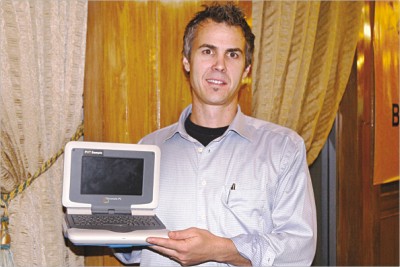
McClure demonstrated an example of low cost solution for the education sector, which is an emerging market specific R&D (research and development) that Intel does to catalyse the industry and deliver certain solutions for certain market segments. "When we travelled around and engaged with schools, we found that having a low cost notebook was a high desire. Another thing was to have a one to one computing blueprint." The Classmate PC is a low cost notebook that does not have a hard disk drive, only has flash memory for storage. It has a much smaller screen size and keyboard. But in terms of having the sufficient functionality that all public schools have and most private schools would need to get to the one-on-one computing model, this has all that's needed. Intel does not sell the Classmate PC directly to schools. It is more like a catalyst. They enable a couple of Taiwanese manufacturers to deliver and then through their local partners they deliver them to fulfill the country specific needs. The price of the Classmate PC depends on the quantity and stands somewhere between $350-400.
|