Medical Waste Management
Deadly wastes ending up at doorsteps
Shahnaz Parveen
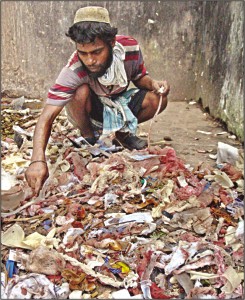
Although public awareness about medical wastes has increased in recent years, a huge amount of such dangerous wastes are being routinely dumped on the city streets, posing serious environmental risks and health hazards.The generation rate of medical wastes has increased rapidly over the past 10 years due to the increased number and size of healthcare facilities and use of disposable medical products. Officially there are around 800 clinics and hospitals in the city that generate about 200 metric tons of wastes daily. The volume of total solid wastes generated in the city is around 3,500 metric tons. About 50 percent of the total wastes are collected by the municipal authorities while the rest remain uncollected, degrading the environment. "Any type of waste poses threat to humans and medical waste is the worst of them. It requires specialised treatment and proper management before disposal," said Prof Mahmudur Rahman, director, Institute of Epidemiology, Disease Control and Research (IEDCR). Rahman said in recent times awareness among the hospital managements has increased, but still it is not adequate. Only a few have necessary facilities for safe disposal of wastes. Most healthcare establishments still dispose of wastes on roads, dustbins, drains and any open space available where they mix up with household wastes. Hospital sweepers are not properly trained to handle them. "Medical wastes need to be classified and quarantined accordingly," Rahman added. Rahman said there are various types of medical wastes. Among them the biological wastes such as human tissues, blood, body fluids, organs, body parts, human foetuses, and other similar wastes from surgeries, biopsies and autopsies pose sever threat. Other clinical wastes include dressings from infected or surgical wounds, disposable towels, gloves, broken hospital equipment, needles, syringes, scalpel blades, razors, infusion sets, broken glass and blood tubes. "A major concern about biological wastes generated in hospitals is that it could spread infectious and blood-transmitted diseases including hepatitis B, tuberculosis, diphtheria and even AIDS," he added. Waste pickers are especially vulnerable because they handle the wastes with bare hands. "Medical wastes also worsen environmental pollution especially during monsoon. Living microorganism such as bacteria or fungus grow faster in wet surface. And also they might get washed out of a concentrated area to other places spreading diseases," Rahman said. Decomposed medical wastes may also contaminate underground water and soil. The only visible efforts to manage medical wastes and increase awareness are now being made by Prism Bangladesh, an NGO, in collaboration with Dhaka City Corporation. Prism initiated the Hospital Waste Management Project in February 2004, financed by the World Bank's Water and Sanitation Programme (WSP). DCC officials said that Prism successfully reached the primarily goal of raising awareness and training up hospital staff about the hazards caused by medical wastes. "Prism Bangladesh received a one-acre plot in Matuail from DCC to run the waste management plant," said Tarit Kanti Biswas, project co-ordinator, Hospital Waste Management Project. Biswas said currently 185 healthcare establishments are receiving service from Prism. So far Prism has provided training to 3,209 hospital staff including doctors, nurses and maintenance staff of 126 healthcare establishments in the city. These hospitals are using specialised needle breakers and separate containers for various wastes. "After safe collection and transportation to the Matuail site, we disinfect some wastes with chemicals, treat them in our autoclaving machine while some wastes go for deep burial and some for incineration," said Biswas. "Since it requires service charge, government hospitals are not taking our service. However, DCC is discussing the issue with the government hospital authorities. We have been successful in making them understand the issue. Hopefully they will take required measures about waste management," Biswas said. So far there are no guidelines for the proper management of medical wastes. The Bangladesh Environment Protection Act, 1995 amended in 1997 does not include any specific clause about the management of medical wastes. Officials of the Department of Environment said though laws on medical wastes are yet to be formulated, they are taking a strong stand about it. "In-house autoclaving and deep burial will be enforced on hospitals and other healthcare providers very soon. We are discussing the issue with clinic owners and DCC. Moving the hospitals from residential areas will be our next step," said Nazimuddin Chowdhury, director of the Department of Environment, Dhaka Division. "Current work by Prism Bangladesh is commendable since it has initiated awareness. The hospitals must have in-house facilities for waste disposal," added Chowdhury.
|