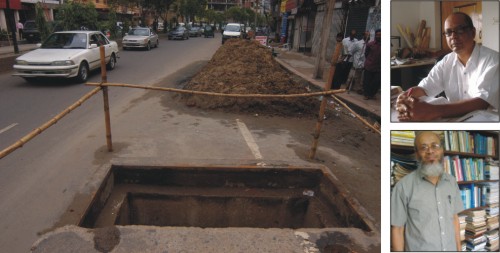
Water Logging in Dhaka City
Experts blame Rajuk, Wasa
Durdana Ghias
Dwellers of the capital once again received a chilling reminder that they live in one of the world's unplanned cities as the monsoon rain wrecked havoc in the city last Sunday. While the existing wetlands and retention ponds in the city keep shrinking due to illegal land filling and so-called development work, the risk for water logging runs high. Dhaka is situated on the floodplain of the Buriganga, the Balu and the Turag rivers. These three rivers eventually retain the internal water (rainwater) of the city. In this present context, architects and water experts expressed concern over the city's future if the so-called 'development work' continues. Star City spoke with architects and water experts and asked for their expert opinion on the reason of water logging in the city and the immediate and long terms solutions to the problem. According to them, water logging is the result of unplanned urbanisation. Rajdhani Unnayan Kartripakkha (Rajuk), the development authority of Dhaka, does not have a responsible approach towards the planning of the city and it is approving development work without any plans whatsoever, they added. Architect Saif Ul Haque said indiscriminate filling up of the city's vital canals is a main reason for this kind of severe water logging. In the absence of canals, the roads are turning into virtual canals during rain. "Dhaka is a city on a delta where lots of canals run through it. These canals play a vital role in saving the city's environment. But I do not know whether Rajuk has any plans regarding the canals. The city's wetlands are being filled up indiscriminately in the name of development," he said. While planning such a city, both dry and wetlands should be given importance. But, in Dhaka, it seems that the city was planned to erect buildings and roads only, he said. "Rajuk should plan the city [properly]. We have had enough 'development', and now we want [real] planning. Why should it be Rajuk's job to develop plots by filling up wetlands? If that's Rajuk's [primary] job, then I think it should be dismantled and a planning authority should be created which would save wetlands and not think about selling housing plots," said Haque. In the name of developing the city, the canals were brutally filled up and now the nature has started to take revenge. In the last 50 years -- from 1958 to 2007 -- all the plans done for Dhaka city are devoid of any reference to canals, except the one designed by Patrick Geddes, a British town planner, in 1917, he added. "To address the water logging issue, we first need to plan. We should have an idea of how many people live in this city, what should be the [ideal] density of housing here and whether we have enough resources to contain and provide the population with basic municipal facilities," Haque said. "We should take into consideration the physiographic characteristics of Dhaka. Its highlands, lowlands, open spaces, wetlands, water retention ponds, canals, rivers, riverbanks and flood flow zones should be classified. There should be designated places for housing and all kinds of wetlands should be preserved," Haque advised. Zahir Uddin Chowdhury, a professor at Institute of Water & Flood Management, Buet, said a big reason for water logging in Dhaka is its existing drainage system, which is not consistent with the landscape of the city. There are not enough canals to contain and carry storm water, floodwater or rainwater. The drainage system is losing consistency due to human intervention like filling up of canals and wetlands, he added. "Canals and wetlands play an important role in draining out internal or extra water. The canals have two functions -- firstly, these drain out extra water and secondly, these retain rainwater. When it rains for long time, the internal water heads towards the city's canals, wetlands and retention ponds. These canals retain the water till the water flows into rivers. This is a natural system," explained Chowdhury. "But due to manmade intervention like wetland filling, these canals are shrinking and losing their capacity to contain and carry water and thus the internal water fails to reach the rivers. The storm water storage capacity of these canals is reducing day by day due to encroachment and we are heading towards a disaster," he warned. The Water and Sewerage Authority (Wasa) has gradually replaced or covered up the canals with box culverts or sewerage lines. After converting a canal into a box culvert, the canals lose their original function. Many canals like Poribagh canal, Segunbagicha canal and Mohakhali canal were lost due to this practice. With these canals lost, the city has also lost the storm water storage capacity, Chowdhury added. Culverts and sewerage lines can carry water, but cannot store it. Their water carrying capacity is also hampered as they remain clogged up often. Wasa should clean up the drainage system by March-April before the start of monsoon, he advised. "As an immediate step, annual maintenance or cleaning of the drainage should be done. Developers should right away stop filing up wetlands. As a long-term step, local retention ponds or reservoirs should be created in every area. All canals should be recovered gradually. In urban areas, concrete pavements hinder soaking up of rainwater. That' why each area should have a patch of open green space that will soak up extra rainwater," added Chowdhury. "While developed countries are spending money to create artificial wetlands to save their cities, we are busy burying up the canals and wetlands we got from nature," said the water expert.
|