Remembering the genocide
Porimol Palma
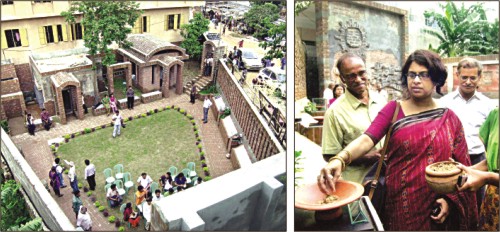
The dead bodies were thrown into an underground water tank of a pump house and the killers thought they could sink into oblivion all evidence of the genocide, but almost after three decades an excavation led to the exhumation of the mass grave.Jalladkhana (Butcher's Den), a memorial for the martyrs of the liberation war, who died in the torturing hands of the invading Pakistani army and their local collaborators in one of the worst genocides of the 20th century at Mirpur in Dhaka, is scheduled to be inaugurated tomorrow. The Liberation War Museum exhumed the Jalladkhana, giving identities to the martyrs as their skulls, bones and personal artefacts were found during the excavation. "Like a phoenix we can be born out of the ashes and rise to higher ground, but we must clear the ashes," said Akku Chowdhury, a trustee of the Liberation War Museum, during a visit by journalists to the memorial. The museum exhumed the mass grave in cooperation with the Bangladesh Army, and recovered 70 human skulls and 5392 bones from there. "Most of the skulls revealed signs of being severed from the rest of the body with sharp weapons and some bore marks of being struck by heavy weapons and one had a bullet hole, shot from a close range. Other bones also showed signs of being hit by heavy weapons." Akku wrote in the memorial brochure distributed among the journalists. After eight years of the exhumation, the Liberation War Museum has built a triangular memorial at the site of the torture chamber and the mass grave keeping the structure of the pump house intact. Museum Trustee and Architect Rabiul Hossain designed the memorial based on the concept provided by another Trustee Mofidul Hoque while artists Rafiqunnabi and Muniruzzaman adorned it with a mural. The walkway surrounding the compound is flanked by marble rails with the names of over 400 killing fields found across the country engraved on them. The invading Pakistani army and their local collaborators used to kill freedom fighters and dump their bodies in mass graves at those killing fields. One of the marble rails is also topped with six altars where soil from six such killing fields in the six divisions of the country is stored as symbols of respect to the martyrs and of the significance of the killing fields in forming the nation's current identity. At the centre of the memorial, is the mural by Rafiqunnabi titled 'Jiban Abinashshar' (life is immortal). The mural made of burnt bricks speaks of the mutilated bodies of the martyrs, whose memories remain unvanquished, said Rafiqunnabi. Where the two ends of the triangular walkway meet, there stands the pump house with a bell hanging over the entrance of the torture chamber. Once tolled, the ring of the bell reverberates through the air lingering for a few minutes, creating an emotional link between the present and the past, said Liberation War Museum Trustee Mofidul Hoque. The words 'What Happened' are engraved in five languages including Bangla over the entrance of the pump house. The words have been extrapolated from a publication of the International Coalition of Historic Site Museums to inspire visitors to be curious and to learn from the site, Hoque noted. Then comes the 20 feet deep water tank of death from where the excavators recovered the skulls and bones of the martyrs. Visitors can see the tank covered with thick glass on which it is written, "We bow our heads in deep respect to all martyrs." This is the pit where men, women and children were thrown in after being butchered throughout the nine months of the liberation war in 1971. "Dead bodies of many others were also dumped here. The shattered lives of the martyrs remind us of our duty towards the victims of genocide" is written on one of the inside walls of the pump house. Visitors then can move through a little atrium where they can sit on benches at the end of the journey through the memory lane of Jalladkhana, a name given to the place by local residents, but the emotion generated in one's heart from the visit lingers on. "Our goal of preservation and collection of the memories here at the site is actually to make our liberation war memorable for ever so that generations to follow us can be inspired by the sacrifices of our freedom fighters and can stand against any genocide anywhere in the world," said cultural activist Aly Zaker. The visit ends, but a sentence engraved on a wall of the pump house clings to one's memory: "The silent call of the martyrs is resonating all around us asking for truth and justice."
|